Key Takeaways:
- Google announced the biggest redesign of its search box in over 25 years at I/O 2026 on May 19
- AI Overviews and AI Mode are now merged into one seamless experience. Users flow from a query to an AI Overview to a full AI Mode conversation without switching interfaces
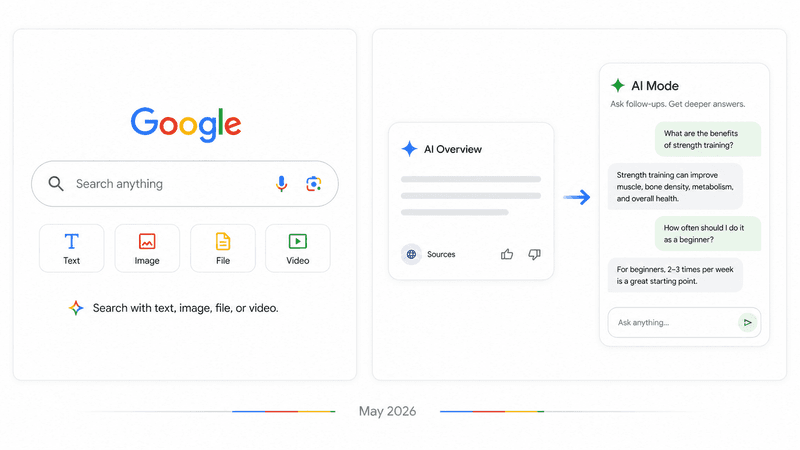
- The new search box accepts text, images, files, videos, and Chrome tabs as inputs simultaneously
- AI Mode is now powered by Gemini 3.5 Flash globally. AI Overviews reach 2.5 billion monthly users. AI Mode has crossed 1 billion monthly users
- Search can now build custom interactive interfaces on the fly using "generative UI" powered by Google Antigravity
Google Search looks and works differently starting this week. The company redesigned its most iconic feature and merged its two AI experiences into one.
Liz Reid, VP and Head of Search, announced the changes at Google I/O on May 19. She called it "the biggest upgrade to our iconic search box since its debut over 25 years ago."
How the new search box works
The old Google search box took text. That was it. Type a query, hit enter, see results.
The new search box accepts multiple input types at the same time. Text, images, files, videos, and even open Chrome tabs can all be dropped into the search bar. Google's AI reasons across all of them simultaneously.
The box also dynamically expands to give users space for longer, conversational queries. AI-powered suggestions go beyond traditional autocomplete. Instead of predicting the next word, the system anticipates intent and helps users formulate more precise questions.
This aligns with what Liz Reid told Bloomberg in April: users are no longer searching in "keywordese." They are describing full problems. The redesigned search box is built for that behavior.
AI Overviews and AI Mode are now one experience
Until this week, AI Overviews and AI Mode were separate features. AI Overviews appeared automatically at the top of search results. AI Mode required a separate tab or toggle.
Now they are connected. A user can type a question, see an AI Overview in the results, and tap into AI Mode for a follow-up conversation. All within one continuous flow. No switching tabs, no toggling modes. Links to source content appear throughout.
This is live now on desktop and mobile worldwide.
The merging matters for how users interact with search. Previously, AI Mode required a deliberate choice. Now it is one tap away from any AI Overview. The barrier to entering conversational search just dropped to near zero.
What is Google AI Mode and how does it work now
Google AI Mode is the conversational search interface launched at I/O 2025. It allows users to have multi-turn conversations with Google Search, asking follow-up questions and getting synthesized answers drawn from across the web.
With the I/O 2026 update, AI Mode is now powered by Gemini 3.5 Flash, Google's newest model that combines frontier-level intelligence with the speed needed for real-time search. It replaced the previous Gemini model as the default for all AI Mode users globally.
AI Mode now supports multimodal inputs. Users can upload images, paste files, share videos, or reference Chrome tabs inside the conversation. Google's system reasons across all inputs and delivers answers that draw from the full context.
The feature is available to all Google Search users. Paid subscribers (AI Pro and Ultra) get additional capabilities like information agents, which run in the background and monitor topics continuously.
The generative UI feature is the part publishers should worry about
Google also announced that Search can now build custom interactive interfaces on the fly. Using its Antigravity platform, Search designs real-time layouts for users: graphs, simulations, comparison tools, and visual experiences tailored to the specific question.
Instead of returning a list of links or a text summary, Search can create a fully interactive tool that answers the query directly. This feature rolls out free to all users this summer.
eWeek called this one of the 10 biggest takeaways from I/O. For publishers who have differentiated through interactive tools, calculators, or visual content, Google can now generate those experiences inside the search results page.
What this means for SEO and content marketing
The merging of AI Overviews and AI Mode into one flow means more users will enter conversational search sessions. Semrush data from late 2025 found that 92-94% of AI Mode sessions end without a click.
With the barrier to AI Mode nearly eliminated, that zero-click percentage applies to a much larger share of searches.
For content teams, three things matter now:
Content needs to be structured for AI citation. Clear headings, specific claims, and well-attributed data help Google's system reference specific passages with inline links.
Multimodal content gains value. If the search box now accepts images, files, and video alongside text, content that includes original visuals, data, and media becomes more relevant to AI retrieval.
Interactive and unique content is the remaining differentiation. Generic informational content is increasingly handled by AI. Content that provides original research, firsthand experience, or unique tools remains the kind of content that AI systems cannot generate on their own.
Google's Q1 2026 earnings showed search queries at all-time highs. People are searching more. But how they search, and what they see, is fundamentally different from even six months ago.
Frequently asked questions about Google AI Mode
What is Google AI Mode?
Google AI Mode is a conversational search interface that lets users have back-and-forth conversations with Google Search. It was launched at I/O 2025 and is now powered by Gemini 3.5 Flash.
How is AI Mode different from AI Overviews?
AI Overviews are short AI-generated summaries that appear at the top of search results. AI Mode is a full conversational experience with follow-ups. As of May 2026, both are merged into one seamless flow.
Is Google AI Mode free?
Yes. AI Mode is available to all Google Search users on desktop and mobile. Paid subscribers (AI Pro and Ultra) get additional features like information agents.
Does AI Mode affect website traffic?
Research shows 92-94% of AI Mode sessions end without a click to an external site. As more users enter AI Mode through the merged experience, zero-click searches are expected to increase.
Disclaimer: This article is AI-assisted content and may contain errors. All details are from Google's official Search blog by Liz Reid (May 19, 2026), Sundar Pichai's I/O keynote, TechCrunch, The Next Web, eWeek, and Cloud Captains. Google features are rolling out globally and availability may vary. Verify with official Google documentation.