Key Takeaways:
- Citation Labs published research on Search Engine Land showing that traditional rankings do not guarantee citation in AI search answers
- AI systems select sources based on entity clarity, factual density, structural organization, and third-party validation, not just PageRank
- The top 20% of cited domains capture 80% of all AI references, creating extreme citation concentration
- Organic CTR drops 58% when an AI Overview appears, per Ahrefs. But brands cited inside AI Overviews see 35% higher CTR than traditional organic results
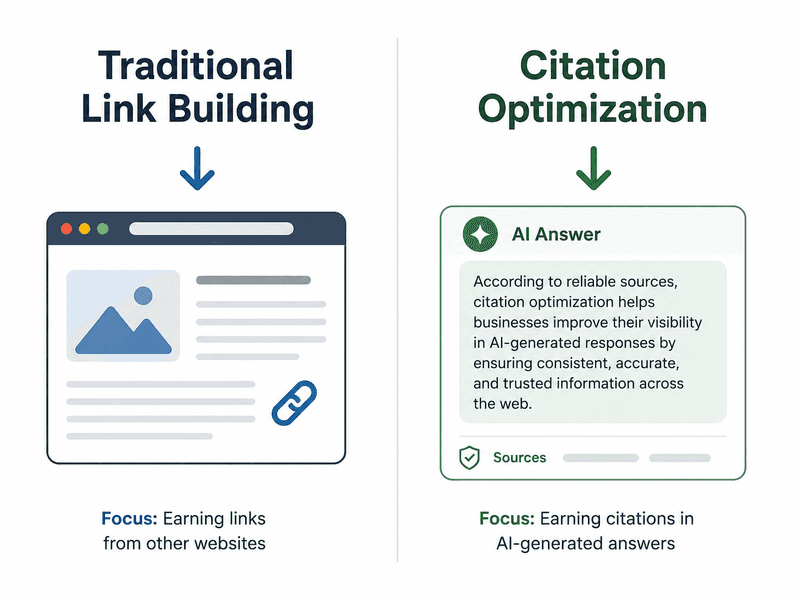
- Link building needs to evolve from earning links for ranking authority to earning citations from sources that AI systems trust
You can rank number one on Google for your target keyword and still be completely absent from the AI-generated answer sitting above your listing.
Citation Labs published this argument on Search Engine Land on May 13. Garrett French, the company's founder, laid out why the link building discipline needs to evolve. The premise is straightforward: AI search systems do not select sources the same way traditional search rankings work.
A page with strong backlinks and high domain authority might rank well in the ten blue links. But the AI Overview above those links pulls from a different set of signals. If your content does not match those signals, your page is invisible in the AI answer where most user attention now goes.
AI systems pick sources differently than Google rankings do
Traditional link building focused on earning backlinks to increase PageRank and domain authority. Those signals still matter for organic rankings. But AI systems that generate answers, including Google AI Overviews, ChatGPT, Perplexity, and Claude, use a different evaluation process.
AI answer engines use Retrieval-Augmented Generation. They pull relevant documents in real time, evaluate them at the passage level, and synthesize answers with citations. The selection criteria center on four factors:
- Entity clarity: Can the AI confidently identify what the content is about and who published it?
- Factual density: Does the content contain verifiable statistics, data points, and cited research?
- Structural organization: Are headings, lists, and logical flow clear enough for a passage to be extracted and understood on its own?
- Third-party validation: Is the brand or claim referenced across multiple trusted sources?
A page that scores well on backlinks but poorly on these four signals will rank in organic results but miss the AI citation.
The concentration problem is severe
Research shows that the top 20% of cited domains capture 80% of all AI references. That extreme concentration means most websites are fighting for a small share of remaining citations.
For small and mid-sized brands, this is the core challenge. The same publications that dominated traditional search, major news outlets, well-known review sites, established industry publications, also dominate AI citations. Breaking into that top tier requires a different approach than traditional link building.
Citation Labs calls this approach "citation optimization." Instead of building links to your own pages, the strategy focuses on earning mentions and citations on the pages and sources that AI systems already trust.
What citation optimization looks like in practice
The shift from link building to citation optimization involves three layers.
First, identify which sources AI systems already cite for queries relevant to your brand. Tools like Citation Labs' Xofu platform track which domains appear in AI-generated answers for specific prompts. If a review site, an industry publication, or a comparison page consistently gets cited by ChatGPT or AI Overviews for your category, that is where your brand needs to appear.
Second, ensure your owned content is citation-eligible. Clear entity signals (author names, organization schema, consistent brand mentions), factual density (original data, statistics, specific claims), and structural clarity (one idea per paragraph, clean headings, extractable passages) make content easier for AI systems to reference.
Third, build a presence on third-party sources that AI systems trust. This is where traditional outreach skills apply, but the target list changes. Instead of pursuing links from high-DA sites, pursue mentions and references on the specific pages that AI systems actively cite.
The numbers make the urgency clear
Organic CTR drops 58% when a Google AI Overview appears, according to Ahrefs data from late 2025. For every 100 clicks a top-ranking page could historically earn, Google now keeps 58 of them inside the AI answer.
But brands cited inside AI Overviews see 35% higher CTR than traditional organic results. Being inside the AI answer is better than being below it.
AI referral traffic is still small in absolute terms, roughly 1% of total web traffic per SE Ranking. But it is doubling approximately every quarter. The compound growth rate means AI referrals could represent 5-10% of web traffic by 2027 if current trends hold.
What this means for SEO and content teams
Link building is not dead. Backlinks still influence organic rankings, and organic rankings still drive traffic. But link building alone is no longer sufficient for maintaining search visibility.
The new requirement is dual optimization. Build links for organic rankings and build citations for AI visibility. The skills overlap. Outreach, content quality, and relationship building apply to both. But the targets, the metrics, and the content format requirements are different.
For agencies selling link building services, the value proposition needs to expand. Clients will increasingly ask not just "where do we rank?" but "are we cited in AI answers?" The agencies that can answer both questions will retain clients. The ones that only track rankings will lose them as AI search grows.
The transition from link building to citation optimization is not a future prediction. It is happening now. The brands and agencies adapting today are building an advantage that compounds with every AI citation they earn.
Disclaimer: This article is AI-assisted content and may contain errors. Research is from Citation Labs, published on Search Engine Land on May 13, 2026. AI citation behavior varies by platform and changes over time.