Key takeaways:
- Opus 4.8 requires no API-breaking changes and keeps flat pricing ($5/M input, $25/M output tokens).
- The 1-million-token context window is now native. Legacy beta headers are no longer needed.
- Modifying sampling parameters like temperature, top_p, or top_k triggers a 400 Bad Request error.
- Honesty failure dropped from 19.7% in Opus 4.7 to just 3.7% in Opus 4.8.
On May 28, 2026, Anthropic released Claude Opus 4.8, just six weeks after Opus 4.7. For founders, engineering leaders, and growth teams, this rapid release reflects a shift in foundation model design.
Rather than focusing on raw computational power, the upgrade from Claude Opus 4.7 to 4.8 prioritizes honesty, context stability, and token discipline.
5 steps to upgrade from Claude Opus 4.7 to 4.8
Here is how you can follow a structured process to upgrade from Opus 4.7 to Opus 4.8:
Step 1: Point your workflows to the new model
All API calls, environment configurations, and model router definitions must point to:
JSON"model": "claude-opus-4-8"
This identifier works across the direct Claude API, claude.ai, AWS Bedrock, Google Cloud Vertex AI, and Microsoft Foundry.
If your product relies on Claude for customer-facing or internal workflows, this step ensures the system is using the latest, more reliable model.
Step 2: Remove old beta headers for 1M context
Previously, using the 1-million-token context window required beta headers. Opus 4.8 now supports this window by default on Claude API, Bedrock, and Vertex AI (Microsoft Foundry supports up to 200,000 tokens).
Practical tip: Remove legacy headers to simplify API requests and reduce potential errors.
Step 3: Adjust how you guide the model
Opus 4.8 enforces strict validation inherited from 4.7. Any non-default values for temperature, top_p, or top_k will trigger a 400 Bad Request.
How to handle it: Instead of tweaking parameters, use system prompts and natural language instructions to guide output style, tone, or deterministic behavior.
Step 4: Set the right effort for your tasks
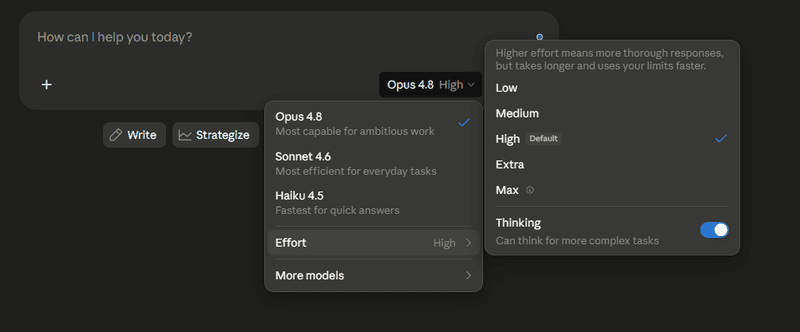
The default effort level is high. For complex tasks like autonomous engineering loops, multi-file code migrations, or deep research, set xhigh (or max on some surfaces).
Developer note: Ensure max_tokens is sufficient; 64,000 tokens is recommended to give the model enough space for complex reasoning.
Business context: Higher effort improves accuracy for critical workflows, but may increase token usage and cost, so adjust based on task priority.
Step 5: Update instructions mid-conversation
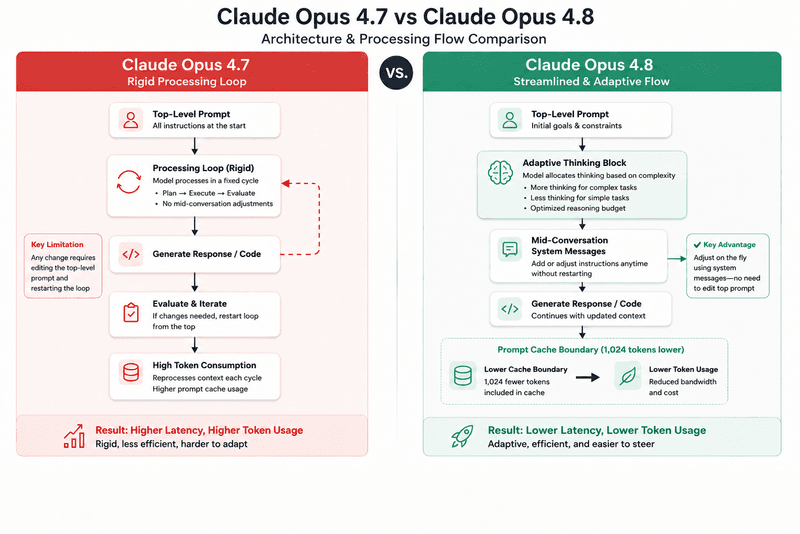
Opus 4.8 supports "role": "system" messages anywhere in the conversation. You can update instructions mid-session without invalidating cached prompts, reducing latency and cost.
Example use case: In long-running autonomous loops, update execution permissions or token limits on the fly, keeping earlier cached instructions intact.
What’s new: Honesty update, fewer errors, and smarter outputs
Opus 4.8 addresses common frustrations from earlier versions:
ImprovementDescriptionExcessive refusalsComplex tasks are less likely to be blocked unnecessarilySkipped toolsMulti-step workflows run more reliablyVerbose outputsCode is cleaner, with fewer redundant comments or disclaimers
This means Opus 4.8 is far less likely to agree with incorrect assumptions and more likely to flag uncertainties.
Adaptive thinking, fast mode, and smarter caching
Opus 4.8 improves efficiency and cost control through these core features:
- Smart adaptive thinking: Dynamically scales reasoning, bypassing unnecessary heavy computation for simple tasks. Cost savings of up to 61% on bimodal workloads have been reported.
- Cost-reduced fast mode: Up to 2.5x faster output speeds, with a threefold price reduction to $10/M input and $50/M output tokens.
- Lower caching boundaries: Minimum cacheable prompt length dropped from 4,096 to 1,024 tokens, making repeated short-to-medium prompts highly cost-efficient.
For non-technical teams, these features reduce latency, lower operating costs, and improve the consistency of AI-driven outputs for business-critical workflows.
Conclusion: Why you should upgrade to Opus 4.8
Upgrading Claude Opus 4.7 to 4.8 is highly recommended. Zero API-breaking changes, flat pricing, and significant improvements in honesty, agentic reliability, and token efficiency make it a clear win.
For engineering and product teams, it’s worth experimenting with the Effort Control toggle on low-stakes tasks first to calibrate performance.
For business leaders, Opus 4.8 represents a step toward AI systems that act as cooperative, reliable peers, catching their own mistakes and optimizing resource usage.
FAQs for upgrade from Claude Opus 4.7 to 4.8
How to get Opus 4.8 in Claude Code?
You can access Opus 4.8 by updating your Claude Code environment to use the new model identifier. This works across the Claude API, Claude Code CLI, and cloud platforms like AWS Bedrock, Google Cloud Vertex AI, and Microsoft Foundry.
How do the honesty and collaboration capabilities compare?
Opus 4.8 is designed to be far more honest and self‑aware, flagging uncertainties and avoiding confident but incorrect claims much more often than Opus 4.7.
Will Opus 4.8 cost more than 4.7?
No. Standard pricing remains $5 per million input tokens and $25 per million output tokens. Fast Mode is now cheaper than in previous versions, making high-speed operations more cost-efficient.
How does Opus 4.8 improve accuracy?
Opus 4.8 dramatically reduces hallucinations, flags uncertainties, and improves tool execution. Its honesty failure rate dropped from 19.7% in Opus 4.7 to just 3.7%, resulting in more reliable, production-ready outputs.
Disclaimer: This article is AI-assisted content and may contain errors. Platform features, policies, and availability may change. Always verify details with official sources.