Key Takeaways:
- Google expanded Preferred Sources from English-only to all supported languages globally on April 30, 2026
- Over 200,000 unique sites have already been selected by users, from niche local blogs to global news desks
- Google confirmed readers are twice as likely to click through to a site after marking it as a preferred source
- Google updated Search Central with downloadable buttons in 16 languages for publishers to embed on their sites
- The feature affects Top Stories and Google Discover. SEJ called it "a global SEO signal"
Google just gave publishers a way to earn more clicks from Search. And most of them have not done anything about it yet.
On April 30, Google announced that Preferred Sources now works in all supported languages globally. The feature was previously limited to English, after expanding from a US and India beta in August 2025 to global English in December 2025.
Nick Fox, SVP of Knowledge and Information at Google, tweeted instructions on how to set it up. Google also published a blog post with the data to back up why publishers should care.
How Preferred Sources works
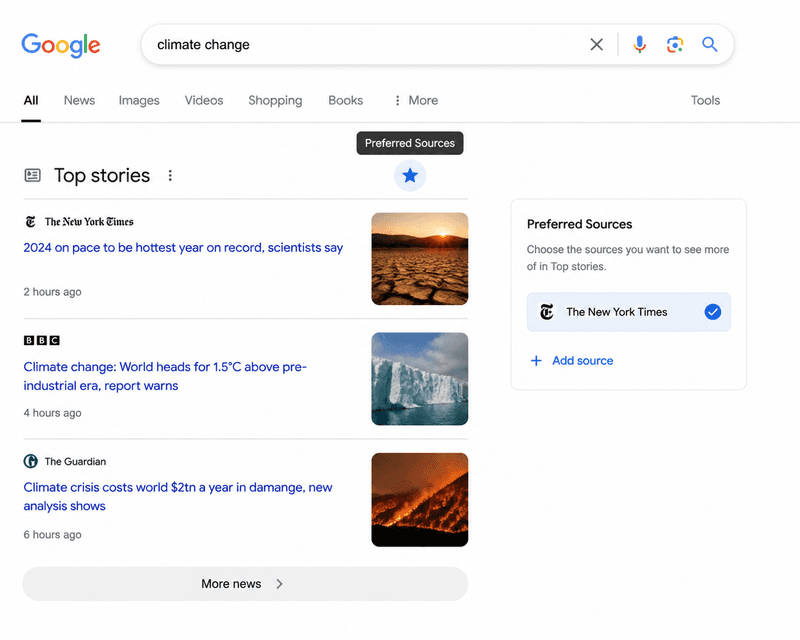
When users search for a news topic and see Top Stories in the results, they can tap a star icon next to the section header. From there, they choose which publications and sites they want to see more often.
Google then uses that signal alongside its ranking systems to show more stories from those preferred outlets. The effect also extends to Google Discover feeds, where preferred sources appear more frequently.
Users can manage their list at google.com/preferences/source. They can add or remove sites at any time.
The feature does not guarantee top placement. But it creates a direct user-controlled signal that favors the sites a reader has explicitly chosen to see more of.
The numbers Google shared are worth paying attention to
Google included two data points in the announcement:
- Readers are twice as likely to click through to a site after marking it as a preferred source
- Over 200,000 unique sites have been selected so far, ranging from niche local blogs to major global newsrooms
That 2x click-through increase is significant. In an environment where AI Overviews and zero-click searches are compressing organic CTR, a feature that doubles click probability for marked sources is a rare advantage.
Barry Schwartz at Search Engine Roundtable noted: if you can get your loyal readers to add your site as a preferred source, the impact on traffic is measurable and immediate.
What publishers need to do right now
Google updated its Search Central documentation with tools specifically designed to help publishers grow their preferred source lists.
Downloadable buttons are now available in 16 languages. Publishers can embed these on their websites alongside other social follow buttons. The button prompts readers to add the site as a preferred source directly from the publisher's page.
SEJ's coverage on May 2 described Preferred Sources as "a global SEO signal" and noted that the feature is no longer limited to English content in any market. Any publisher producing fresh content in any language where Google Search operates can benefit.
The practical steps are straightforward:
- Add the Preferred Sources button to your site. Place it near newsletter signups, social follow buttons, and other audience-building prompts
- Mention it in newsletters, email footers, and social posts. Most readers do not know the feature exists
- Publish fresh content consistently. The feature works best for sites that regularly produce new articles or posts. Google surfaces preferred sources "when they have new articles or posts that are relevant to your search"
Why this matters beyond just clicks
Preferred Sources represents a broader direction for Google Search. It is one of several recent moves that reward brand recognition, audience loyalty, and trust signals over raw keyword optimization.
In an AI-driven search environment where Google synthesizes answers from multiple sources, being a site that users actively choose to follow creates a direct relationship that algorithms alone cannot replicate.
This feature works alongside AI Overviews, AI Mode, and traditional rankings. A site that is both cited in AI Overviews and selected as a preferred source has two separate mechanisms driving visibility.
For content agencies and publishers in India and other non-English markets, this expansion is particularly relevant. The feature was English-only until yesterday. Now it covers every language Google supports. The opportunity to build preferred source lists in Hindi, Tamil, Marathi, or any regional language is available for the first time.
The window to act is open. With 200,000 sites already selected, early movers in non-English markets have less competition for user attention. Publishers who add the button and promote it to their existing audiences will build an advantage that compounds over time.
Disclaimer: This article is AI-assisted content and may contain errors. Details are from Google's official blog post (April 30, 2026), Nick Fox's X post, 9to5Google, Search Engine Journal (May 2), Search Engine Land, and Search Engine Roundtable. Feature availability and behavior may change. Verify with Google's Search Central documentation.