Key Takeaways:
- Seer Interactive analyzed 5.47 million queries across 53 brands and 2.43 billion organic impressions for the full year of 2025
- AI Overview CTR for brand-cited pages fell 61% from Q3 to Q4 2025, but impressions doubled while clicks stayed nearly flat
- Organic CTR on AI Overview queries rebounded 85% in early 2026, climbing from 1.3% in December 2025 to 2.4% in February 2026
- Pages cited in AI Overviews get 120% more clicks per impression than uncited pages, but still trail non-AIO pages by 38%
- Comparison queries trigger AI Overviews 95.4% of the time. Question-format queries trigger them 85.9% of the time
That 61% CTR drop made headlines across the industry. But Seer Interactive's own researchers say the number hides two completely different stories.
The agency published its third AI Overview CTR study on April 24, covering January 2025 through February 2026. The dataset is massive: 5.47 million tracked queries, 53 brands, 2.43 billion organic impressions, and 296.9 million paid impressions.
The headline finding sounds alarming. The data underneath it is far more nuanced.
October was an impression story, not a click story
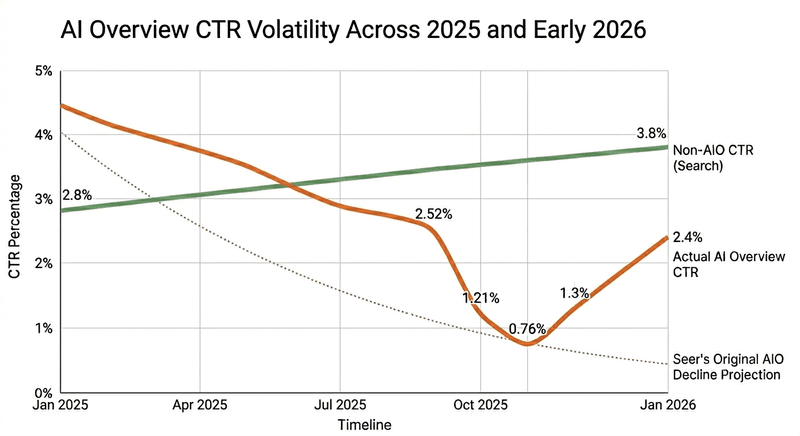
In September 2025, brand-cited pages in AI Overviews received 15.8 million impressions and 398,798 clicks. CTR sat at 2.52%.
One month later, impressions jumped to 33.1 million. Clicks barely moved: 400,271. CTR fell to 1.21%. The denominator grew not because performance worsened, but because Google showed AI Overviews for more queries in which these brands were already cited.
November told a different story. Impressions continued rising to 39.5 million, but clicks actually dropped to 301,783. CTR fell further to 0.76%. Something pulled real clicks away while visibility kept growing.
The combined Q4 number of 61% blends both patterns into a single figure. Seer's team was explicit about this: analyzing months separately in Search Console is essential because the Q4 aggregate hides what actually happened.
Early 2026 shows a rebound, not a continued decline
Seer's September 2025 model predicted CTR would keep falling into 2026. It did not.
Organic CTR on AI Overview queries climbed from 1.3% in December 2025 to 2.4% in February 2026. That is an 85% increase in two months. Every single informational and transactional organic segment beat the model's projection in both January and February.
The agency is careful not to call this a recovery. They describe it as a "leveling off" and warn against forecasting based on two months of data. But the direction is clear: the steepest period of CTR compression appears to be over.
Queries without AI Overviews also improved. Non-AIO organic CTR rose from 2.8% in January 2025 to 3.8% by February 2026. These queries represent topics Google has not chosen to summarize with AI yet, and users click through on them at higher rates.
Being cited helps but does not restore what was lost
Brand-cited pages receive about 120% more clicks per impression than uncited pages on AI Overview SERPs. That gap is significant. Being in the AI Overview clearly beats being left out.
But cited pages still lag behind non-AIO pages by 38%. A citation is an advantage over competitors on the same results page. It is not a return to pre-AI Overview click-through rates.
Seer also found that transactional query CTR for cited brands doubled from 0.7% in January 2025 to 1.65% in December 2025. After a rough mid-year dip, commercial intent queries with citations recovered strongly by year's end.
Which queries trigger AI Overviews most often
The report includes AIO trigger rates across 30,842 tracked informational queries:
- Comparison queries: AI Overview appears 95.4% of the time
- Question-format queries: 85.9%
- Overall informational queries: 36%
- Commercial queries: 8%
- Transactional queries: 5%
For content teams, this breakdown is actionable. If you write content in question or comparison format, expect an AI Overview to appear. Optimize for citation, not just ranking.
What to do with this data
Seer's practical recommendations come down to measurement and strategy.
Stop treating AI Overview CTR as a standalone success metric. Clicks, impressions, citations, and AI Overview appearance rates all need separate analysis. A falling CTR might just mean Google is showing your brand in more places.
Check whether your impressions grew during the same period a CTR drop appeared. If clicks stayed flat while impressions doubled, visibility increased. That is not the same problem as losing traffic.
Non-AIO queries are an underexplored opportunity. Organic CTR on these queries climbed steadily throughout 2025 and into 2026. These are topics Google is not summarizing yet.
Publishing original analysis and unique perspectives on these queries can capture clicks that AI Overviews have not yet absorbed.
Paid search CTR was the most stable and predictable metric throughout the study. Seer's model estimated paid CTR within 0.09 percentage points. Organic missed by up to 2.6 points.
If you need a reliable forecasting anchor, paid data is currently more dependable than organic.
The broader picture from this study is cautiously positive. The worst of the CTR compression may be behind us. But the old click-through rates are not coming back. What is emerging looks more like a "new normal" where being cited in AI Overviews is table stakes for maintaining visibility on Google.
Disclaimer: This article is AI-assisted content and may contain errors. Individual results will vary by industry, brand, and query type. Verify with your own Search Console data.