Key Takeaways:
- Google expanded Search Live globally on March 26, covering all countries and territories where AI Mode is available
- The feature is powered by Gemini 3.1 Flash Live, a new audio and voice model with native multilingual support
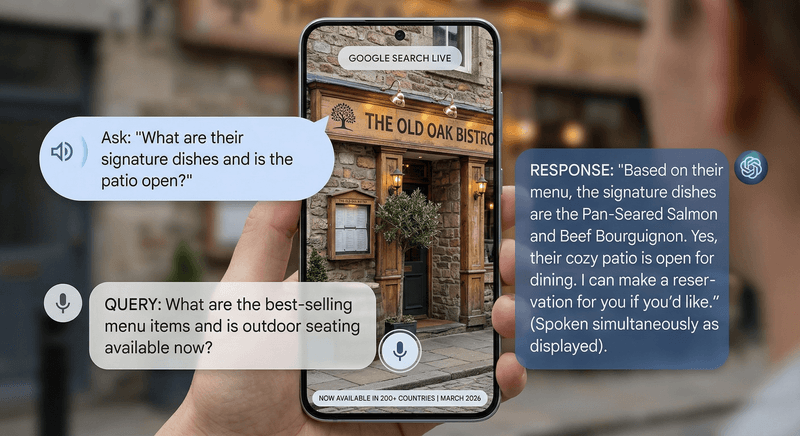
- Users can point their phone camera at objects and have real-time voice conversations with Google Search
- AI Mode queries are now 3x longer than traditional typed searches, per a Google guide distributed to marketers in March
- Search Live was previously available only in the US and India. It now covers 200+ locations
Search is no longer just about typing. As of March 26, Google Search Live is available everywhere AI Mode operates.
Google announced the global expansion through a blog post by Liza Ma, Director of Product Management for Search. The feature, first launched in July 2025 for US users, now reaches over 200 countries and territories.
Search Live allows users to open the Google app on Android or iOS, tap the Live icon below the search bar, and start a voice conversation with Google. Point the phone camera at something and ask questions about it. The AI responds with audio and keeps the conversation going through follow-ups. Web links surface when the user wants to go deeper.
Gemini 3.1 Flash Live powers the expansion
The global rollout runs on Gemini 3.1 Flash Live, Google's latest audio and voice model. Google says it delivers more natural conversations than previous versions and handles multiple languages natively. Users do not need to switch settings to search in their preferred language.
TechCrunch confirmed the expansion covers all languages and locations where AI Mode is currently available. In Canada, VP and Country Managing Director Sabrina Geremia confirmed availability in both English and French. Nick Fox, SVP of Knowledge and Information at Google, commented that he was "super excited" about the Canadian launch.
AI Mode queries are fundamentally different from typed searches
A Google guide distributed to marketers in March 2026 described AI Mode queries as 3x longer than traditional searches. A meaningful share of those queries generate follow-up questions within the same session.
The guide framed this as a structural difference, not just faster searching. Users are having conversations rather than typing keywords. They combine text, voice, camera, and gestures in ways that traditional search was never designed to handle.
Semrush data from September 2025 found that 92-94% of AI Mode searches end without a click. Users spend 49 seconds per session on average, more than double the 21 seconds for AI Overviews. Median time for comparing brands or products in AI Mode was 77 seconds.
That behavior profile matters. Users are spending more time inside AI Mode and clicking out less. The feature satisfies intent directly through conversation rather than routing users to external websites.
What this means for marketers and publishers
Search Live introduces voice-delivered AI answers as a real channel at global scale. That raises questions the industry has not fully answered.
When Google speaks an answer, the format changes what gets surfaced. A spoken response synthesizes information from multiple sources into a single audio output. The user may never see the underlying citations. Web links appear when the user wants to explore further, but there is no guarantee they will.
For publishers, this continues the trend of information being consumed inside Google's interface rather than on the publisher's site. For local businesses, voice search combined with location data could drive discovery in new ways, especially in markets where typing is less natural than speaking.
For content strategy, the 3x query length finding is actionable. Longer, conversational queries mean content needs to match natural language patterns. Question-and-answer formats, clear topical structure, and conversational headings become more important when the search input is a spoken sentence rather than a two-word keyword.
Google reported a 65% year-over-year increase in visual searches as of July 2025. Robby Stein, who leads Google's AI Search team, attributed much of that growth to younger users who move naturally between different input methods. Search Live formalizes that behavior at global scale.
The feature is live now. The implications for click-through rates, publisher traffic, and advertising visibility in voice-delivered responses are still forming. What is clear is that search just became something fundamentally different from what most marketing strategies were built to optimize for.
Disclaimer: This article is AI-assisted content and may contain errors. Dates and feature details are sourced from Google's official blog, TechCrunch, and Search Engine Land as of March 29, 2026. Google features and availability change frequently. Verify with official sources.