Key Takeaways:
- Google expanded Personal Intelligence from paid-only to all free US users on March 17, 2026
- AI Mode in Search, the Gemini app, and Chrome can now access Gmail, Google Photos, Calendar, Maps, YouTube, and Search history
- The feature was a paid perk just two months ago. Google moved it to free faster than any previous premium feature
- No other AI platform offers this level of personal data integration at no cost
- Google says it does not train models directly on Gmail or Photos content, but prompts and responses may be used to improve the system
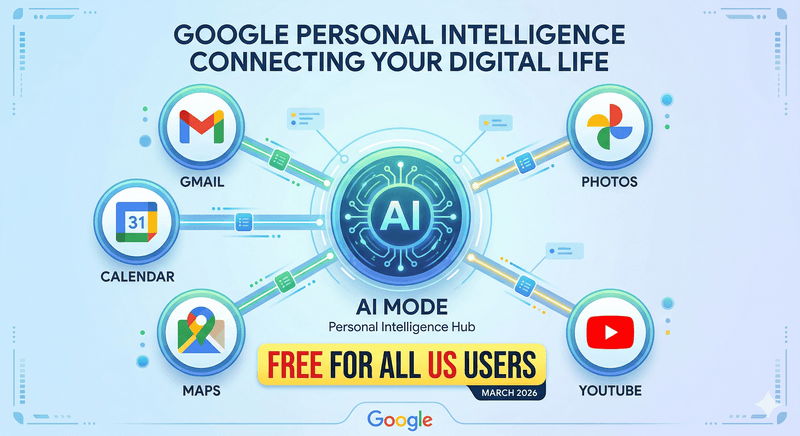
Two months ago, Personal Intelligence was a paid feature for Google AI Pro and Ultra subscribers. As of March 17, it is free for every US user with a personal Google account.
That speed of transition from premium to free is unusual even for Google. It signals that broad adoption matters more to the company than subscription revenue for this particular feature.
Personal Intelligence connects AI Mode in Search, the Gemini app, and Gemini in Chrome to a user's Google ecosystem. Gmail. Google Photos. Calendar. Maps. YouTube watch history. Past search activity. When enabled, AI Mode can reference flight confirmations in email, surface shopping receipts, suggest restaurants based on food preferences, and pull up vacation photos without the user restating any of that context.
Google's VP Nick Fox confirmed the feature now has 75 million daily active users in AI Mode globally. The free expansion will push that number significantly higher.
No competitor offers anything close to this for free
The comparison with rivals makes clear why Google moved fast.
ChatGPT's memory feature stores context from conversations, but only what users share manually. It cannot access an email inbox, a photo library, or a calendar. Apple has promised similar personalization through Siri, but repeated delays mean it may not ship broadly until late 2026. Microsoft Copilot accesses Office 365 data but primarily for enterprise accounts, not free consumer use.
Google is the only company connecting Gmail, Photos, Calendar, Maps, YouTube, and Search activity into a single AI assistant available at no cost. That ecosystem breadth is difficult for competitors to replicate because none of them own the same range of services that billions of people already use daily.
The strategic logic is straightforward. The more personal data flowing through Google's AI, the more useful the responses become. The more useful the responses, the harder it is for users to switch to a competing assistant. Industry analysts describe this as a "stickiness" play designed to deepen user dependency on Google's ecosystem.
The privacy question is real and unresolved
A Malwarebytes survey found that 9 in 10 respondents expressed concern about AI using their data without consent. Google is aware of the tension.
The feature is opt-in and off by default. Users must manually navigate to their Search profile, tap Search personalization, and choose which apps to connect. Permissions can be revoked at any time. Google says Gemini does not train directly on Gmail inbox content or Google Photos libraries. It trains on "limited info, like specific prompts in Gemini or AI Mode and the model's responses."
Android Police published a critical analysis in January arguing that the reality is more nuanced than Google's messaging suggests. The concern: even if Google does not use inbox content for model training today, the scope of access is vast, and policies can change.
Google has also not announced whether Personal Intelligence data will influence advertising. When asked directly, Nick Fox responded "TBD." That unanswered question hangs over the entire rollout. If personalized search behavior eventually feeds into ad targeting, the advertising implications would be enormous.
What this changes for marketers and SEO
Personal Intelligence introduces individual user context as a factor in search results. Two users typing the same query may now get completely different AI Mode responses based on their email history, past purchases, and location patterns.
For content marketers, this adds unpredictability to keyword-level optimization. A query like "best laptop for remote work" might return different product suggestions for different users based on their purchase history and browsing habits. The idea of a single "correct" ranking for a keyword becomes less reliable when personalization is this deep.
For e-commerce brands, this could be an advantage. If a user has purchased from a brand before, Personal Intelligence may surface that brand's products more prominently in AI-generated shopping recommendations. Past behavior becomes a ranking signal.
For publishers, the picture is more uncertain. Personalization could mean that content matching a user's demonstrated interests gets surfaced more often. But it could also mean that AI Mode generates answers from personal data alone without needing to cite external sources at all.
The feature is currently limited to US personal accounts. Workspace business, enterprise, and education accounts are excluded. No international rollout timeline has been confirmed.
Google is betting that the value of deeply personalized AI is compelling enough to override privacy concerns at scale. Whether that bet is correct will become clearer as adoption data comes in over the next quarter.
Disclaimer: This article is AI-assisted content and may contain errors. Google's features, privacy policies, and availability are subject to change. Always verify with official sources before making decisions.