Key Takeaways:
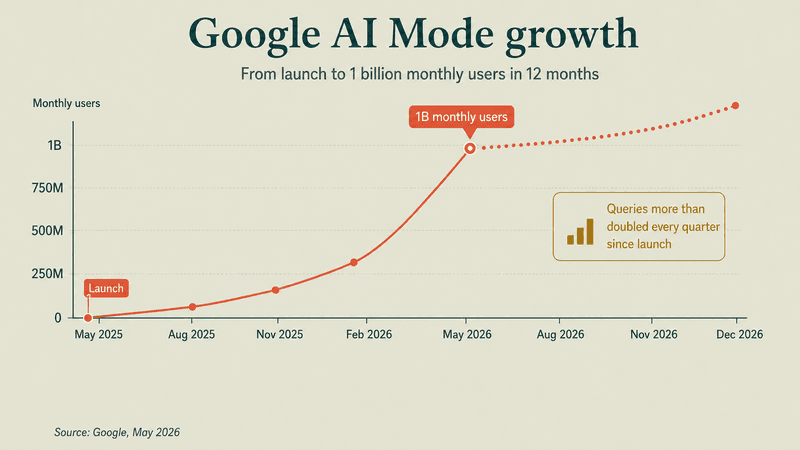
- AI Mode surpassed 1 billion monthly users just one year after its debut at I/O 2025. Queries are more than doubling every quarter
- AI Overviews now reach 2.5 billion monthly users globally
- Google's AI products process 3.2 quadrillion tokens per month, up 7x year over year
- Google Search revenue grew 19% to $60.4 billion in Q1 2026. Pichai says queries hit an all-time high
- 92-94% of AI Mode sessions end without a click to an external website, per Semrush data
The debate about whether AI search is mainstream just ended. The numbers Google shared at I/O 2026 settle it.
AI Mode, the conversational search interface launched at I/O 2025, has crossed 1 billion monthly users. Not annual. Monthly. In twelve months.
AI Overviews, the AI summaries that appear above traditional results, reach 2.5 billion monthly users. Given that Google has roughly 4.5 billion total users, that means more than half of everyone who uses Google now sees AI-generated content regularly.
Sundar Pichai's framing at the I/O keynote was direct: "People are searching more than ever before. Queries reached an all-time high last quarter."
The growth rate is the number that matters most
The billion-user milestone is significant. The growth trajectory is more significant.
AI Mode queries are more than doubling every quarter. That is not linear growth. That is exponential. If the pattern holds through 2026, the number of conversational AI search queries by year-end will be many times what it is today.
For context, it took Google Search itself years to reach 1 billion monthly users. AI Mode did it in 12 months, helped by being integrated directly into a product that billions already use daily.
Monthly token processing across all Google AI products reached 3.2 quadrillion per month. That is up 7x year over year. Tokens are the basic unit AI models process when generating responses. That volume indicates how much AI content Google is producing across Search, Gemini, Workspace, and other products.
Revenue confirms that AI search drives business results
The adoption data aligns with Google's financial performance. Q1 2026 results showed Google Search revenue at $60.4 billion, up 19% year over year. That is acceleration from Q4 2025's 17% growth.
Pichai explicitly connected the growth to AI features on the earnings call: "People love our AI experiences like AI Mode and AI Overviews, and they're coming back to Search more."
The math works for Google. More AI features means more searches. More searches means more ad inventory. More ad inventory means more revenue. AI is not cannibalizing Search. It is expanding it.
Google also noted that AI Overviews are monetizing at rates similar to traditional Search. That means ads inside AI Overviews generate comparable revenue to ads alongside the ten blue links.
The traffic question remains unresolved for publishers
Google's numbers are good for Google. The picture for publishers is more complicated.
Semrush data from late 2025 found that 92-94% of AI Mode sessions end without a click to an external website. Users spend an average of 49 seconds per session, more than double the 21 seconds for AI Overviews.
With 1 billion monthly AI Mode users and queries doubling every quarter, the absolute volume of zero-click sessions is growing rapidly. Even if a small percentage of AI Mode sessions generate clicks, the total addressable click pool from traditional search is shrinking.
Seer Interactive's 2026 data offers some nuance. Organic CTR on AI Overview queries rebounded from 1.3% in December 2025 to 2.4% in February 2026. Pages cited inside AI Overviews get 120% more clicks than uncited pages. But cited pages still trail non-AI Overview pages by 38%.
For publishers, the strategy remains the same: earn citations inside AI responses. The value of being cited is growing as the volume of AI search grows. The value of traditional ranking positions without AI citations is declining.
What these numbers mean for marketing strategy
AI search is not a pilot program. It is the primary search experience for more than a billion people. Marketing strategies that treat AI Overviews and AI Mode as edge cases are already behind.
For SEO teams, every target keyword should be evaluated for AI Overview and AI Mode presence. If AI generates the answer for a query, the content strategy for that query needs to focus on citation, not just ranking.
For paid search teams, Google's GML 2026 announcements introduced AI Max for Shopping and new ad formats designed specifically for AI Mode conversations. Paid strategy now needs to account for conversational ad surfaces, not just traditional search results.
For content teams, the volume data creates urgency. 1 billion users with queries doubling every quarter means the transition to AI-first search is happening faster than most organizations have planned for. The time to adapt content formats, structure, and distribution is now, not next quarter.
Frequently asked questions about Google AI Mode adoption
How many people use Google AI Mode?
As of May 2026, AI Mode has over 1 billion monthly active users globally, according to Google's I/O 2026 announcement.
How many people see Google AI Overviews?
AI Overviews reach 2.5 billion monthly users globally as of May 2026.
How fast is AI Mode growing?
AI Mode queries are more than doubling every quarter since its launch at I/O 2025.
Does AI Mode reduce website traffic?
Research from Semrush found that 92-94% of AI Mode sessions end without a click to an external website. However, sites cited in AI responses receive significantly more clicks than uncited sites.
Is Google making more money from AI search?
Yes. Google Search revenue grew 19% to $60.4 billion in Q1 2026. Pichai said AI features are driving queries to all-time highs and AI Overviews monetize at rates similar to traditional Search.
Disclaimer: This article is AI-assisted content and may contain errors. Adoption numbers are from Google's I/O 2026 keynote by Sundar Pichai (May 19, 2026) and Liz Reid's Search blog post. Revenue data from Alphabet Q1 2026 SEC filing. Click-through data from Semrush and Seer Interactive studies. Numbers change rapidly. Verify with official sources.