Ever Googled "what is marketing in business"? You probably saw that classic diagram with four neat boxes: Product, Price, Place, and Promotion. That's the marketing mix; born in the 1950s, streamlined into the "4Ps" by Jerome McCarthy in the 1960s.
Here's the gist: it's your toolkit for influencing buyers. How you build it, price it, get it out there, and tell people about it.
But here's the thing, 1960 was a long time ago. Today's customers scroll, click, complain in real-time, and ghost you in seconds. The original 4Ps? They need backup.
That's where the 5 Ps and 7 Ps come in; adding people, process, and physical evidence to the mix.
So what changed, and why does it matter for your business? Let's break down that evolution, look at real examples, and give you a checklist you can actually use; not just screenshot and forget.
How did the marketing mix grow from 4Ps to 7Ps?
Here's the trap most teams fall into: they treat the marketing mix like a one-time setup. Build the product, set the price, push it live, done.
But the Ps aren't static; they're dynamic and must bend to changing customer expectations, technology, and platforms. You see, as marketing matured, so did the mix. Service-heavy businesses needed more focus on people because experiences started to matter as much as the product itself.
Meanwhile, digital-first brands needed to build trust without physical storefronts, which meant adding proof and process. That's how the 5 Ps and eventually the 7 Ps of marketing came into play.
Let's unpack each version and how they're still 100% relevant today (if you actually use them right).
How do the 4Ps of marketing work?
Product, Price, Place, Promotion- these are the OGs. And in 2025, they have gone through a major glow-up.
- Product is what you're selling, but now it's less about features, more about positioning, personalization, and experience. Think beta testing, influencer collabs, and real-time feedback loops.
- Price is what customers pay, but it also signals value. Freemium, subscriptions, tiered plans, psychological pricing; it's all about perception, not just the number on the tag.
- Place is where you distribute. Retail shelves still exist, but now it's Shopify stores, Amazon, Instagram DMs; anywhere your audience actually shops.
- Promotion is how you spread the word. Not just ads; content marketing, influencer campaigns, PR, email flows, viral Reels; anything that grabs attention and drives action.
When used right, these 4 Ps give structure to your strategy. When powered by content, they do more than just describe your offer; they help sell it.
The 5th P: People
As brands became more service-driven and community-led, people entered the chat. This refers to everyone involved in delivering the brand experience, like your CX team, founder, and community moderators.
Here’s what makes this shift critical: 95% of consumers say customer service is essential for brand loyalty, and a whopping 60% have ditched brands because of poor service. If your team is unfriendly, slow, or clueless, even the flashiest campaign won't stick.
In SaaS and DTC, especially, your people often are your brand. That’s why many businesses moved from the classic 4Ps to the 5 Ps of marketing, because humans now carry just as much weight as products. Ignore this P, and even a great product becomes forgettable.
The 7 Ps: Process and physical evidence
Meet the final two Ps who make the marketing mix whole in today's digital-first world:
- Process is how you deliver- sign-up flows, onboarding, automated emails, help docs, refunds. If it's clunky, customers bail. If it's smooth, they stick around and come back.
- Physical evidence builds trust when there's nothing to touch. Think reviews, badges, screenshots, testimonials, packaging; proof that your offer is legit and worth it.
So, whether you're working with the 4P marketing base or expanding into the 5 Ps or 7 Ps of marketing, the goal is the same: make sure your mix moves with your market.
Importance of marketing mix
Look, the marketing mix isn't just some dusty framework from a textbook, it's your actual game plan. When you nail it, you're not guessing anymore. You're making smart, intentional moves that actually resonate with your audience.
Here's why it matters:
- Aligns your entire strategy- Keeps product, pricing, distribution, and messaging working together instead of in silos. When one P shifts, the others adjust with it.
- Helps you compete smarter- Shows where you stand against competitors and where you can differentiate. You stop trying to win on every front and focus on what actually sets you apart.
- Improves customer experience- Ensures every touchpoint, from discovery to purchase to support, feels intentional. Customers notice when things flow smoothly, and they definitely notice when they don't.
- Guides budget decisions- Tells you where to invest (ads? product? distribution?) based on what actually moves the needle. Instead of spreading your budget thin, you double down on the Ps that drive results.
- Adapts to market changes- Gives you a framework to pivot when customer behavior, tech, or trends shift. The market doesn't sit still, and neither should your strategy.
- Increases ROI- When all the Ps work in sync, you waste less and convert more. You're not just getting traffic or awareness, you're turning interest into revenue.
Where content marketing plugs into every P
The 4Ps, 5Ps, and 7Ps give you structure, a way to make your content not just relevant, but revenue-generating. Use whichever framework fits: 5Ps when people are central to your brand, 7Ps when process and proof matter most.
Let’s break down what it looks like when content enters with the mix:
1. Product: Tell the story before the sale
A landing page is not a product story. People want context: what does this thing do, why does it matter, and how is it different from the 17 other tabs they have open?
Here’s how you fix that: long-form content. Use explainer videos, deep-dive blogs, interactive demos, and customer stories to shape perception pre-launch and strengthen your marketing mix product strategy at the foundation.
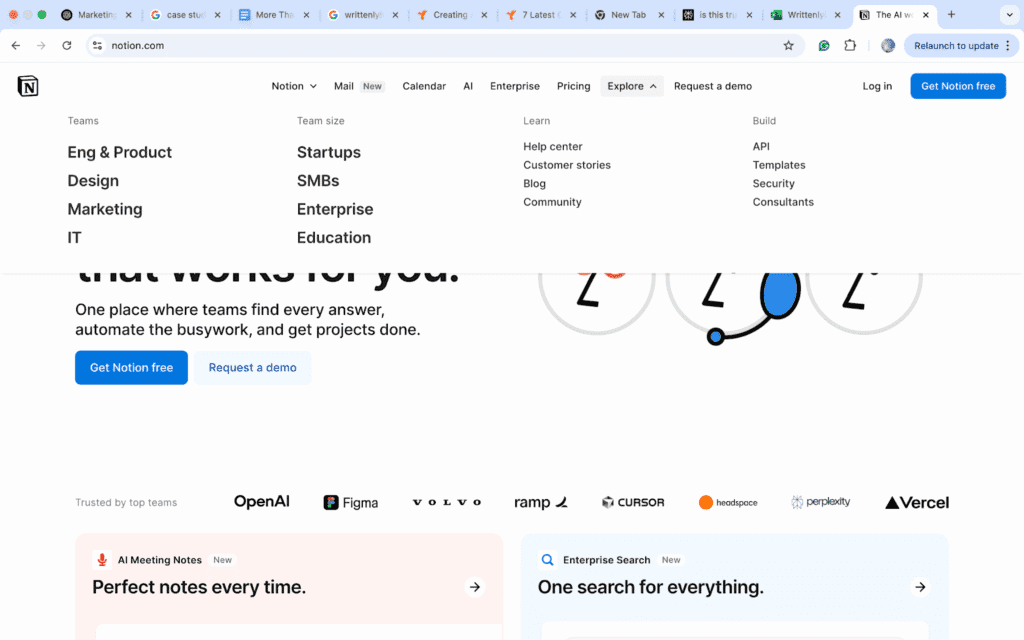
Example: Notion’s landing page always comes with mini-launch pages, tutorial videos, and social content that make even the most boring update feel like a big deal.
2. Price: Make the value obvious
People rarely buy because something is "cheap." They buy because they believe it’s worth it. Use content to bridge that gap.
This means publishing ROI calculators and transparent breakdowns of your pricing tiers. You can also build comparison content that positions your offer against alternatives, without sounding desperate or defensive.
Example: Webflow's pricing page links directly to support and “value vs cost” blogs that explain who should pick what tier and why.
3. Place: Show up where people buy
Know where your audience actually discovers and buys. This could be places like marketplaces, niche forums, or casual DMs. Then, show up consistently with content that fits the format and intent of each space.
Whether it's Shopify, Amazon, WhatsApp, or LinkedIn, your content should move with your product. Create modular assets you can repurpose across formats: turn a blog into a carousel, a testimonial into a sales email, or localize landing pages for specific regions.
Power your brand with WrittenlyHub’s all-in-one Content Engine - start today.
4. Promotion: Be everywhere strategically
Promotion isn’t just “running ads.” It’s the art of consistently showing up with the right message at the right time.
This includes high-intent discovery channels like SEO, high-trust sequences like newsletters, and fast-moving formats like short-form video, LinkedIn content, or webinars. The goal is to stay visible, consistent, and useful, without overwhelming or turning off your audience.
Example: Ahrefs runs ads, yet they dominate search by publishing insanely valuable blog content that outranks half the internet and turns organic traffic into trial users.
5. People: Let your team speak for you
Content from your team builds more trust than anything your marketing team could write. Why? Because people believe people, not brands.
A major stat to remember: 76% of consumers trust content shared by employees more than brand posts. It means your support team’s quick video reply or your founder's LinkedIn story carries more weight than your marketing HQ's perfectly crafted brochure.
Example: Fae Beauty's CEO, Karishma, regularly shares product updates and opinions on Instagram, and the brand's reach grows without spending a dollar on distribution.
Drive real results with WrittenlyHub as your end-to-end organic marketing powerhouse.
6. Process: Turn operations into content
Your workflows say a lot about your brand, so don’t keep them in the dark. Today's buyers want to know how things work before they commit.
Share your onboarding experience, support setup, delivery timelines, or cancellation flow in public. It sets clear expectations, builds trust, and signals confidence. No surprise, then, that 94% of customers say transparency makes them more loyal.
Example: Basecamp openly documents how they work, what they don’t do (like calls), and what users can expect. It filters the right users in and saves time for everyone else.
7. Physical evidence: Show proof over promises
You can talk about value all day. But what actually convinces people is evidence.
Build a strong library of case studies, video testimonials, third-party reviews, industry certifications, “as seen in” logos, and UGC. These become the content breadcrumbs that lead to trust.
Example: Loom showcases video testimonials from real users, public feedback on X, and customer stories front-and-center on their site, making it easy for prospects to trust what they’re signing up for.
5 steps to building your own marketing-mix guide
Knowing the marketing mix is one thing; using it to drive actual results is another.
Whether you're working with 4Ps or 7Ps, it only works when you back it with structure, feedback, and content that matches how your buyers actually behave.
Here's how to build a guide that makes it all click:
1. Start with a quick audit
First, take stock of where you are. What’s actually driving results across your current marketing mix, and what feels like filler? Go one P at a time and map each one to what you’re currently doing.
For example:
- Under product, do you have content that clearly explains what you offer and why it matters?
- Under price, are you supporting your pricing with comparison pages, ROI calculators, or explainer content?
- For place, are you showing up on the channels where your audience buys?
- And for promotion, are your efforts balanced, or are you just throwing everything into social posts and hoping something brings engagement?
If everything is skewed toward only one category, then you're not using the full framework.
2. Define your ICP and map the journey
A strong marketing mix product only matters if it’s aligned with the right customer. Define your Ideal Customer Profile (ICP) clearly, beyond demographics.
What problem are they trying to solve? What stage of awareness are they in? Where do they spend time online? What triggers a buying decision?
Once you’ve got that clarity, map their journey to the relevant Ps.
So, if you're a B2B SaaS company that sells through outbound and demos, place isn’t about shelf space or social media reach; it’s about showing up in the right inbox or during the right buying cycle.
On the other hand, for a DTC brand, place could mean optimizing your Shopify store, Amazon listings, or even WhatsApp sales flows.
3. Turn insights into execution across the Ps
Once you've mapped your audience and journey, the next step is execution, but not everything deserves equal effort. Use your marketing mix to decide where your content team (or agency) should focus first.
Ask:
- Which Ps are already getting attention?
- Which ones are under-supported?
- What’s most critical to influence a buying decision right now?
Instead of building content by format (e.g., “we need more blogs”), build it by function.
- If your process causes drop-off, create help docs or onboarding flows.
- If people are your edge, invest in team-led content.
- If physical evidence is missing, gather social proof fast.
This keeps your strategy grounded and your content team aligned on what actually matters.
4. Set KPIs tied to the mix, not just traffic
If you're only measuring traffic, you're missing the point of the marketing mix. Each P represents a different lever in your strategy, and each one deserves its own success metric.
For example:
- Price: Run A/B tests to understand how pricing changes affect conversions or average order value.
- Promotion: Use UTM-tagged campaigns to track which content formats actually drive sign-ups, not just clicks.
- People: Measure engagement on employee-led content like LinkedIn posts or support-led how-to videos.
When you measure the right things, you stop guessing and start optimizing. That’s how the 7 Ps of marketing become a performance system and not just a strategy slide.
5. Build feedback loops to adapt fast
The marketing mix isn’t static; your product and buyers keep changing. That’s why real feedback matters. Support tickets show where people get stuck, surveys reveal how pricing really landed, and reviews expose gaps between what you say and what they hear.
No surprise that 65% of successful product launches rely on customer feedback.
When you plug those insights into your 5Ps or 7Ps, every part of your strategy gets sharper and more aligned.
If this feels overwhelming, a fractional CMO can turn all that data into a clear, ready-to-execute plan so you can focus on actually running the business.
What not to do with your marketing mix
At this point, you’re probably thinking, “Okay, this all makes sense… but am I about to mess it up anyway?” Fair question. Most teams don’t fail because their marketing mix is wrong; they slip because of how they apply them.
Below are the most common mix mistakes, plus how to dodge them like a pro.
Siloing your Ps like separate departments
When product, marketing, and sales work in isolation, the mix falls apart.
Your product says "premium," but your promotion screams discount, or your pricing changes and nobody updates the website. This isn't just an ops issue, it's a brand trust problem. A shared calendar or campaign plan keeps every P moving in sync.
Over-prioritizing promotion because it feels productive
Promotion is visible, fast, and easy to throw money at, so it gets all the attention. But if your pricing feels off or your product isn't clearly positioned, you're just driving traffic to confusion. Fix the foundation first, then amplify the message.
Skipping the post-sale experience entirely
You nailed the campaign, got the signup… then ghosted the customer. Weak onboarding or zero follow-up kills retention faster than a bad ad ever could. Support content, follow-ups, and proof points matter just as much as the pre-sale hype.
Forgetting that "place" isn't just where you sell
A lot of brands think place = website or storefront. But it's really about how your audience prefers to buy. Ignoring convenience, payment methods, or mobile UX? That's a lost sale hiding in plain sight.
Making content without mapping it to a P
Not every blog needs to go viral, but it should have a job. If a piece of content doesn't support your product, clarify your pricing, enhance your process, or build social proof; it's just filler. Every asset should be tied to a lever in your marketing mix, driving clarity, not just clicks.
Spotting these early and fixing them fast is what separates brands with strategy from brands just winging it. The mix only works when all the Ps pull in the same direction.
The 20-point marketing-mix checklist
Before launching any new campaign or doing a quarterly reset, run through this quick but powerful checklist. It’s designed to help you catch gaps across all 7 Ps of marketing, from messaging to distribution to feedback loops.
Grab the complete checklist in Excel and add it directly to your planning workflow.
Turn theory into traction with the right mix
Look, if the marketing mix has ever felt like a jumble of buzzwords you're supposed to get but never quite apply; you're not alone. Whether it's the classic 4Ps or the full 7Ps, the hard part isn't memorizing the framework. It's making it work in real campaigns, with shifting priorities, tight deadlines, and limited bandwidth.
Content can support every P, but only if it's created with the full picture in mind. From product messaging to pricing explainers to post-sale support, every piece should pull its weight and serve a purpose beyond just filling your content calendar.
If your current approach feels a little too "launch first, align later," we get it.
At WrittenlyHub, a full-stack marketing agency, we help teams untangle messy marketing layers and build strategies that reflect how people actually buy, not just how teams happen to be structured.
Because knowing the Ps of marketing is one thing. Using them to make smarter decisions and drive real results? That's where the work begins, and where we come in.
Ready to make your marketing mix actually work? Let's talk.
FAQs on marketing mix
What are the 4 C's of marketing mix?
The 4 C’s; Customer, Cost, Convenience, and Communication; shift the classic 4Ps toward a customer-first view. They focus on how buyers experience value, not just how brands sell.
What are the 4Ps in swot analysis?
It’s a trick question: the 4Ps and SWOT are separate tools. You can use SWOT on the 4Ps, but the 4Ps aren’t part of the SWOT framework.
What is STP in marketing?
STP- Segmentation, Targeting, Positioning, helps brands identify the right audience, shape the right message, and place it where it converts.
What is a brand marketing mix?
It’s the full setup of how a brand creates, prices, promotes, and delivers its offering so every part works together to drive consistent growth.