Key Takeaways:
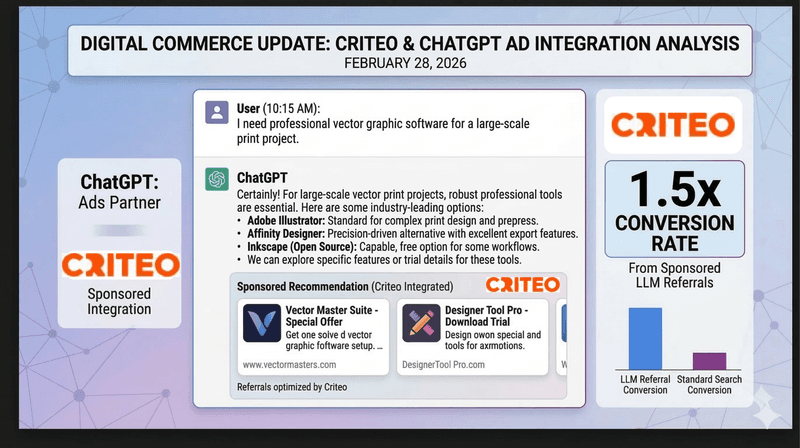
- Criteo announced it is the first advertising technology partner to integrate with OpenAI's ChatGPT ad pilot
- Early data from 500 US retailers shows users referred from LLM platforms convert at 1.5x the rate of other referral channels
- Ads appear only on ChatGPT's Free and Go tiers. Plus, Pro, and Enterprise users remain ad-free
- Premium ChatGPT ad placements reportedly carry a $60 CPM, far higher than traditional display
- Search Engine Land warns ChatGPT ads won't grow the ad market. They will redistribute spending from Google, Meta, and Amazon

ChatGPT ads are no longer a test. They have an ad tech partner now.
On March 2, Criteo announced it is the first advertising technology company to integrate with OpenAI's ChatGPT ad pilot. The integration covers ChatGPT's Free and Go subscription tiers in the United States.
This is an important update because it moves ChatGPT from "we're testing ads" to "brands can now buy through the same ad tech platforms they already use." That is a meaningful step toward scale.
The early numbers are worth paying attention to
Criteo shared one data point that stands out. Across a sample of 500 US retailers in February 2026, users referred from LLM platforms like ChatGPT convert at roughly 1.5x the rate of other referral channels.
That conversion premium makes sense. Someone asking ChatGPT, "What is the best project management software for remote teams?" has higher purchase intent than someone scrolling a social feed. The query itself signals a decision in progress.
Premium ad placements inside ChatGPT reportedly carry a $60 CPM. That is significantly higher than standard display advertising spend. But if the conversion rates hold, the economics could work for advertisers in high-consideration categories like B2B software, professional services, and premium consumer goods.
How ChatGPT ads actually work right now
OpenAI launched the ad test for US users in February 2026. Ads appear at the bottom of ChatGPT responses in clearly labeled sponsored boxes. They are matched to the conversation topic, not to a keyword bid.
The key rules OpenAI has set:
- Ads do not appear for Plus, Pro, Business, Enterprise, or Education subscribers
- Ads do not influence ChatGPT's answers. The response generates first, ads are served separately
- Users can dismiss any ad and provide feedback on why
- No ads appear near sensitive topics like health, politics, or mental health
- Users under 18 do not see ads
OpenAI has also confirmed that conversation data is not shared with advertisers. They receive aggregated performance data, such as views and clicks.
Why this matters more than another ad platform launch
Search Engine Land published a smart analysis on March 9 that frames this correctly. ChatGPT processes 2.5 billion prompts every day. A single LLM query costs roughly 10x more than a traditional search query. OpenAI needs advertising revenue.
But the key insight: ChatGPT ads will not expand the advertising market. They will pull spending away from Google, Meta, and Amazon. This is redistribution, not growth.
For content marketers and SEO professionals, the implications are practical:
- If your audience uses ChatGPT to research, your content needs to be cited in AI responses. That is your organic visibility in this channel
- Paid placements inside AI chat are now a real option. Budget conversations need to include LLM advertising alongside search and social
- Anthropic's Claude, by contrast, ran a Super Bowl ad campaign with the tagline "Ads are coming to AI. But not to Claude." The competitive positioning between AI tools is now partly about the ad experience
Criteo CEO Michael Komasinski called the pilot "an exciting step forward in advancing advertising in an emerging AI experience." The more telling statement is what he didn't say. He didn't call it experimental. He called it emerging.
This channel is being built. The question for marketers is whether to watch or start learning how it works while the competition is still low.
*This post content was created with the help of AI. Kindly cross-verify any data, statistics, or claims through primary sources, as there could be some discrepancies.