Key Takeaways:
- US creator economy ad spend projected to reach $43.9 billion in 2026, up 18% from $37.1 billion in 2025
- 59% of brands globally plan to increase influencer marketing budgets this year
- Paid amplification of creator content expected to jump 48% to $13.2 billion
- Half of marketing leaders still cite ROI measurement as their biggest challenge
- 92% of marketers plan to work with both macro and micro-influencers in 2026

Creator marketing just graduated from "nice experiment" to budget line item.
The numbers tell the story. US brands will spend $43.9 billion on creator partnerships this year, according to IAB projections. That's nearly double the $29.5 billion spent in 2024.
Why brands are shifting money into creator content
The shift isn't subtle. CMOs are actively pulling budget from legacy channels and redirecting it toward creators.
According to recent data, 60% of brand leaders are cutting print advertising investment. Another 50% are reducing linear TV spend.
Where's the money going? Straight into creator-driven strategies.
The IAB's 2025 Creator Economy Ad Spend & Strategy Report shows creator advertising growing four times faster than the broader media industry. Nearly half of all advertisers now classify creators as a "must buy," putting them alongside paid search and social media.
Paid amplification becomes the real growth driver
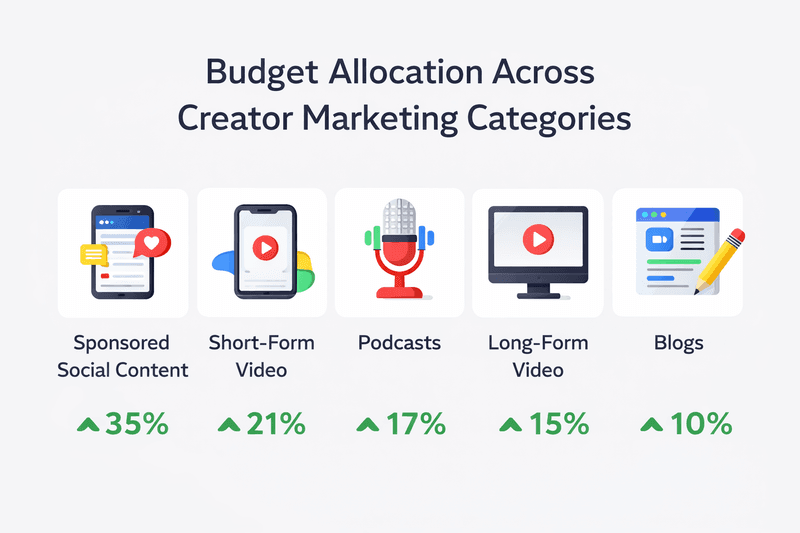
Here's where the budgets are actually landing in 2026:
- $13.2 billion on paid amplification of creator content on social media (up 48%)
- $11.6 billion on direct partnerships with creators (up 21%)
- $11.1 billion on paid amplification beyond social platforms (up 56%)
- $7.9 billion on ad adjacencies to creator content (up 33%)
The pattern is clear. Brands aren't just paying for posts anymore.
They're taking high-performing organic content and scaling it with precision targeting. That combination of creator authenticity and paid media efficiency is driving the fastest growth in the category.
ROI measurement remains the elephant in the room
Here's the tension: brands believe in creator marketing enough to write bigger checks, but not enough to fully commit.
The reason? Half of Western European marketing leaders identify ROI measurement as their greatest challenge in influencer marketing.
This isn't unique to Europe. Brands everywhere are investing based on instinct, competitive pressure, and anecdotal wins rather than hard performance data.
The problem compounds itself. Without reliable attribution, teams can't optimize campaigns in real time. They can't confidently identify which creators, content formats, or platforms drive actual results.
Micro-influencers win the strategy debate
The creator mix is shifting. Big follower counts matter less than they used to.
According to Linqia's 2026 State of Influencer Marketing report, 92% of marketers plan to work with both macro (100K-500K followers) and micro (5K-100K followers) influencers this year.
Only 29% of marketers are prioritizing celebrity partnerships.
The reasoning is practical. Micro-influencers deliver higher engagement rates and cost less. They also feel more authentic to audiences who've grown skeptical of polished brand messaging.
What this means for your 2026 planning
The brands that win won't just "do influencer marketing." They'll build systems around it.
A few considerations for marketing teams:
- Invest in measurement infrastructure now. The brands that crack attribution will outpace competitors stuck on vanity metrics.
- Think hybrid compensation. Performance-based payouts tied to actual conversions are becoming standard.
- Blend creator and affiliate budgets. The smartest programs treat these as one unified channel, not separate experiments.
- Prioritize long-term partnerships. One-off posts are giving way to ambassador-style relationships that compound over time.
The creator economy is no longer a side project. It's becoming the center of how brands reach consumers who actively ignore traditional advertising.