Key Takeaways:
- OpenAI confirmed it will start testing ads in ChatGPT for free and Go tier users in the US
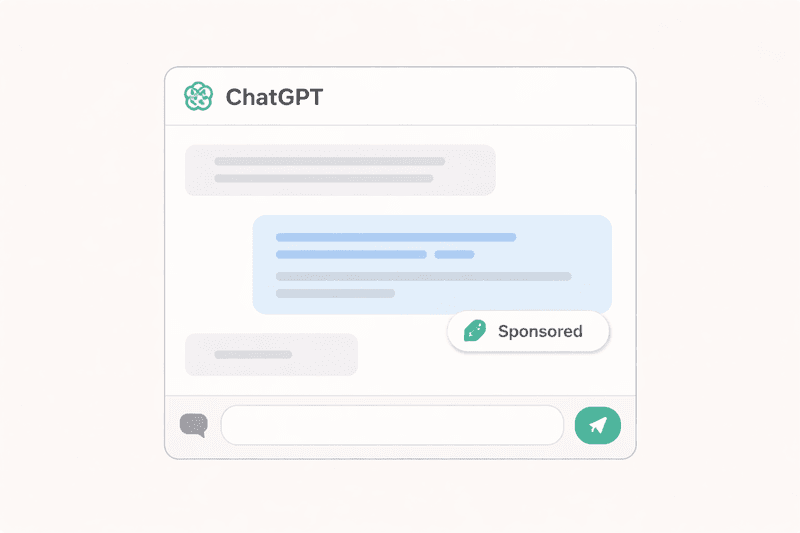
- Ads will appear at the bottom of responses, clearly labeled as sponsored
- Plus, Pro, Business, and Enterprise subscribers will not see ads
- OpenAI says ads will not influence ChatGPT's responses
- Beta advertisers are committing $200,000 or more to participate in initial tests

OpenAI is bringing ads to ChatGPT. On January 16, 2026, the company announced it will begin testing advertisements in ChatGPT for logged-in adult users in the United States on the free and Go tiers.
Sam Altman had previously called ads a "last resort." That last resort is now here.
How ChatGPT ads will work
Ads will appear at the bottom of ChatGPT responses when there is a relevant sponsored product or service based on the user's current conversation.
OpenAI says ads will be clearly labeled and separated from the chatbot's answers.
Users will be able to learn more about why they are seeing a specific ad, dismiss ads, and submit feedback about the experience. The company will not show ads in conversations about sensitive or regulated topics like health, mental health, or politics.
Which ChatGPT users will see ads
OpenAI's ad rollout targets specific user groups:
- Free tier users (logged in, adults, US only)
- ChatGPT Go subscribers ($8/month)
Users on paid plans remain ad-free:
- Plus ($20/month)
- Pro ($200/month)
- Business and Enterprise accounts
- Edu accounts
OpenAI will not serve ads to users who have identified themselves as under 18 or who the system predicts are minors.
OpenAI's advertising principles
OpenAI outlined five principles for how ads will work in ChatGPT.
Answer independence means ads do not influence what ChatGPT says. Responses are based on what is most helpful to the user.
Conversation privacy means OpenAI keeps conversations private from advertisers and will not sell user data to advertisers. Choice and control means users can turn off personalization and clear data used for ads at any time.
Long-term value means OpenAI will not optimize for time spent in ChatGPT. The company says it prioritizes user trust over revenue.
Mission alignment means advertising supports the goal of making AI more accessible.
What advertisers are paying to test ChatGPT ads
According to ADWEEK, OpenAI is asking select advertisers to commit at least $200,000 to participate in the beta test. Some advertisers represented by search intelligence platform Adthena were approached with $250,000 commitments.
The test is small and tightly controlled. OpenAI says the limited scope is deliberate, intended to see what types of ads provide value for users.
Ads will be billed on a pay-per-impression (PPM) basis rather than pay-per-click. This model ensures OpenAI earns revenue even if users do not interact with ads.
Why OpenAI is adding ads now
OpenAI has committed $1.4 trillion to data center infrastructure over the next eight years.
Altman wrote on X that many people want to use AI and do not want to pay. He positioned ads as a way to fund accessibility.
Internal documents reported in mid-2025 showed OpenAI planning $1 billion in free user monetization starting in 2026, growing to $25 billion by 2029.
ChatGPT now has 800 million monthly users. At that scale, advertising becomes one of the few revenue levers large enough to matter.
What this means for marketers and SEO
ChatGPT ads represent a new advertising surface tied directly to conversational AI and high-intent queries.
Unlike traditional search ads that interrupt a list of results, ChatGPT ads appear after an answer has already been delivered. The user has already received the information. The ad is adjacent to an answer the user may be ready to act on.
This format could create premium, high-impact placement that competes directly with organic answers.
For SEO and GEO practitioners, the arrival of ChatGPT ads means AI search visibility is no longer just about getting cited in answers. Paid placements are now part of the equation.