Key Takeaways:
- BrightEdge data shows AI Overview coverage grew 58% from February 2025 to February 2026
- AI Overviews now trigger on close to 50% of all tracked queries. But 52% still return classic results only
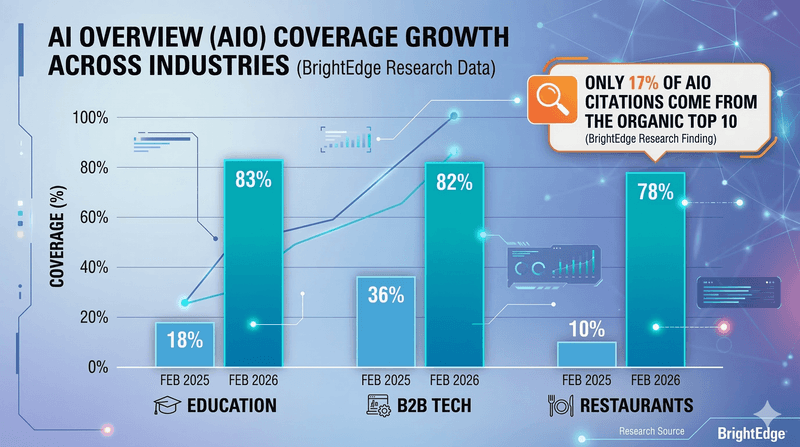
- Education queries jumped from 18% to 83% coverage. B2B tech went from 36% to 82%. Restaurants from 10% to 78%
- Only 17% of AI Overview citations come from pages ranking in the organic top 10. That number has stayed flat all year
- The average AI Overview now takes up more screen space than the entire visible desktop viewport before scrolling
Ranking on page one no longer means what it used to. BrightEdge just put numbers behind that reality.
New research published on Search Engine Journal covers BrightEdge's latest AI Overview analysis. The data spans February 2025 to February 2026 and tracks coverage across industries, citation patterns, and the amount of screen space these summaries occupy.
The top-line number: AI Overview coverage grew 58% year-over-year. These summaries now trigger for nearly half of all tracked queries.
But the more useful details are in the rest of the story.
The industries getting hit hardest
Google did not roll out AI Overviews evenly. Some sectors saw massive expansion while others barely moved.
The biggest jumps in AI Overview coverage:
- Education: from 18% to 83%
- B2B technology: from 36% to 82%
- Restaurants: from 10% to 78%
- Healthcare: consistently above 80%, with treatment queries at 100%
Meanwhile, real estate, shopping, and arts and entertainment remain lightly affected. AI Overviews appear on fewer than 3% of keywords in those categories.
Google is clearly choosing where AI answers belong. High-information queries get AI Overviews. High-commercial-intent queries mostly do not. That pattern protects ad revenue while giving users faster answers on informational searches.
The citation gap that should worry SEOs
Here is the finding that changes how you think about optimization.
Only 17% of sources cited in AI Overviews also rank in the organic top 10. That number has been flat all year. It barely moves.
Flip that around: roughly 5 out of 6 AI Overview citations pull from content that is not on page one of traditional search results.
The broader overlap is growing slowly. About 53% of cited sources rank somewhere in the top 100, up from 49% a year ago. But the page-one connection remains weak.
What this means: ranking #1 for a keyword does not automatically get you cited in the AI Overview for that keyword. And not ranking on page one does not exclude you from citations either. The two systems are connected but operate on different logic.
AI Overviews are physically dominating the screen
BrightEdge tracked the pixel height of AI Overviews over the past year. The average AI Overview now takes up more vertical space than the entire visible desktop viewport before a user scrolls.
The first organic result sits completely below the fold.
Even if your organic ranking is strong, the sheer size of AI Overviews means fewer users reach the traditional blue links when an AIO is present. This directly affects click-through rates.
Classic search is not dead. But it is now half the game
Here is the counterweight. AI Overviews trigger on nearly half of queries. That means 52% of searches still return only classic results with no AI summary at all.
For more than half of the search, organic rankings are still the entire experience. That is not a detail. It is the foundation.
Search now runs in two modes, depending on the query. Some results start with an AI summary. Many others show only ranked links. Content strategy needs to account for both.
What to do with this data
If you work in education, B2B tech, healthcare, or restaurants, AI Overview optimization is no longer optional. Your queries are already dominated by AI summaries.
Focus on what BrightEdge's citation data tells you:
- Page-one rankings help, but they are not enough for AI visibility
- Content ranked on pages 2 through 10 is increasingly getting cited
- Topical authority, clear structure, and original data are the signals that earn citations
- Track AI citation presence alongside traditional rankings. Both now matter
For industries where AI Overviews remain rare, like e-commerce and real estate, traditional SEO fundamentals still drive results. But watch the data quarterly. Google's expansion is not finished.
*This post content was created with the help of AI. Kindly cross-verify any data, statistics, or claims through primary sources, as there could be some discrepancies.