Key Takeaways:
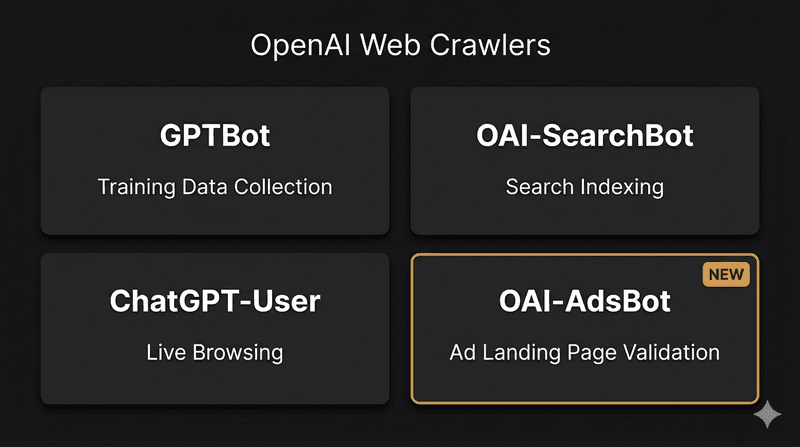
- OpenAI added OAI-AdsBot to its public crawler documentation. It is the fourth named bot alongside GPTBot, OAI-SearchBot, and ChatGPT-User
- OAI-AdsBot only visits pages submitted as ChatGPT ad landing pages. It does not crawl the open web
- The bot performs three functions: safety verification, policy compliance checking, and content relevance assessment for ad targeting
- Data collected by OAI-AdsBot is not used to train OpenAI's generative AI models
- No IP range file has been published yet. Cloudflare and other bot protection tools may accidentally block

OpenAI is building advertising infrastructure faster than most marketers realize. The latest sign: a dedicated web crawler for ad landing pages.
SEO consultant Glenn Gabe spotted the new entry in OpenAI's crawler documentation on April 21 and shared a screenshot on X. Search Engine Roundtable covered it the next day. SEJ published a deeper analysis on April 25.
OAI-AdsBot joins three existing bots in OpenAI's crawler lineup: GPTBot (training data), OAI-SearchBot (ChatGPT search indexing), and ChatGPT-User (user-initiated browsing). Each serves a separate function. OAI-AdsBot handles ad validation only.
What the bot actually does
When an advertiser submits an ad to run inside ChatGPT, OAI-AdsBot may visit the linked landing page. It performs three checks:
- Safety verification: confirms the page does not contain harmful or misleading content
- Policy compliance: ensures the page meets OpenAI's advertising policies
- Relevance assessment: analyzes page content to determine when the ad should be shown to users
OpenAI is explicit that data collected by OAI-AdsBot is not used to train generative AI models. This keeps it separate from GPTBot's territory entirely.
The bot identifies itself with a specific user-agent string. It only visits pages that have been submitted as ad destinations. It does not discover or index the broader web.
The ChatGPT ad ecosystem is maturing fast
OAI-AdsBot is one piece of a rapidly growing advertising operation. The timeline since February shows how quickly things have moved:
- February 9: ChatGPT ad pilot launches in the US at $60 CPM with $200K-$250K minimum commitment
- March 2: Criteo becomes the first ad tech partner
- March 26: OpenAI confirms $100 million in annualized ad revenue within six weeks
- April 10: Self-serve ads manager launches with a lowered $50K minimum spend
- April 18: CPMs reported as low as $25, down from $60 at launch
- April 21: OAI-AdsBot appears in public crawler documentation
The drop in CPMs from $60 to $25 in two months and the minimum spend reduction from $250K to $50K suggest OpenAI is aggressively scaling advertiser access. More advertisers means more landing pages for OAI-AdsBot to validate.
Why this creates a practical issue for advertisers
OAI-AdsBot needs to reach your landing page to validate it. If the bot cannot access the page, the ad may not get approved.
This is where things get complicated. Many websites use Cloudflare, Akamai, or similar bot protection tools that aggressively filter automated traffic. These tools may block OAI-AdsBot before it reaches the page.
OpenAI has not published an IP range file for OAI-AdsBot. For the other three bots, IP range JSON files are available at openai.com (searchbot.json, gptbot.json, chatgpt-user.json). Without an equivalent adsbot.json, verifying legitimate OAI-AdsBot traffic is harder. User-agent strings can be spoofed.
For advertisers running or planning ChatGPT ad campaigns, the action is clear:
- Ensure your landing pages are accessible to OAI-AdsBot. Check your bot protection settings
- Do not block OAI-AdsBot in robots.txt unless you want to prevent your ads from being validated
- Make sure landing page content clearly matches the ad promise. The bot uses page content for relevance scoring
- Watch for a published IP range file. OpenAI will likely release one as the ad program scales
What this means for the broader marketing ecosystem
OAI-AdsBot signals that ChatGPT advertising is being treated as a serious, infrastructure-level operation. Ad validation crawlers are a feature of mature advertising platforms. Google has Googlebot and AdsBot-Google. Meta has its own verification systems. OpenAI is building the same machinery.
For marketers tracking AI bot activity in server logs, OAI-AdsBot is a new user-agent to monitor. Unlike the other OpenAI bots, this one is tied directly to paid inventory. Seeing OAI-AdsBot in your logs means someone is running or testing ChatGPT ads that point to your domain.
The broader signal: ChatGPT is not experimenting with ads anymore. It is building the full infrastructure of an advertising platform. Crawlers, self-serve tools, declining CPMs, and expanding advertiser access. The trajectory is clear.
Disclaimer: This article is AI-assisted content and may contain errors. Details are from OpenAI's public crawler documentation, SEJ (April 25), Search Engine Roundtable (April 22), PPC Land, and ALM Corp. OpenAI's advertising program, bot behavior, and documentation change frequently. Verify with OpenAI's developer docs.