Key Takeaways:
- Google confirmed the March 2026 core update finished rolling out on April 8 at 6:12 AM PDT
- The rollout lasted 12 days, starting March 27. Faster than the December 2025 update, which took 18 days
- Barry Schwartz called it "a weird one" that "didn't seem as powerful" as previous core updates
- The March spam update completed just two days before the core update started, finishing in a record 19.5 hours
- Google issued no new guidance. Standard advice remains: focus on helpful, people-first content
Google's first core update of 2026 is officially done.
The Search Status Dashboard confirmed the rollout ended on April 8 at 6:12 AM PDT. It started on March 27 at 2:00 AM PT. Total time: 12 days and 4 hours.
That is within Google's two-week estimate and faster than the December 2025 core update, which needed 18 days.
This update felt different from December 2025
Barry Schwartz at Search Engine Roundtable tracked the update throughout and described it as "a weird one." He noted that it "didn't seem as powerful" as the December 2025 core update, which landed fast and caused significant ranking movement.
The March update was more gradual. SEO professionals monitoring thousands of domains reported minimal movement in the first two days. More noticeable ranking changes only started appearing around March 31, suggesting a staggered rollout.
Some sites saw clear gains or losses. But the overall volatility was lower than what the industry typically sees from broad core updates.
Three Google updates in six weeks created a messy data picture
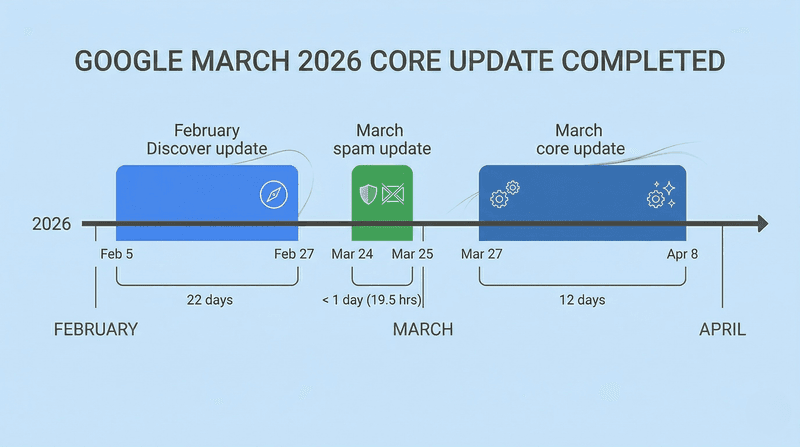
The March core update did not arrive in isolation. Google ran three algorithm updates in close sequence:
- February 2026 Discover update (February 5 to February 27 - 22 days, Discover only)
- March 2026 spam update (March 24 to March 25 - 19.5 hours, fastest ever)
- March 2026 core update (March 27 to April 8 - 12 days)
That overlap makes it harder to attribute ranking changes to a single update. A traffic drop on March 24 could be the spam update. A change starting March 27 is more likely the core update. Sites with heavy Discover traffic may still be feeling the effects from February.
Search Engine Journal noted that the spam-then-core sequencing may not have been a coincidence. Clearing out spam first could have "prepared the ground" before recalibrating broader quality signals.
What to do now that it is complete
Google recommends waiting at least one full week after completion before analyzing Search Console data. That means mid-April is the earliest window for reliable before-and-after comparisons.
Your baseline period should be the weeks before March 27. Compare that against performance from April 8 onward. Keep the spam update completion (March 25) in mind when reading the data between March 24 and 27.
Google issued no new guidance with this update. The standing advice has not changed: ranking drops after a core update do not indicate a penalty. Core updates reassess how Google evaluates content quality across the web. Some pages gain, some lose, and many see no meaningful change.
Google's documentation notes that smaller, unannounced core updates happen continuously between the larger confirmed rollouts. The March update may serve as a recalibration point that establishes rankings until the next expected core update, likely around June or July 2026.
For sites that lost visibility, the most productive step is reviewing content against Google's E-E-A-T framework. Pages that add original research, data, or firsthand experience are consistently favored. Pages that restate what already ranks are increasingly vulnerable.
Disclaimer: This article is AI-assisted content and has data based as per April 2026 and may contain errors. Algorithm updates affect sites differently. Monitor your own Search Console data before making strategy changes.