Key Takeaways:
- Google completed its first Discover-only core update on February 27 after a 22-day rollout
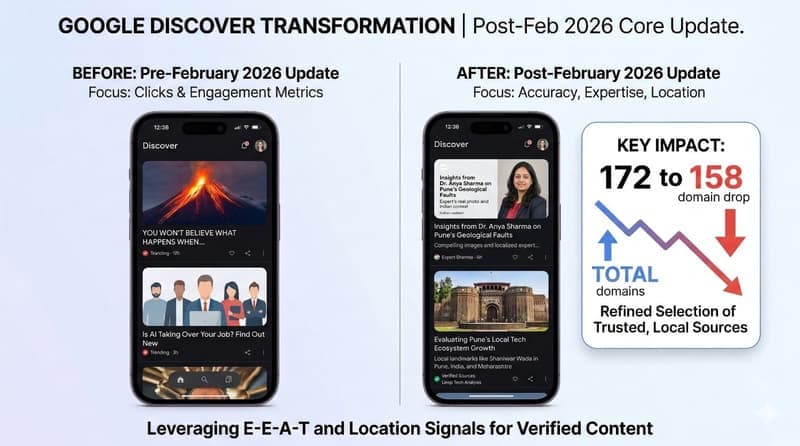
- The update targets clickbait, boosts local content relevance, and rewards niche topic expertise
- Unique domains in the US top 1,000 Discover placements dropped from 172 to 158. Fewer publishers are getting top visibility
- X/Twitter posts from institutional accounts jumped from 3 to 13 items in the US Discover top 100
- The update currently affects only English-language US users. A global rollout is coming in the months ahead

Google just separated Discover from Search. For the first time ever, each channel runs on its own algorithm.
The February 2026 Discover core update started rolling out on February 5 and finished on February 27. It took 22 days, about a week longer than Google's original estimate. Google confirmed it on the Search Status Dashboard, and the Search Central Blog laid out three goals: more locally relevant content and depth from sites with real expertise and less clickbait.
This was not a standard core update that affects everything. It only touched Discover. Your Search rankings were not part of this.
The early data tells a clear story
NewzDash, which tracks Discover performance across millions of US users, published a scorecard comparing pre-update (January 25-31) and post-update (February 8-14) windows.
The headline finding: fewer publishers are getting Discover's best placements. Unique domains in the US top 1,000 dropped from 172 to 158, an 8% decline. California saw a similar drop from 187 to 177.
More topics are being covered. But that traffic is going to a narrower set of publishers who demonstrate real authority on those topics.
Google is matching its actions to what it said. Sites that relied on "dramatic reveal" templates and curiosity-gap headlines lost ground fast:
- Yahoo dropped from 11 to 6 articles in the US top 1,000, and from multiple top-100 items to zero
- Autoevolution had 5 articles pre-update using a near-identical sensational formula. Post-update: zero
- A listicle-style "psychology says..." article fell from roughly #14 to #153
Local content is winning visibly
Regional personalization increased across the board. NewzDash found that New York-local domains appeared roughly five times more often in the New York feed than in the California feed, and the reverse held true for California-local domains.
The feeds still share most of their top 100 items nationally. But each state now gets a meaningful local layer on top of that core.
For publishers based in India and other non-US markets, the short-term news is not great. International publisher share in US Discover feeds declined from 8.52% to 7.04%. But when Google rolls this update out globally, the same local prioritization will work in your favor on your home turf.
X posts in Discover jumped significantly
One unexpected finding: X/Twitter posts from institutional accounts grew from 3 to 13 items in the US Discover top 100. NewzDash has been tracking this trend since November 2025 and says the update appeared to accelerate it.
Most top-performing X items came from established media brands. Not random accounts. Google appears to use real-time social engagement from trusted entities as a Discover signal.
What publishers and content marketers should do now
Google's message is specific enough to act on:
- Audit your headlines. If they promise more than the content delivers, expect Discover to downgrade you.
- Build topic-by-topic expertise. A site covering 50 categories thinly loses to a niche site covering one deeply.
- Use images at least 1,200 pixels wide and add the max-image-preview:large meta tag.
- Check your Search Console Discover report. If traffic dropped while search rankings held steady, this update is likely the cause.
- If you publish for a regional audience, strengthen your local signals. Geographic relevance is now an active ranking factor.
Google said it will expand this update to all countries and languages in the coming months. The playbook it rewards, niche depth, original reporting, no clickbait, is worth adopting now regardless of where your audience sits.