Key Takeaways:
- Former Google employee Pedro Dias asked the SEO community on X whether Google is deindexing URLs at a higher rate since early April. The response was overwhelmingly yes
- Multiple SEOs confirmed seeing pages disappear from Google's index without manual penalties, warnings, or spam violations
- Google's John Mueller responded on Bluesky: "Some sites go up, some sites go down. I don't see anything exceptional"
- One SEO reported noticing the pattern starting in December 2025, with only two pages remaining indexed on some media websites
- Community theory points to Google getting pickier about indexing as AI-generated content floods the web
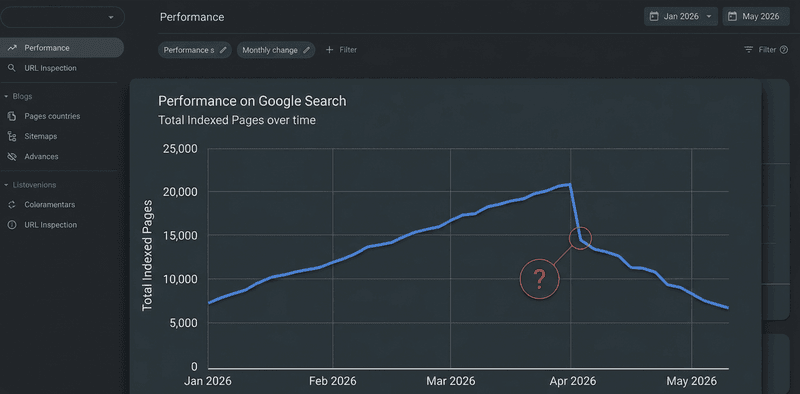
Pages are disappearing from Google's index, and nobody is getting an explanation.
Pedro Dias, a former Google employee, raised the alarm on X on April 30. He asked a simple question: "Is everyone noticing Google de-indexing URLs randomly at a higher rate since the beginning of April?"
The SEO community responded immediately. The answer was a near-unanimous yes.
What practitioners are reporting
The reports are consistent across different site types and industries. Pages that were indexed for months or years are being removed without any notification in Google Search Console.
Cory, one of the SEOs who replied, described it as a regular pattern tied to updates: "Some type of freshness/stale evaluation and quality component. Purge garbage to reduce the index size."
Alex Gramm noted he first saw this pattern in December 2025. He described finding "only two pages in Google's index" for some media websites, which he called "interesting and weird."
Valentin Pletzer offered a different angle. He checked several URLs manually using site: searches and found all of them still indexed. He raised the possibility that it could be a Search Console reporting bug rather than actual deindexing.
That distinction matters. If Search Console is misreporting indexed page counts, the problem is less severe than it appears. If pages are genuinely being removed, the implications are much larger.
Google says nothing unusual is happening
John Mueller, Google's Search Advocate, addressed the concerns on Bluesky on April 30. His response was brief: "Some sites go up, some sites go down. I don't see anything exceptional there."
That response has not satisfied the community. Multiple practitioners are seeing the same pattern independently, and Mueller's characterization does not explain why the rate appears to have increased since early April.
Barry Schwartz at Search Engine Roundtable covered the discussion on May 1 and noted the timing. The March 2026 core update completed on April 8. The increased deindexing reports started around the same time. Whether the two are connected is unclear.
The AI content theory
Several commenters pointed to AI-generated content as a likely factor. One SEO wrote: "I suspect, with all the AI content being pushed out, that Google is getting pickier."
The logic makes sense. If the volume of indexed content is growing faster than the volume of genuinely useful content, Google has an incentive to be more selective about what stays in the index. Removing thin, duplicate, or low-value pages reduces the index size and improves the quality of results returned to users.
Google's own documentation has emphasized "helpful, people-first content" since the Helpful Content updates of 2022-2023. If the deindexing spike is intentional, it would be consistent with that direction.
But Google has not confirmed this interpretation. Without official acknowledgment, the community is working with anecdotal evidence and pattern matching.
What to check on your site right now
Whether this is a real increase in deindexing, a core update aftereffect, or a reporting issue, the monitoring steps are the same.
Open Google Search Console and go to Pages under the Indexing section. Look at the total count of indexed pages over the last 90 days. If there is a visible drop starting in early April, your site may be affected.
Check specific pages using the URL Inspection tool. If a page shows as "not indexed" that was previously in the index, look at the reason Google gives. Common reasons include "crawled but not indexed" and "discovered but not currently indexed."
Run site: searches in Google for your domain. Compare the number of results against your sitemap. A significant gap between the two is worth investigating.
For pages that were deindexed without obvious quality issues, consider whether they add unique value that is not available elsewhere on the web. Google has been tightening its quality bar for over a year. Pages that restate widely available information without adding original analysis, data, or expertise are the most likely candidates for removal.
If you run a content-heavy site, audit for pages that are thin, outdated, or duplicated across multiple URLs. Proactively removing or consolidating low-value pages may be better than waiting for Google to do it.
Disclaimer: This article is AI-assisted content and may contain errors. Reports of increased deindexing are from SEO practitioners on X, covered by Search Engine Roundtable (May 1, 2026), Optimixed, and Digital Phablet. Google has not confirmed any change in indexing behavior. Individual site experiences vary. Monitor your own Search Console data.