Key Takeaways:
- ChatGPT processes 50 million shopping-related queries daily, roughly 2% of its 2.5 billion daily prompts
- 900 million weekly active users as of February 2026. The user base doubled in 12 months from 400 million
- OpenAI confirms product recommendations are "organic and unsponsored, ranked purely on relevance." There is no paid placement for shopping results
- Shopping Research runs on a specialized GPT-5 mini model achieving 52% product accuracy on complex multi-constraint queries
- 83% of ChatGPT product recommendations come from Google Shopping's top 40 organic listings, per a March 2026 study of 43,000 products
Someone is asking ChatGPT right now whether your product is worth buying. And ChatGPT probably cannot find you.
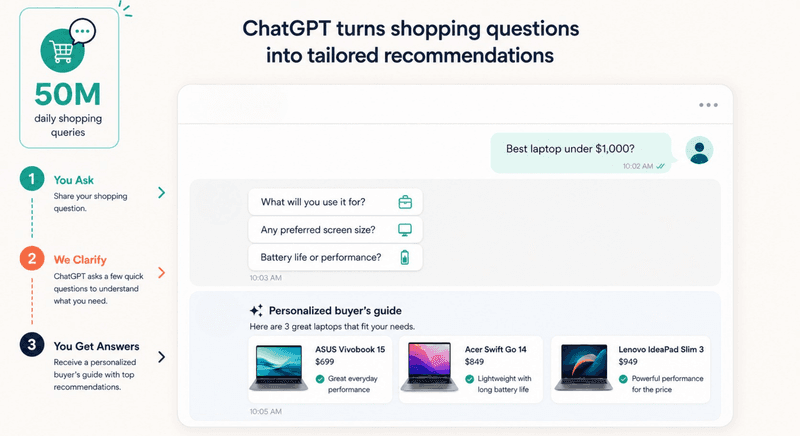
50 million shopping queries flow through ChatGPT every day. Users ask things like "best wireless earbuds under $100 for running" or "compare these three strollers for city apartments." ChatGPT does not return a list of links.
It asks clarifying questions about budget, preferences, and use case. Then it spends 3-5 minutes researching before delivering a personalized buyer's guide with specific product recommendations.
The products it recommends are not ads. OpenAI's help documentation is explicit: "Product results are selected independently by ChatGPT and are not ads, nor influenced by any OpenAI partnerships."
That makes this one of the largest organic product discovery channels in the world. And most e-commerce brands have done nothing to show up in it.
How ChatGPT shopping actually works
Shopping Research runs on a specialized variant of GPT-5 mini trained specifically for shopping tasks. According to HubSpot's analysis, this model achieves 52% product accuracy on complex multi-constraint queries, compared to 37% for standard ChatGPT Search.
When a user asks a shopping question, ChatGPT follows a multi-step process. It asks follow-up questions to clarify priorities (brand preference, budget, features, size). Then it searches across multiple sources: Google Shopping feeds, Bing's web index, product review sites, Reddit discussions, and merchant websites.
Users can swipe right on products they like and left on ones they do not. ChatGPT refines its recommendations based on these signals and delivers a tailored buyer's guide with prices, specs, images, and reviews from across the web.
If ChatGPT memory is enabled, it uses what it already knows about the user. A user who previously discussed gaming gets laptop recommendations weighted toward gaming specs without having to say it again.
Google Shopping feeds power most recommendations
A March 2026 study analyzing 43,000 products found that 83% of ChatGPT's product recommendations come from Google Shopping's top 40 organic listings. Your Google Merchant Center feed is the single highest-leverage optimization lever for ChatGPT shopping visibility.
That finding means e-commerce brands already investing in Google Shopping optimization have a head start. Clean product feeds with complete attributes, accurate pricing, high-quality images, and detailed descriptions give ChatGPT the structured data it needs to recommend your products.
Brands without a Google Merchant Center feed or with incomplete product data are structurally invisible to ChatGPT shopping. The AI cannot recommend what it cannot parse.
The ChatGPT Merchant Program is live
OpenAI launched the ChatGPT Merchant Program, which allows businesses to submit product feeds directly to improve the likelihood that ChatGPT can access accurate, structured product information.
The program is separate from ChatGPT's advertising system. Ads exist inside ChatGPT (launched February 2026, now generating $100 million+ in annualized revenue), but they are clearly labeled and separated from organic shopping recommendations. Paying for ads does not influence which products ChatGPT recommends organically.
For e-commerce brands, joining the Merchant Program is a direct path to visibility. It ensures ChatGPT has access to your current product data, pricing, and availability rather than relying on whatever it can scrape from the open web.
What makes ChatGPT recommend one product over another
An experiment published by O'Reilly Radar tested this directly. Researchers gave AI shopping agents two products: one expensive with clean structured specs, one cheaper with only marketing copy. The agents consistently recommended the expensive product because they could parse its data. The cheaper product was invisible.
The lesson is clear. ChatGPT evaluates products based on structured attributes: material composition, dimensions, compatibility, care instructions, ratings, and reviews.
A product page with "waterproof rating IPX4, 650-fill goose down, weight 14 oz, packable to 6x8 inches" gives the AI everything it needs. A page with "our amazing jacket keeps you warm in any weather" gives it nothing.
Third-party reviews carry significant weight. ChatGPT explicitly prioritizes "high-quality, publicly available" sources like review sites and Reddit. What people say about your product on Reddit can matter more than your own product page copy.
The technical requirement most brands are missing
Blocking OAI-SearchBot in your robots.txt file means complete exclusion from ChatGPT shopping recommendations, regardless of how good your product is.
OpenAI operates two main crawlers: GPTBot (used for model training) and OAI-SearchBot (used for real-time search and shopping). Many sites block GPTBot to prevent their content from being used in training data. That is a reasonable choice. But blocking OAI-SearchBot means ChatGPT cannot access your product pages when a user asks about your category.
Sites that allow OAI-SearchBot see approximately 5,000 AI search visits and $15,000 in AI-attributed revenue monthly, according to Prime Avenue Group's analysis. That number will grow as ChatGPT's user base continues expanding.
Server-side rendering matters too. AI crawlers do not wait for JavaScript to execute. If your product schema loads dynamically through client-side JavaScript, AI crawlers may never parse it. JSON-LD structured data rendered server-side is the format AI systems process most reliably.
What e-commerce brands should do now
This is one of the rare moments where a major discovery channel is growing fast and most competitors have not optimized for it. The window is open.
Check your robots.txt file. Ensure OAI-SearchBot is not blocked. If you blocked all AI crawlers as a blanket policy, revisit that decision for OAI-SearchBot specifically.
Clean up your Google Merchant Center feed. Since 83% of ChatGPT recommendations come from Google Shopping's top 40, Merchant Center optimization directly improves ChatGPT visibility.
Add complete structured data to every product page. JSON-LD with GTIN/MPN, brand, condition, availability, price, ratings, and detailed attributes. Server-side rendered.
Join the ChatGPT Merchant Program. Submit your product feed directly to OpenAI so ChatGPT has current, accurate data to work with.
Monitor what ChatGPT says about your products. Ask ChatGPT the same questions your customers would ask. See which products it recommends for your category. If you are not there, your competitors are.
Frequently asked questions about ChatGPT shopping
Are ChatGPT product recommendations ads?
No. OpenAI confirms product results are "organic and unsponsored, ranked purely on relevance to the user." Ads exist separately inside ChatGPT and are clearly labeled.
How do I get my products recommended by ChatGPT?
Ensure OAI-SearchBot can crawl your site, optimize your Google Merchant Center feed, add complete JSON-LD structured data to product pages, and join the ChatGPT Merchant Program.
How many people use ChatGPT for shopping?
ChatGPT processes 50 million shopping queries daily across 900 million weekly active users (as of February 2026).
Does blocking GPTBot also block shopping recommendations?
No. GPTBot is for model training. OAI-SearchBot is for real-time search and shopping. You can block GPTBot while allowing OAI-SearchBot to maintain shopping visibility.
Disclaimer: This article is AI-assisted content and may contain errors. Data sourced from OpenAI Help Center, HubSpot (April 2026), Elogic Commerce, Evolve Media Agency, O'Reilly Radar, Prime Avenue Group, ALM Corp, Modern Retail, Ecommerce Fastlane, Dataslayer, and TechnologyChecker. ChatGPT features, merchant programs, and recommendation algorithms change frequently. Verify with OpenAI's official documentation.