Key facts:
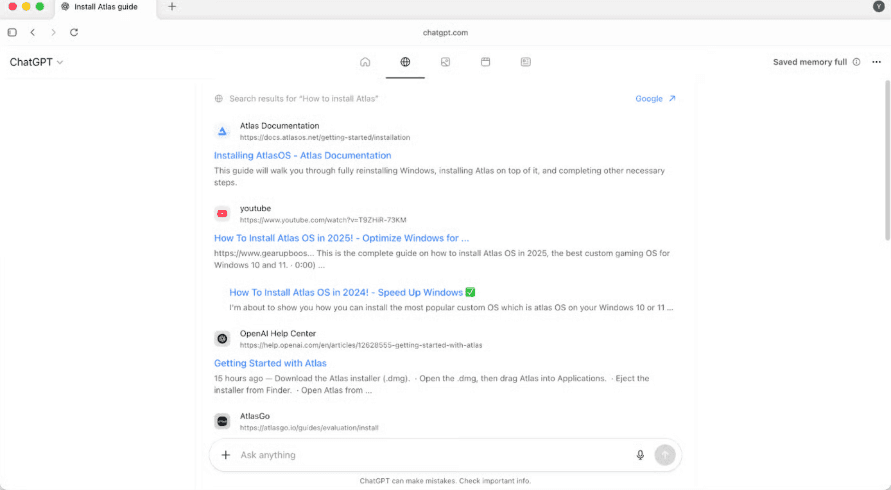
- Launch: OpenAI unveiled ChatGPT Atlas on October 21, 2025 (macOS first; Windows/iOS/Android “coming soon”).
- Agent mode: Atlas includes an AI agent that can browse, click, and complete tasks.
- Privacy: Browser Memories are optional; data controls default to user opt-out for training.
- Ad/analytics risk: Early tests show Atlas can mimic human clicks, potentially distorting paid media metrics.
OpenAI just shipped Atlas, an AI-native browser. While Perplexity's Comet is already live and free, and Chrome and Edge now ship agentic features, every marketer should now be up to date on how Atlas will reshape content discovery.
ChatGPT Atlas vs Google Chrome: What’s Different and Why It Matters for Brands
Atlas puts ChatGPT in the browser Chrome. It reads pages, summarizes content, cites sources, and clicks on your behalf. That inverts search: answers first, links second. For marketers, this resets how visibility, attribution, and ad spend work.
What changes in SEO
The rules you learned still apply. But AI browsers add a new layer: can an agent read, quote, and act on your content without a human clicking through? Let’s find out how you can optimize your content to achieve that.
Answers drive the click
Atlas prioritizes an answer layer powered by ChatGPT. Citations inside that answer become the new shelf space. If your brand isn't cited, you may never get the click - even if you rank in classic results.
To skip this hurdle, ship sections that read like quotable evidence blocks: dates, methods, and primary sources per claim.
Passage-level competition
Atlas quotes passages, not pages. Treat every H2 and H3 as a landing unit. Add schema for Organization, Person (authors), and Product or FAQ where accurate.
Keep author bios and About pages entity-clean for model grounding. This improves your shot at being the cited snippet in Atlas' sidebar.
Short on time? WrittenlyHub helps your brand rank and get cited on OpenAI Atlas.
How Atlas changes SEM
Because Atlas can click and navigate, it can trigger paid ads and inflate click metrics that look human.
What to expect: A lift in assists without proportional on-site engagement.
How to tackle it:
- Set up bot/agent segmentation, exclude suspect placements, and move to modeled conversions and LTV checks. Flag “no-scroll” purchases and agent-like session patterns in reporting.
- Your ad copy must be parsable: claim, qualifier, proof, and a source. Feed product data and a policy-compliant copy that an AI can summarize without distorting. For high-intent terms, test action extensions - deep links to book, buy, or compare - that agents can trigger.
How Atlas changes content discovery beyond research
AI-native browsers don't send users on a scavenger hunt. They read, compare, and decide in one pass, then serve the answer.
This means your content doesn't sit on a results page hoping for a click. It gets pulled into the answer itself, quoted, cited, or ignored based on how well an agent can parse and trust it.
What to expect: This “read → research → decide” path changes what you publish. Atlas scans for structure and proof, not persuasion.
How to tackle it: Publish evidence blocks like charts with alt text, bullet claims with citations, and original data. Include explicit "when to use" and "when to avoid" sections - Atlas rewards nuance over hype.
For example, a SaaS comparison that lists deal-breakers by use case will surface more often than a generic feature table.
Compliance, consent, and parsing
Atlas’ default privacy stance helps adoption, but consent walls and intrusive banners still break parsing.
I find that keeping essential content indexable and accessible to the sidebar agent, and avoiding overzealous interstitials that hide sources and tables, helps bypass this hurdle.
For extra measures, monitor security discourse (prompt-injection risks) when you ship interactive widgets that Atlas might “operate.”
90-day Atlas playbook
- Citations audit: Track where you are (and aren’t) cited inside Atlas answers for your top 20 topics. Prioritize missing-citation pages.
- Refactor into evidence blocks: Each section needs numbers, methods, and 2-3 primary sources.
- Entity hygiene: Tighten schema, author pages, and consistent brand strings across site + Wikidata.
- Agent analytics: Create UA/behavior filters; report assisted conversions and “zero-scroll” buys.
- SEM guardrails: Update exclusions, cap CPC on at-risk terms, test deep-link extensions.
- Original data cadence: Publish one charted dataset per month with clean licensing and CSV download.
The bottom line on future of AI browsing
AI browsers are not “another channel.” They’re the interface between users and the web. Optimize for being the trusted citation inside answers and the fastest next step after them.
Atlas shifts power from ten blue links to a live, cited answer inside the browser. Win by becoming the safest citation and the fastest action. Fix passage quality, entity signals, and agent-ready UX now, before answer panels get crowded.
Want first-mover visibility? Book a consult with WrittenlyHub (a full-stack marketing agency). Our experts have assisted more than 30 brands to dominate AI overviews and LLM results.
FAQs about OpenAI’s Atlas
Is Atlas available beyond Mac?
Windows, iOS, and Android are coming soon, per OpenAI; macOS is first.
Does Atlas store my browsing data?
Memories are optional, and training opt-out is the default per OpenAI's help docs.
Can Atlas click ads like a user?
Yes. Tests suggest Atlas' agent can mimic human clicks; monitor paid metrics closely.
How do I get cited in Atlas answers?
Publish evidence-rich passages with clear entities and primary sources; aim for sidebar citations.