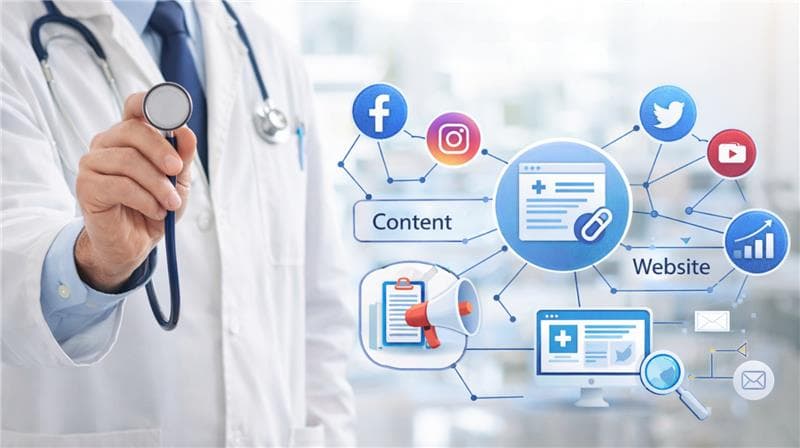
Healthcare marketing isn’t what it used to be. People increasingly begin their healthcare journey online: around 5% of all Google searches are health-related, making search the top channel for healthcare queries.
That means before a patient phones a clinic or walks in for a visit, they’ve likely already checked symptoms, compared providers, or read reviews. In fact, in many healthcare verticals, over 60% of consumers search online before scheduling an appointment.
At the same time, the role of social media and online presence can’t be ignored: many patients turn to social media and online platforms to help build trust and make decisions.
So in 2026, “healthcare digital marketing” isn’t just marketing; it’s a patient-first, data-aware, and multi-channel experience that meets people where they already are: online, on social media, reading reviews, comparing doctors.
To succeed, healthcare brands must navigate data privacy, establish credibility, and craft sensitive, trust-building content for an audience that’s more informed, and more selective, than ever before.
Today, we are going to break down what healthcare digital marketing looks like and how you can future-proof your healthcare marketing.
Why is healthcare digital marketing the need of the hour?
If you think a good clinic location and a loyal patient base are all you need in 2026, then think again.
Today's consumers start their journey online. Before anyone even walks through your door or hops on a call, they have already done their part by researching online and assessing how your services align with their specific health needs.
Consider this:
- 71% of patients rely on online reviews before choosing a healthcare provider.
- 3 out of 4 patients research health topics online before even speaking to a doctor
- 88% of appointments are still reserved via phone after online research
Need more reasons why healthcare needs digital marketing more than anything? Here's why:
- Competition is intense: With telehealth, wellness apps, and healthcare startups growing, your practice needs to stand out anyhow.
- Patients are digital-first: On average, people spend 5-6 hours online communicating and consuming content.
- It drives better ROI: Digital marketing tends to generate 50% more interactions than traditional healthcare methods while costing less.
- Improves patient education and builds trust: A strategic marketing plan will help you simplify complex health topics and come across as a credible and patient-first brand.
Key trends in healthcare digital marketing
If healthcare marketing in 2020 was about "going digital," 2026 will be about getting smarter, faster, and hyper-personalized. Here's what's been brewing up in the healthcare marketing scene currently:
1. AI-powered patient experiences
AI is taking big steps in the healthcare industry. From AI chatbots answering patient queries to automated appointment scheduling, AI is transforming how patients interact with healthcare providers.
For instance, the Cleveland Clinic uses AI-driven chatbots for appointment reminders and virtual care recommendations. These chatbots not only handle basic inquiries but also offer a personalized approach with suggestions solely based on the patient's medical history and upcoming appointment.
This integration helps healthcare providers deliver a more responsive, personalized experience while freeing up staff to focus on what’s really important, and that is patient care. This is how this brought a significant uptick in patient engagement for them.
2. Personalized health content
Did you know that 80% of patients are more likely to engage with brands that personalize their experiences?
So, no more one-size-fits-all campaigns. AI and data analytics now help segment audiences by age, condition, location, and even search history to present personalized health tips and service recommendations.
3. Rise of short-form, health-focused visual content
People want health info at their fingertips. Instagram reels and YouTube shorts explaining symptoms, prevention, or debunking medical myths pull millions of views.
According to a study, 33% of consumers use YouTube before consulting their doctor or other medical professionals.
4. Omnichannel marketing
You can't just win patients from one single platform. Patients want more than just one place to know it all. A single healthcare search starts with Google, jumps to Reddit for reviews then ends with a phone call.
Many successful brands are syncing SEO, socials, email campaigns, and offline touchpoints to offer more connected experiences.
This is significant as this leads patients to read about your services on a social media platform, and they will find the same information when they visit your website or open an email. So, aligning these channels can be a great way to make a patient journey easier to engage with you.
5. Voice search and “near me” healthcare queries
“Near me” searches for healthcare services have doubled since 2015, especially with smartphones becoming a dominant tool for quick on-the-go decisions.. Thus, highlighting the need to optimize for voice search and Local SEO.
Healthcare brands leading in these trends aren't necessarily the biggest, but they are the ones adapting fast. So, think about prioritizing patient experience along with tech innovation. It'll help set your brand apart and drive long-term success.
How does healthcare digital marketing differ from standard digital marketing?
First, we need to understand that marketing healthcare services is nothing like selling shoes or streaming subscriptions. Why? Because people here aren't just buying a product, they are trusting you with their health! And that changes everything.
Let's understand this with a quick comparison:
7-step guide for a winning healthcare digital marketing strategy
Healthcare isn't just confined to treatments, it's about trust, timing, and patient-centered conversations. Let's see how we can work around new strategies and create a winning impact for the healthcare business.
Step 1: Define clear, measurable goals
Every successful strategy starts by knowing what you are actually aiming for. In healthcare marketing, your goals must directly target patient-centric outcomes and business growth.
Examples of effective goals:
- Increase appointment booking by 20% in Q2
- Reduce no-shows by 15% in 3 months via automated reminders
- Grow website traffic from organic SEO by 30% in 6 months
Without KPIs, it's almost impossible to measure ROI or optimize campaigns effectively.
Step 2: Build patient and caregiver personas
Unlike retail or tech, healthcare decisions are often made collaboratively, involving patients, their family, and caregivers. This collaborative nature highlights the importance of creating detailed personas to ensure your message resonates with their unique pain points, habits, and decision-making triggers of both patients and their support systems.
How to do it:
- Scan through appointment records, surveys, and call center data
- Track social media conversations and health forums
- Review competitor testimonials to spot any hiccups
Imagine you run a Physiotherapy center. Here are a few examples you can try:
- Persona A: "Active senior, 60+, wary of surgery, values home visits"
- Persona B: "Young professionals in their 30s want sports rehab with same-day appointments"
Step 3: Create a HIPAA-compliant, mobile-optimized website
70% of healthcare-related searches happen on mobile devices. Patients today seek seamless access to services like appointment booking and consultations. A slow or poorly optimized site can drive them to frustration, thus increasing the bounce rates. And we really don't want this to happen.
Thus, your website must be fast, secure, and built around patient convenience and not just for visual appeal. Also, make sure your site is HIPAA-compliant for protecting sensitive patient data, securing forms, and online bookings, and building trust while avoiding potential legal risks.
Essentials:
- SEO-optimized pages for each service
- Clear calls-to-action: Book Now, Live Chat
- ADA-compliant design for accessibility
- HIPAA-compliant data capture for forms and online bookings
Step 4: Use multi-channel, empathy-led content marketing
Most healthcare decisions are emotionally driven. The right content educates, reassures, and nudges patients towards action without hard selling
Content formats to focus on:
- Explanatory videos: Simplify procedures or FAQS via 60-sec reels or YouTube shorts
- Blog posts and symptom checklists: Rank for "best migraine remedies" or "flu symptoms in kids"
- Patient stories/ testimonials: Build credibility with genuine patient journeys
- Voice search-friendly content: Optimize content for conversational queries like "Why does my throat hurt on one side?"
Pro insight: 66% of healthcare marketers report higher-quality leads with video content
Step 5: Focus on highly targeted, localized paid ad campaigns
Most healthcare decisions are made within a 1-15 km radius. That is why geo-targeted, service-specific ads convert at higher rates than broad, national campaigns.
Where to advertise:
- Google search ads
- Facebook/Instagram Ads
- Google Maps and Waze Ads
Pro tip: Use ad extensions for click-to-call and directions for higher on-the-spot conversations.
Step 6: Automate patient engagement & follow-ups
The real relationship with a patient begins after their appointment. Regular, thoughtful follow-ups build trust, improve health outcomes, and keep your brand at the top of patients' minds.
Automation tools can simplify this by sending appointment reminders, check-in messages, prescription refills, and wellness tips, without adding to your team's workload.
What can you automate?
- Appointment confirmation and reminders via SMS/WhatsApp
- Condition-specific email sequences (eg. Managing Diabetes This Summer)
- Reactivation campaigns for lapsed patients (We've missed you, book your check-up today"
Step 7: Track, analyze, and continuously optimize
Digital marketing isn't a one-and-done project. Healthcare trends, patient preferences, and algorithms keep changing, and so should your strategy.
Key metrics to keep a check on:
- Patient acquisition cost (CAC)
- Appointment conversion rate by channel
- Retention and rebooking rates
- Online review sentiment and volume
- Top-performing content and ad creatives
Pro move: Hold monthly review meetings. Identify what's working and drop what isn't. This way, you can pilot new tactics on a small scale before scaling up.
A healthcare marketing strategy should feel as human as the care you provide. Focus on empathy, data, and agility. This way, you can build meaningful, long-term patient relations while driving sustainable growth.
Not sure where you stand? Use our Quick Healthcare Digital Marketing Health-Check for 2026 to audit your strategy in minutes. It’s free, easy, and actually useful.
Challenges to look out for in healthcare digital marketing
For all its opportunities, healthcare digital marketing is not a plug-and-play game. Between strict compliance laws, sensitive subject matter, and an audience that expects both empathy and precision, it comes with certain challenges. Here's what you need to watch for:
1. Striking a balance between compliance and creativity
Healthcare is constantly tightrope with HIPAA, GDPR, and other privacy regulations and compliance. One wrong move with personal data or messaging, and you're not just risking your reputation, you're risking lawsuits!
The smartest healthcare marketers know compliance isn't a hurdle; it's a competitive advantage. Align closely with the legal team and invest in HIPAA-secure platforms to protect patient trust and your brand reputation.
2. Simplifying complex medical information
You are talking to people who aren't medical professionals, yet many brands are overwhelmed with jargon. The challenge is to create content that's medically accurate but super simple to understand.
Solution: Think "Explain like I'm five" without dumbing it down. Here, visuals, analogies, and short-form content can help.
3. Budget limitations
Not every clinical or hospital has a big marketing budget. That means maximizing ROI becomes everything.
What can work: Work on strengthening your organic content, SEO, and localized campaigns. These often outperform high-cost ads in the long term.
4. Keeping up with tech (AI, automation, analytics)
From AI tools to advanced CRM software, everything is evolving fast. The challenge lies in knowing what's useful vs what's just hype.
Pro tip: Use different tools and choose the ones that genuinely help in improving patient experiences and not just the ones that sound cool.
5. Managing reputation
Managing reputation in a transparent world can be tricky. One bad review, one misinterpreted blog post, one viral misunderstanding. It can take everything down at once. In healthcare, trust is fragile.
What to do: Monitor brand mentions, respond quickly to feedback, be it positive or negative, and invest in patient experience, both online and offline.
Brands you can learn from
1. Ahana Hospitals (neuropsychiatric & mental-health services)
What they did: Ahana Hospitals rolled out a “cohesive and multi-layered social media marketing strategy,” producing engaging content around mental health awareness, events/festivals, and patient-education topics.
Outcome: Their social-media presence grew significantly; page likes rose from ~347 to ~4,935, and they started receiving direct patient inquiries through social platforms (Facebook, Twitter, LinkedIn).
Why it matters: For a hospital in a sensitive specialty (mental health), content + social media helped build awareness, destigmatize issues, and open a channel for patient engagement; showing that even for “taboo” or sensitive healthcare areas, social content + education works.
2. Cleveland Clinic
What they did: The Cleveland Clinic embraced social media channels early, with policies allowing staff participation and content sharing. This helped build authenticity, trust, and engagement through staff voices rather than purely marketing-tone posts.
Outcome: In rankings of U.S. hospitals for social-media engagement, Cleveland Clinic has consistently been among the top performers; generating a large share of social engagement among thousands of hospitals across platforms.
Why it matters: Using staff voices and social proof (doctors, medical staff sharing content) builds credibility, especially in healthcare, and helps a large hospital network maintain trust and visibility globally.
The future trends in healthcare digital marketing
If the last few years have taught us anything, it’s that healthcare marketing adapts fast, and patient expectations change even faster. So, what do you think, what's next? Let's check below:
1. AI-powered predictive care marketing
We are not just talking about chatbots here. AI in healthcare is a serious and evolving concept now. AI can now predict when a patient might need a check-up, refill, or follow-up. It's personalizing the content at just the right moment.
Beyond that, healthcare systems are using AI to flag potential no-shows, forecast ER visits, and send timely reminders or health advice, keeping patients engaged and care teams one step ahead.
2. Hyper-personalized, condition-specific campaigns
Forget broad targeting. Future campaigns are expected to be designed based on symptoms, conditions, and even genetic predispositions. Expect a dynamic website and AI-driven content suggestions based on browsing history, past appointments, and wearable data.
3. The rise of virtual healthcare communities
Patients trust patients. This is why there could be more digital support groups, patient forums, and brand-facilitated online health communities. Here, patients can connect with patients alike and share stories, advice, and care hacks, making it a strong community that is focused on improving healthcare.
4. AI-driven healthcare data analytics
AI-driven healthcare data analytics will go beyond marketing. Healthcare marketers will tap into AI-powered insights, measuring patient sentiment, campaign effectiveness, and ROI in real-time. This enables marketers to adjust campaigns on the fly as results roll in.
Our tips for successful healthcare digital marketing
Well, to be honest, there is no standard blueprint for healthcare digital marketing. But after working with healthcare brands, we have picked up a few power moves worth sharing.
So, here's what we swear by (and what we wish more brands knew):
Prioritize local SEO (it's still criminally underrated)
While everyone's busy chasing broad keywords like "best healthcare app", you could be winning high-converting searches like "dentist near sector 40 Gurgaon" or maybe "pediatrician open Sunday in Delhi."
Our tip: Get your Google business profile in shape, collect reviews, and localize your content. It pays faster than road SEO.
Ditch the usual CTA
Not every piece of content needs a "Book an Appointment Now" button. We can work on CTAs that match patient intent:
- For symptom blogs: "Download our free care checklist."
- For success stories: "Meet our specialists"
Something like this small tweak has a big impact.
Invest in real patient stories (not stock photos)
One of the great ways to build trust? Human faces and authentic experiences.
- You can go about running a simple campaign:"Share your story, inspire others."
- Record short patient testimonials, before and after the journey or Q&A sessions.
Make the first 5 seconds count
Patients bounce back faster than you think. Be smart with punchy headers, bite-sized facts, or myth-busting hooks right at the beginning.
Articles with bold intros (“Did you know 88% of patients still book by phone?") tend to outperform slow-burn openings.
Don't sleep on healthcare content marketing
Yes, we're biased, but content marketing for healthcare is magic when done right.
- B2B? Publish whitepapers on AI in diagnostics
- B2C? Create Instagram carousels about flu season hacks
- Clinics? Create downloadable guides for new parents or chronic illness patients.
Pro tip: Aim for a mix of evergreen, seasonal, and trending content.
Today, healthcare marketing is more about earning trust and building relationships. That’s what we help our clients do at Writtenly Hub. And if you want to brainstorm ideas over a virtual coffee, you know where to find us.
How WrittenlyHub has helped healthcare brands win with digital marketing
This has been an established fact: that healthcare marketing is beyond selling a product. It's more about winning trust. At Writtenlyhub, a full stack content marketing agency, we have worked with brands across industries, and healthcare has been one of the most significant collaborations. Because here, content does more than just convert; it reassures, informs, and builds real relationships.
We help healthcare brands create excellent digital experiences that patients actually want to engage with. From SEO to blogs to campaigns that feel personal and not too pushy.
One of our proudest projects?
Partnering with Apollo, they wanted to move beyond transactional marketing and build content that added value to people's everyday health decisions.
We stepped in to help them build a clear, SEO-driven content plan. From informative lab test pages to creating product category pages for their online store, every piece was designed to be useful and easy to find.
We also worked on local SEO through Google My Business posts, helping Apollo connect with the right people in the right places. The results? Stronger search rankings, more footfall online, and a digital presence that actually delivered.
Endnotes
Pick one digital touchpoint this week: a homepage banner, an Instagram reel, or a follow-up email. Make it clearer, kinder, and genuinely useful for your patients. Small, thoughtful tweaks build lasting trust.
In healthcare, empathy works and converts. It's not just about being seen online; it's about being remembered for the right reasons. Start where it matters most: with the people you serve. The algorithm will follow.
FAQS
What are the 5 P's of healthcare marketing?
The 5 P's are Product (your services), Price (cost and value), Place (physical and digital presence), Promotion (marketing channels), and People (staff and patients who shape your reputation).
How long does it take to see results from healthcare digital marketing efforts?
It actually depends on your approach. Paid ads can show results in 1 week, SEO takes 3-6 months, and social media needs 2-3 months of consistent activity.
How can healthcare providers ensure compliance with regulations like HIPAA in digital marketing?
Never share patient data without consent, use encrypted forms and HIPAA-compliant tools, and display clear privacy policies on your website.
Is digital marketing really necessary for small or local healthcare practices?
100%, yes. Having a firm online presence, accurate Google listings, patient reviews, and active social channels builds confidence before a patient ever walks through your door.
What kind of content works best in healthcare marketing?
Educational content that solves real problems: procedure FAQs, what-to-expect guides, doctor videos, and practical health tips.
Can healthcare providers run ads on Google and social media?
Yes, but avoid using personal health data, follow platform policies for sensitive categories, and include disclaimers and privacy policy links.