Key Takeaways:
- Yoast SEO introduced a new feature that consolidates site-wide schema and disambiguates entities like authors, articles, products, and organizations
- The feature helps search engines and AI systems understand exactly which "entity" your content refers to, reducing confusion across similar names or topics
- Structured data is increasingly how AI Overviews, ChatGPT, and Perplexity verify business information and select citations
- This connects directly to E-E-A-T: Google uses schema to validate author expertise, organizational authority, and content trustworthiness
- The update is available now for Yoast users and does not require manual schema editing

Google has a hard time telling "John Smith the author" apart from "John Smith the company founder." Yoast just made that easier.
On March 4, Yoast SEO released a feature that consolidates schemas across your site and disambiguates entities. In plain language: it helps search engines understand that the "John Smith" in your author bio is the same person as the "John Smith" credited on your about page and your LinkedIn profile.
This sounds technical. But it solves a real problem that affects how AI systems cite and trust your content.
What entity disambiguation actually means
Every website talks about people, products, companies, and topics. Search engines try to connect those mentions into a clear picture. When they cannot, they guess. And guesses lead to errors.
Entity disambiguation means giving search engines enough structured data to remove the guesswork. Instead of seeing "Apple" and wondering if you mean the fruit or the company, your schema explicitly says which one.
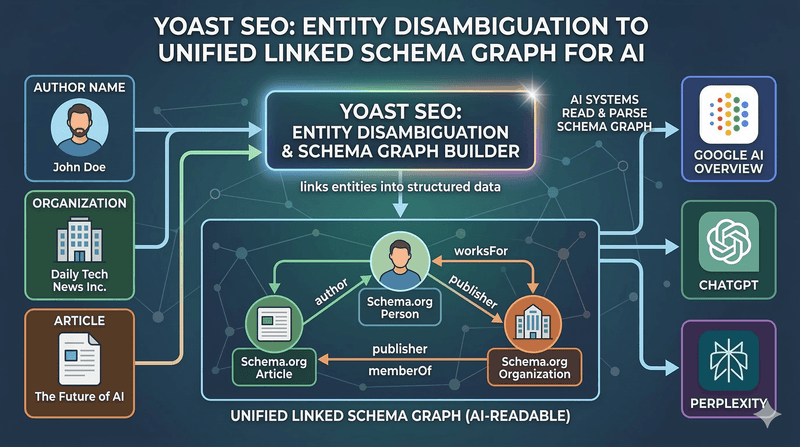
Yoast's new feature handles this at the site level. It links your author entities, organization details, product references, and article metadata into a consistent schema graph. One author profile. One organization. No contradictions.
You do not need to edit JSON-LD manually. The feature builds and maintains the schema graph through Yoast's existing settings.
Why this matters for AI search specifically
Schema has always helped with Google's rich results. But its role in AI search is growing fast.
AI Overviews, ChatGPT, and Perplexity all use structured data to verify information and select citations. When BrightEdge reports that only 17% of AI Overview citations come from the organic top 10, the question becomes: what makes the other 83% of cited sources get selected?
Part of the answer is structured data. AI systems prefer sources they can verify. Clean schema that clearly identifies who wrote the content, what organization published it, and what the content covers gives AI systems confidence.
This connects directly to E-E-A-T. Google's quality guidelines emphasize experience, expertise, authoritativeness, and trustworthiness. Schema is the machine-readable version of those signals.
Search Engine Journal reported that schema now helps Google and AI systems "verify business information and reduce conflicts across local packs, AI Overviews, and search results." That is not future-tense. That is happening now.
What Yoast's feature does in practice
The update works through three layers:
- It consolidates author schema so that every mention of an author on your site points to a single, consistent entity. No duplicate profiles. No conflicting information
- It links your organization schema to your content, making it clear which company or publication is behind each piece
- It disambiguates product and article entities so that AI systems can tell apart products with similar names or articles covering similar topics
For agencies managing multiple client sites, this reduces a common source of schema errors. Many sites have fragmented or contradictory structured data because different plugins, themes, or manual edits created conflicting entity references over time.
What to do this week
If you use Yoast SEO, check whether the entity disambiguation feature is active on your site. Review your author profiles and organization settings to make sure they are complete and accurate.
If you do not use Yoast, the principle still applies. Audit your schema for entity consistency. Make sure your structured data does not create two different versions of the same author, product, or organization.
AI systems are getting better at reading schema. The sites that make their entities clear and unambiguous will have an advantage in AI citation selection. The sites that leave their schema fragmented will keep losing visibility to competitors who get this right.
This is a quiet update. But in a search environment where AI systems increasingly choose who to cite, making your entities unmistakable is not optional. It is infrastructure.
………
*This post's content was created with the help of AI. Kindly cross-verify any data, statistics, or claims through primary sources, as there could be some discrepancies.