Key Takeaways:
- Search Engine Land published analysis on May 12 showing how outdated or negative Wikipedia content gains renewed visibility when AI systems cite it in generated answers
- Wikipedia is among the most cited sources in Google AI Overviews, ChatGPT, and Perplexity
- A controversy or lawsuit from years ago that sat dormant on a Wikipedia page can now appear every time someone asks an AI system about your brand
- Unlike traditional search where negative content could be pushed down with SEO, AI answers synthesize information directly and often include the negative context
- Brand reputation management now requires monitoring what AI systems say about you, not just what ranks on page one of Google
A brand controversy from 2019 should be old news by now. On Google, you could bury it with strong SEO, fresh content, and positive press. On page one, the negative story could be pushed to page two or three where almost nobody looks.
AI search does not work that way.
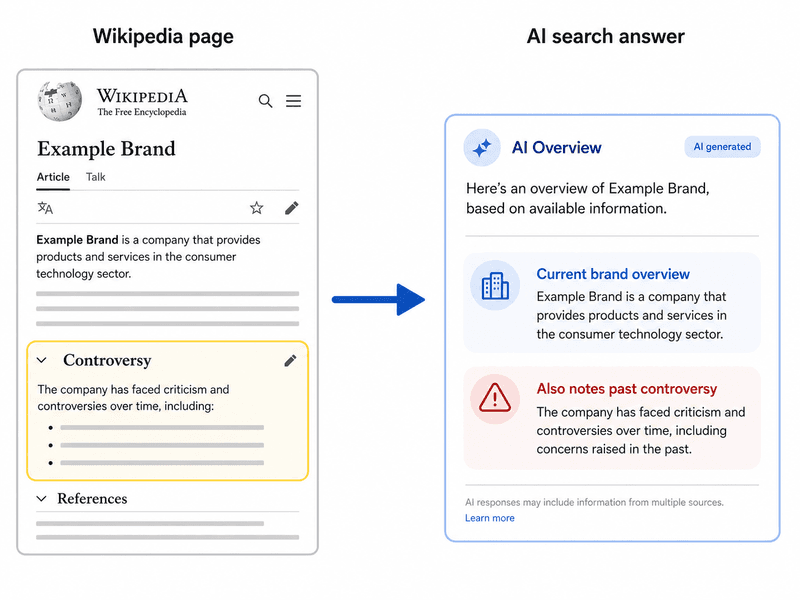
Anthony Will published an analysis on Search Engine Land on May 12 showing how AI systems are giving new life to negative and outdated Wikipedia content. When a user asks ChatGPT, Perplexity, or Google AI Overviews about a brand, these systems often pull from Wikipedia as a primary source. If that Wikipedia page contains a section about a past controversy, a lawsuit, or a product failure, the AI answer may include it.
There is no page two in an AI-generated answer. There is one synthesized response. And it may reference the worst thing that ever appeared on your Wikipedia page.

Wikipedia is one of the most cited sources in AI
Wikipedia's position in the AI ecosystem makes this problem significant. It is among the most frequently cited domains across all major AI platforms.
Google AI Overviews reference Wikipedia extensively for entity definitions, brand summaries, and factual claims. ChatGPT draws on Wikipedia content both through its training data and through real-time search retrieval. Perplexity cites Wikipedia pages directly in sourced answers.
When AI systems need a quick, authoritative summary of a company or product, Wikipedia is often the first place they look. That means the content on your Wikipedia page is no longer just a reference for curious readers. It is the foundation of how AI describes your brand to anyone who asks.
The problem is structural and not easy to fix
In traditional search, negative content could be managed through a combination of SEO, PR, and content production. Publish enough positive content, earn enough authoritative links, and the negative result moves to page two.
AI answers work differently. They do not rank pages. They synthesize information from multiple sources into a single response. If Wikipedia mentions a data breach, a regulatory fine, or a product recall, the AI may weave that fact into its summary alongside your products, leadership, and market position.
The user gets one answer. That answer includes the good and the bad. And unlike search results, users do not scroll past the AI response to look for alternative perspectives.
Wikipedia's own policies make editing difficult. Brands cannot remove accurate negative information from their pages. Wikipedia requires neutral point of view, verifiability, and sources for all claims. If a negative event was covered by reliable publications, it belongs on the page regardless of how the brand feels about it.
AI can amplify outdated information
The timing issue makes this worse. A Wikipedia section about a 2019 controversy might sit untouched for years. Few human readers visit the full Wikipedia page for a brand regularly. The content is technically accurate but functionally dormant.
When an AI system retrieves that content and includes it in a 2026 answer, it is suddenly active again. A user asking "what should I know about [brand]" may get a summary that references a seven-year-old incident as if it is still relevant.
AI systems do not always distinguish between historical context and current reality. They present facts. If the Wikipedia page says a company faced a $50 million fine in 2019, that fact may appear in the answer without the context that the issue was resolved, reforms were made, and no further violations occurred.
What brand teams need to do differently
Brand reputation monitoring now needs to include AI answers. Track what ChatGPT, Perplexity, and Google AI Overviews say when users ask about your company. Several tools, including Xofu and Semrush's AI visibility tracking, can help monitor this.
Review your Wikipedia page carefully. If sections contain outdated information that no longer reflects reality, work with the Wikipedia community to update them. Do not try to delete negative content. Do add sourced updates that show how the situation has evolved. Resolution, reforms, and context matter.
Build positive, citable content that AI systems can reference. Original research, data reports, and authoritative publications on your own domain give AI systems alternative material to draw from. If the only authoritative source about your brand is Wikipedia, AI answers will reflect Wikipedia's editorial choices, including the negative ones.
Earn fresh editorial coverage. Positive mentions in publications that AI systems trust (major news outlets, industry publications, established review sites) can balance what appears in AI-generated answers. AI systems synthesize from multiple sources. More positive, recent sources means a more balanced answer.
The shift is real. Brand reputation used to be about what appeared on page one of Google. Now it is about what AI tells someone when they ask about you. And AI has a long memory.
Disclaimer: This article is AI-assisted content and may contain errors. Wikipedia citation patterns in AI systems are based on industry research and may vary by platform and query. Wikipedia editing policies are governed by the Wikimedia Foundation.