Key Takeaways:
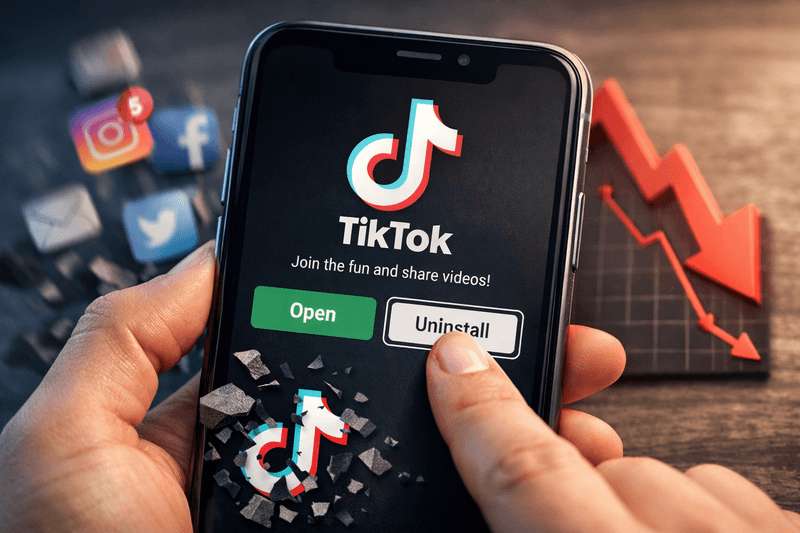
- TikTok uninstalls in the US jumped 150% in five days after the January 22 joint venture announcement
- The new privacy policy now allows precise GPS location tracking, a change from previous policy
- Daily active users remained flat despite the deletion surge, according to Sensor Tower
- Alternative app UpScrolled saw downloads increase more than tenfold in the same period
- Skylight Social downloads surged 919% and Rednote climbed 53% week-over-week

TikTok users are deleting the app at a rate not seen in months.
The daily average of US users removing TikTok jumped nearly 150% over five days compared with the previous three months, according to Sensor Tower data shared with CNBC on January 26.
The spike followed TikTok's announcement that its US operations would shift to a new joint venture under American leadership.
What triggered the TikTok deletion wave
On January 22, TikTok finalized the creation of TikTok USDS Joint Venture LLC, majority-owned by American and global investors including Oracle, Silver Lake, and UAE-based MGX, while ByteDance retained a 19.9% stake.
The same day, users were required to accept updated privacy policies or lose access to the app. Backlash quickly followed, focused on a major change to location data collection.
Unlike earlier policies that barred GPS tracking in the U.S., the 2026 policy allows precise location data, depending on user settings. TikTok says the feature will be opt-in, disabled by default, and used to support new services and features.
Caitriona Fitzgerald, deputy director of the Electronic Privacy Information Center (EPIC), told CBS News: "The change in location data is the most stark because the previous privacy policy had explicitly said that the current versions of the app do not collect precise GPS information."
TikTok says the feature will be opt-in and disabled by default. The company plans to use precise location data to provide new services and features.
What data TikTok says it may collect
The updated privacy policy lists several categories of sensitive personal information TikTok may collect, like:
- Racial or ethnic origin
- Sexual orientation
- Status as transgender or nonbinary
- Citizenship or immigration status
- Financial information
- Precise location data
CNBC noted that similar language appeared in archived versions of the policy from August 2024, meaning it wasn’t entirely new. However, its inclusion in a mandatory pop-up drew fresh scrutiny.
User frustration grew amid technical issues during the ownership transition. Creators reported outages, delayed analytics, and failed uploads, which TikTok attributed to a temporary weather-related power outage at an Oracle data center.
Some users also claimed their content was being suppressed, especially posts critical of the new ownership or political topics. TikTok has not confirmed any changes to its moderation policies.
Alternative apps see record downloads
As TikTok users deleted their accounts, competing platforms gained traction.
UpScrolled, a social app founded by Palestinian-Australian entrepreneur Issam Hijazi, saw US downloads increase more than tenfold week-over-week. By January 29, the app had crossed 1 million users and ranked second in the US App Store, behind only ChatGPT.
Sensor Tower data shows 85% of UpScrolled's US downloads occurred between January 21 and 27. Skylight Social downloads surged 919%, while Chinese-owned Rednote climbed 53% in the same period.
Why daily active users stayed flat
Despite the 150% increase in uninstalls, TikTok's daily active user levels in the US remained relatively stable. Sensor Tower data shows usage held steady compared with the previous week.
This pattern suggests the deletion surge reflects user hesitation rather than a broad decline in core engagement. Many users appear to be reacting to the policy changes while others continue using the app. For marketers, the situation requires monitoring rather than immediate action.
What this means for brands on TikTok
The ownership transition and policy backlash create short-term uncertainty for brands invested in TikTok.
However, sustained shifts in creator sentiment and content diversity will pose more serious risks than temporary uninstall headlines.
Marketers should watch for changes in reach, engagement patterns, and any new content moderation policies under the joint venture structure. The platform remains one of the largest short-form video destinations. But the trust gap between TikTok and its users just got wider.