Key Takeaways:
- TikTok launched its Local Feed for US users on February 11, 2026, surfacing nearby travel, food, events, and shopping content based on location
- The feed is opt-in, off by default, and available only to users 18+
- In the UK, 46% of TikTok users visited a local business after discovering it on the platform
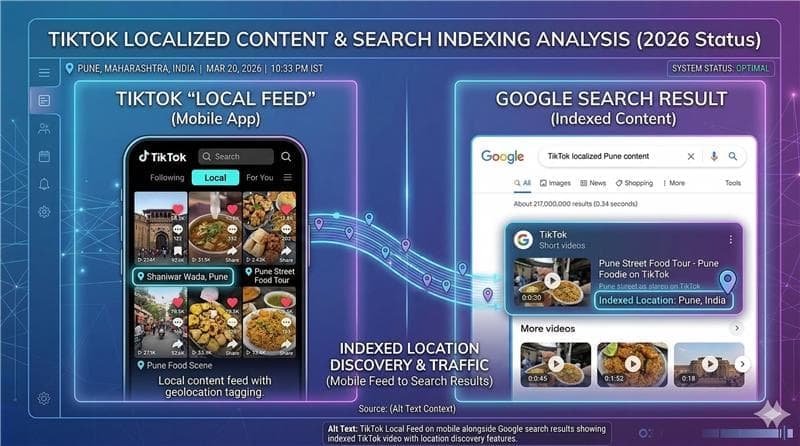
- TikTok video titles and captions now appear in Google Search results
- 7.5 million businesses use TikTok in the US, supporting over 28 million workers per a 2025 Oxford Economics report
- Emplifi's 2026 benchmarks show TikTok led all platforms in audience growth at 200% year-over-year

A bakery owner getting more walk-in customers from TikTok than Google Maps sounds like an exaggeration. The data says otherwise. TikTok just launched a Local Feed in the US. Google started indexing TikTok videos in search results. And in the UK, where the Local Feed has been live since December, 46% of users visited a local business after discovering it on the platform.
The ground already moved. The question is who noticed.
How the Local Feed works
The Local Feed shows up as a new tab on TikTok's home screen. Content surfaces based on three factors: the user's location, the topic of the post, and when it was published. Fresh, nearby content from public accounts gets priority.
TikTok launched this first in the UK, France, Italy, and Germany in December 2025. The US rollout on February 11 was the first major product release under TikTok's new American ownership. Oracle, Silver Lake, and MGX now hold roughly 80% of the US entity. ByteDance retains a 19.9% minority stake.
The feature is off by default. Users must opt in and grant precise location access. Location data is collected only while the app is in use. The feed is restricted to users 18 and older.
TechCrunch noted the timing was messy. TikTok had just updated its US privacy policy to mention enhanced location data use, which spooked some users into deleting accounts. The Local Feed launch was partly designed to explain why that location data matters: it powers local content recommendations, not surveillance.
46% of UK users visited a local business they found on TikTok
That number from TikTok's own data in the UK is what matters most for local businesses. Almost half of users in a mature market took offline action after discovering something on TikTok.
Additional data from the Small Business & Entrepreneurship Council paints a similar picture for the US: 84% of small business users say TikTok helped grow their business. 75% say it reached customers beyond their local area. 74% say it helped connect with their local community.
Those numbers explain the investment. TikTok is not building the Local Feed just for content discovery. It is building a case that TikTok drives foot traffic and is essential small business infrastructure.
Google is indexing TikTok videos in search results
TikTok video titles and captions now appear in standard Google Search results. This mirrors what happened when Google and Twitter struck a deal in 2015 for immediate tweet indexing. TikTok content shows up in Google's video results and through the "Perspectives" filter on mobile.
For brands and creators, this changes how TikTok content should be produced. A video is no longer competing only for the For You Page. It is competing for Google search real estate.
That shifts the playbook:
- Captions matter beyond TikTok now. Keyword-rich, specific, and structured copy will outperform vague or emoji-heavy descriptions in search
- Location tags serve double duty. They surface content in the Local Feed and improve discoverability in Google
- Older evergreen videos may be worth updating with better titles and descriptions now that they carry search value
- Geo-tagging should become a habit for any business operating from a physical location
Both Google and TikTok are pushing local visibility at the same time. Google's Discover core update from February rewards locally relevant content. TikTok's Local Feed surfaces nearby creators and businesses. The two platforms are converging on the same user behavior: people want to find things near them, fast.
TikTok crossed a line and most marketers have not caught up
Emplifi's 2026 Social Media Benchmarks Report found TikTok led all platforms in audience growth with a 200% year-over-year median follower increase. It delivered the highest engagement rates of any platform measured.
Combined with the Local Feed, the Google indexing, and ownership stability in the US, TikTok has become something bigger than a video app. It is a search engine, a commerce platform, a local discovery tool, and a short-form media channel operating at scale.
The brands building local content strategies on TikTok today will have a measurable head start by Q3. Start with the Local Feed. Geo-tag everything. Write captions for search. And check whether existing videos are showing up in Google. The results might be surprising.
Disclaimer: This article is AI-assisted content and may contain errors. TikTok features, policies, and availability vary by region and are subject to change. The statistics cited are sourced from TikTok, Oxford Economics, Emplifi, and industry publications as of March 2026. Always verify with official sources.