Key Takeaways:
- OpenAI CEO Sam Altman confirmed India has 100 million weekly active ChatGPT users, second only to the US
- Indian students represent the largest global cohort using ChatGPT for learning
- Blackstone acquired majority stake in Neysa with $600M raise to deploy 20,000+ GPUs in India
- Microsoft committed $17.5 billion for AI infrastructure over 2026-2029, its largest Asia investment
- Over 80% of new Global Capability Centers in India are now AI-led operations

OpenAI's CEO just confirmed what many suspected.
India is ChatGPT's second-largest market globally.
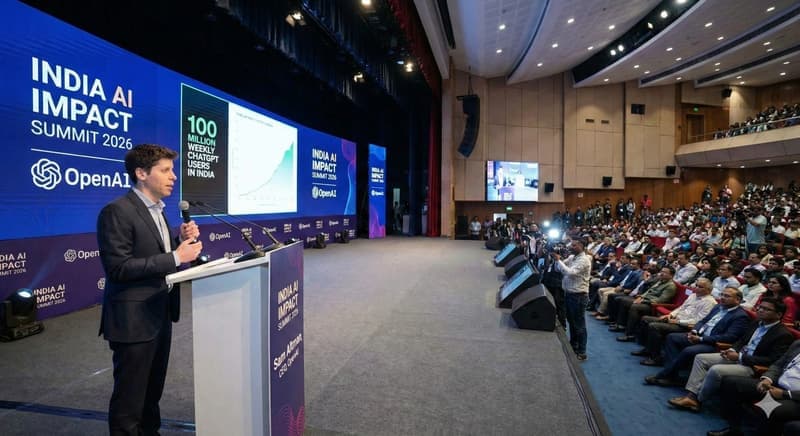
Sam Altman shared the data at the India AI Impact Summit 2026 in New Delhi. The country now has over 100 million weekly active ChatGPT users, trailing only the United States.
Indian students lead global ChatGPT adoption
Here's the more interesting detail from Altman's remarks.
Indian students represent the platform's largest user group worldwide. They're using ChatGPT for learning at a scale that no other country matches.
This user behavior signals something important. India isn't just consuming AI passively. The next generation of workers is building AI into their skill sets before entering the workforce.
OpenAI recently opened a New Delhi office and created a dedicated India sales team. The company is also offering lower-cost pricing tailored to India's market.
Why tech giants are betting billions on India's AI future
The summit attracted every major AI company because India offers three things they need:
Scale. Over one billion internet users. Hundreds of millions of smartphone users. A vast base of potential customers.
Talent. More than 70,000 engineers trained across 315 universities. Every major chip company designs products in India.
Market access. India's tech-forward consumer base provides data and adoption rates that accelerate AI development.
The investment numbers announced around the summit reflect this:
- Microsoft: $17.5 billion over 2026-2029 for AI infrastructure
- Google: $15 billion for an AI hub and data center in Visakhapatnam
- Tata Group: $11 billion for an AI innovation city in Maharashtra
- Blackstone: $600 million equity in Neysa (plus $600M planned debt raise)
Blackstone's $600 million bet on Indian AI infrastructure
The Neysa deal stands out among private investments.
Blackstone acquired a majority stake in the Indian AI cloud startup as part of a $600 million equity raise. Teachers' Venture Growth, TVS Capital, 360 ONE Asset, and Nexus Venture Partners joined the round.
Neysa plans to raise another $600 million in debt financing. Combined capital will fund deployment of over 20,000 GPUs across India.
The move targets a gap in the market. Many Indian companies want domestic AI infrastructure that offers scalable, secure compute without relying on overseas cloud providers.
Global Capability Centers shift to AI-first operations
India's role for multinational tech companies is changing fast.
According to ANSR, more than 60% of Global Capability Centers (GCCs) established in the last two years focus on AI, data, digital engineering, or product development.
Over 80% of GCCs expected to launch in the next six to eight months are projected to be AI-led.
The shift goes beyond engineering work. Companies are increasingly hiring Chief AI Officers and senior AI leadership from India. The country is moving from cost center to strategic hub.
What this means for marketing and content professionals
Altman's 100 million user number carries practical implications for digital marketers.
- AI tool adoption is mainstream, not emerging. Your audience in India is already using ChatGPT weekly. Content strategies that ignore AI-assisted consumption miss reality.
- Vernacular AI matters more than ever. With 100 million users but 22 official languages, there's massive demand for non-English AI experiences. BharatGen's Param2 launch at the same summit signals infrastructure is catching up.
- India's talent pool is AI-native. Students learning with ChatGPT today become your marketing team members tomorrow. Hiring strategies should account for AI literacy as a baseline skill.
- Data center investments mean faster, cheaper AI access. Microsoft, Google, and domestic players building local infrastructure will reduce latency and costs. AI-powered marketing tools should become more accessible.
The gap between AI leaders and laggards will widen faster in India than most markets.
Organizations not integrating AI into their workflows risk falling behind a workforce that grew up with these tools.