Key Takeaways:
- BuzzStream analyzed 4 million AI citations across ChatGPT, Google AI Mode, AI Overviews, and Gemini
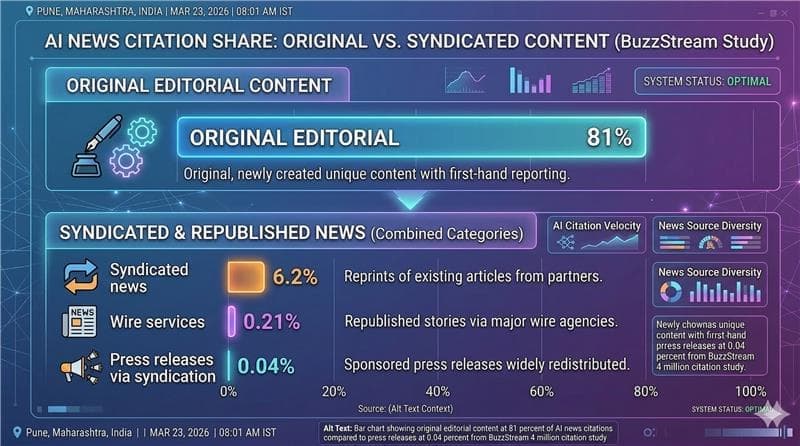
- Press releases distributed through syndication channels (Yahoo, MSN) accounted for 0.04% of all citations
- Direct citations from wire services like PRNewswire made up 0.21% of the total dataset
- Original editorial content made up 81% of all news citations
- Syndicated news content overall (articles republished through MSN and Yahoo) accounted for just 0.9% of the total

Press release distribution services have been selling AI visibility hard in 2026. ACCESS Newswire offers an "AI Visibility Checklist." eReleases published a guide on positioning press releases for AI search. Business Wire has written about optimizing for answer engine discovery.
BuzzStream's data tells a different story. A much simpler one.
The company partnered with Citation Labs and used the XOFU citation monitoring tool to track where ChatGPT, Google AI Mode, AI Overviews, and Gemini pull their sources. The dataset: 4 million citations. The findings published on March 16, 2026, are hard to argue with.
The numbers are stark
News publications as a category accounted for 14% of all citations in the dataset. Within that news category, the breakdown is where things get interesting.
Original editorial content, meaning independently produced journalism and analysis from outlets like Reuters, CNBC, The Wall Street Journal, and CNET, made up 81% of all news citations. That is the dominant source type by a wide margin.
Syndicated news content, including articles republished through MSN and Yahoo networks, accounted for 6.2% of news citations and 0.9% of the total dataset.
Press releases specifically, the ones distributed through syndication channels and showing up on Yahoo Finance or MSN, earned 0.32% of news citations. Of the entire 4 million citation dataset, that works out to 0.04%.
Direct citations from newswire services like PRNewswire did slightly better at 0.21% of the total. Their strongest showing was in exploratory and informational prompts, where they reached 0.37%. Still a tiny number.
Why syndicated content fails in AI citation
AI systems are built to find the most authoritative, original source for a given claim. A press release that gets republished across 50 syndication partners creates 50 copies of the same content. AI systems do not treat those copies as 50 separate endorsements. They treat them as one source with many mirrors.
Google's VP of Product for Search, Robby Stein, said in a recent interview that being mentioned by other sites could help with AI recommendations. He compared AI's behavior to how a human might research a question. That comparison favors earned editorial coverage, where an independent journalist writes about a company, over distributed content, where the company writes about itself and pays for placement.
The distinction matters. AI citation systems appear to value third-party editorial judgment over self-published promotion, even when the self-published content sits on high-authority domains like Yahoo Finance.
What this means for PR and content teams
The finding does not mean press releases are useless. They still serve a function in media relations, investor communications, and official record-keeping. But the idea that distributing a press release through a wire service will earn meaningful AI visibility is not supported by the data.
For PR teams and content marketers advising clients on AI visibility, the practical direction is clear:
Earned editorial coverage works. Getting a journalist at a respected publication to write about a company, product, or finding carries citation weight that syndicated press releases do not. The 81% figure for original editorial content is the number to anchor strategy around.
Owned newsrooms and company blogs matter more than wire distribution. If a company publishes original research, data, or expert analysis on its own domain, that content has a better chance of earning citations than a press release republished on aggregator sites.
Press releases can support AI visibility indirectly. A well-written release can prompt a journalist to write an original story. That original story is what AI systems will cite. The release itself is the catalyst, not the citation target.
BuzzStream sells outreach and digital PR tools, so the finding that earned media outperforms distribution aligns with its business model. That context is worth noting. But the 4 million citation dataset is large enough and the gap between editorial content (81%) and press releases (0.04%) is wide enough that the directional finding holds regardless of who published it.
For anyone still paying for premium wire distribution and expecting AI search visibility in return, this data suggests a different investment might produce better results.
Disclaimer: This article is AI-assisted content and may contain errors. The data referenced is from BuzzStream's report published in partnership with Citation Labs on March 16, 2026. AI citation behavior varies by platform and changes over time. Always verify with original sources.