Key Takeaways:
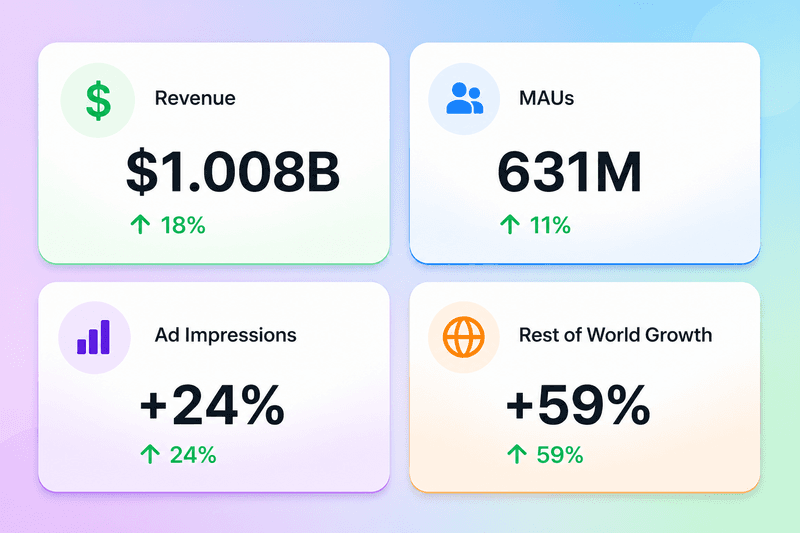
- Pinterest Q1 2026 revenue reached $1.008 billion, up 18% year over year, beating the high end of guidance
- Global monthly active users hit 631 million, up 11% YoY, marking the 10th consecutive record quarter
- Rest-of-world revenue grew 59%. Europe grew 27%. US and Canada grew 13%
- Ad impressions grew 24% while average ad pricing declined 5%, meaning more ads are being served at lower cost per impression
- 73% of Pinterest search users say visual results are more appealing than text-based search results

Pinterest is a billion-dollar-a-quarter business now. Most marketing teams still treat it as an afterthought.
The company reported Q1 2026 earnings on May 6. Revenue came in at $1.008 billion, up 18% year over year and above the high end of guidance. On a constant currency basis, growth was 15%.
Monthly active users reached 631 million globally. That number has been a record for ten consecutive quarters. Pinterest is growing in every region, but the fastest growth is coming from outside its home market.
The international growth is the real story
US and Canada remain the biggest revenue regions at $750 million. But the growth rate there is 13%, the slowest of the three regions.
Europe brought in $186 million, up 27% on a reported basis and 16% on constant currency. The rest of the world generated $72 million, up 59% reported and 50% constant currency.
That international trajectory matters because Pinterest's ad monetization outside the US is still early. Revenue per user in markets like India, Brazil, and Southeast Asia is a fraction of what it is in the US. As ad infrastructure matures in those regions, the revenue opportunity expands without needing more users.
AI visual search is the engine behind the numbers
Pinterest has been investing in AI-powered visual search for two years. The Q1 results suggest that investment is paying off.
The platform now uses computer vision to read images directly. It picks up colors, materials, textures, styles, and overall aesthetic. That visual understanding feeds into how content gets ranked and served, alongside traditional text metadata like pin descriptions and board titles.
Pinterest Assistant, rolling out through 2026, lets users search using a combination of voice and images. Users can say "show me shoes that go with these pants" while pointing at a saved pin. The system responds with product suggestions pulled from the platform's shoppable catalog.
Two other AI features are changing how users interact with the platform:"Styled for you" creates AI-curated collages from saved fashion pins. Users can tap items and see recommended alternatives"Boards made for you" curates entire boards automatically based on a user's save history and tastes
These features turn Pinterest from a passive inspiration board into an active shopping assistant. That matters for ad revenue because the closer a user gets to a purchase decision, the more valuable the ad placement beside them becomes.
Pinterest is a search engine and the data proves it
73% of Pinterest search users say visual results are more appealing than text-based results. 69% of Gen Z users say visual results are more helpful than text or reviews when deciding what to buy. Both stats come from Pinterest's own research.
The behavioral pattern is different from Google or ChatGPT. Users do not type keywords and get text answers. They browse images, discover aesthetics, refine their taste, and move toward purchase decisions through a visual process.
That process is harder for text-based AI search to replicate. When someone asks ChatGPT what color to paint their living room, they get a text answer with options listed in words. When they search the same thing on Pinterest, they see hundreds of actual rooms across styles, finishes, and lighting conditions.
For marketers, this distinction matters. Pinterest reaches users at the inspiration and consideration stage of the buying journey, a stage where text-based search is weakest and visual discovery is strongest.
What marketers should do
Pinterest's product feed integration is one of its most underused features. Link a product catalog and every item becomes a shoppable pin automatically, no design work required. These pins appear in searches and home feeds organically, with no ad spend needed.
For brands in fashion, beauty, home, food, and travel, the visual search capabilities make Pinterest a discovery channel that performs differently from Google or Meta. Users searching on Pinterest have commercial intent. They are looking for things to buy, make, or try.
Ad impressions grew 24% in Q1 while average ad pricing fell 5%. That combination means more ads are being served at lower cost per impression. For advertisers, this is an opportunity window. The platform is growing ad inventory faster than advertiser demand is filling it.
Pinterest is not trying to be TikTok or compete with Google's text-based search. It occupies a space between inspiration and purchase that no other platform owns at this scale. For marketers who have been ignoring it, the Q1 numbers make the case that the opportunity is real and growing.
Disclaimer: This article is AI-assisted content and may contain errors. Financial data is from Pinterest's Q1 2026 earnings report, covered by PYMNTS (May 6, 2026) and TechCrunch. Revenue figures and user counts are subject to change. This is not financial advice.