Key Takeaways:
- Meta launched an official Google Tag Manager template for Meta Pixel setup in early April 2026
- The template simplifies Pixel installation, event configuration, and cross-platform tracking
- Previously, setting up Meta Pixel through GTM required manual tag creation and custom code
- The update makes attribution more consistent for advertisers running campaigns across Meta and Google
- Agencies managing multiple client accounts will see the biggest time savings from the standardized setup

If you have ever spent an hour debugging a Meta Pixel installation inside Google Tag Manager, this update is for you.
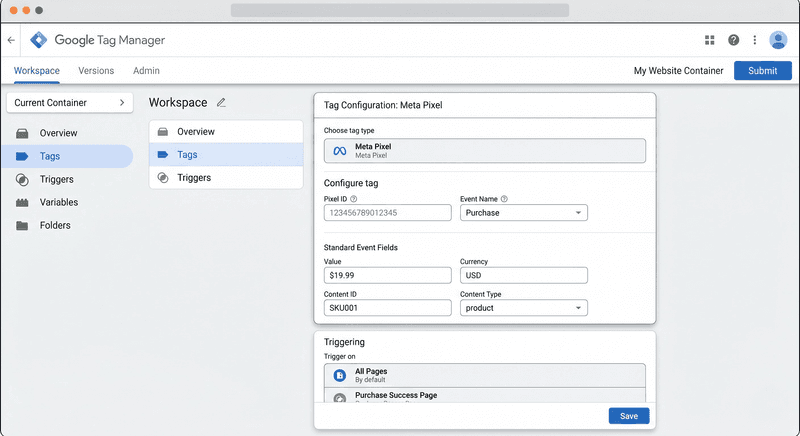
Meta released an official GTM template for Meta Pixel, reported on April 8. The template standardizes how Pixel fires events, tracks conversions, and passes data between Meta's ad platform and Google's tag management system.
This sounds like a small thing. It is not. Pixel setup through GTM has been a consistent source of errors for advertisers and agencies for years.
What the template actually changes
Before this update, setting up Meta Pixel in Google Tag Manager meant creating custom HTML tags, manually configuring event parameters, and troubleshooting firing rules that often broke during site updates.
The official template handles the heavy lifting. It provides a structured interface inside GTM for configuring Pixel events like PageView, Purchase, AddToCart, and Lead without writing custom code. Event parameters map to standard fields rather than requiring manual variable setup.
For agencies running Meta ads for multiple clients, this eliminates one of the most common implementation headaches. Every GTM container used to require a slightly different custom setup. Now there is a standard path.
Why this matters for attribution and ad performance
Meta also recently updated its attribution model. Click-through attribution for website conversions now only counts real link clicks. Other interactions like saves, shares, and comments are tracked separately under a new "engage-through attribution" category.
Those two changes together, cleaner Pixel implementation through GTM and sharper attribution definitions, mean advertisers should see more accurate conversion data going forward.
Accurate data matters because Meta's Advantage+ campaigns and AI-driven ad optimization depend on the signals Pixel sends back. A poorly implemented Pixel that fires inconsistently or double-counts events gives the algorithm bad data. Bad data leads to worse targeting and wasted spend.
This is part of a bigger Meta advertising push
The GTM template arrives alongside several other Meta ad updates from late March and early April:
- Meta changed in-stream ad labels from "Sponsored" to "Ad"
- Meta expects verified advertisers to drive 90% of ad revenue by end of 2026, up from 70% currently
- Meta launched the Creator Fast Track program paying up to $3,000/month to attract creators to Facebook
- Meta added Manus AI integrations for Ads Manager, Instagram, and WhatsApp Business
Together, these moves point to Meta maturing its advertising infrastructure. Simpler Pixel setup, cleaner attribution, AI-powered campaign tools, and stronger advertiser verification.
What to do with this
If you manage Meta ads through Google Tag Manager, update your implementation. The official template is available in the GTM template gallery.
For new setups, use the template from the start. For existing implementations, test the template in a staging container first. Compare event firing behavior against your current custom tags before switching over.
If you run both Meta and Google campaigns, the standardized GTM approach makes cross-platform reporting cleaner. One tag management system handling both platforms with official templates reduces the chance of tracking discrepancies.
This is not a flashy update. It is a practical one that saves time and reduces errors for every marketer running Meta ads.
Disclaimer:This article is AI-assisted content and may contain errors. The Meta GTM template release was reported by Optimixed and Social Media Today in early April 2026. Verify implementation details with Meta's official developer documentation.