Key Takeaways:
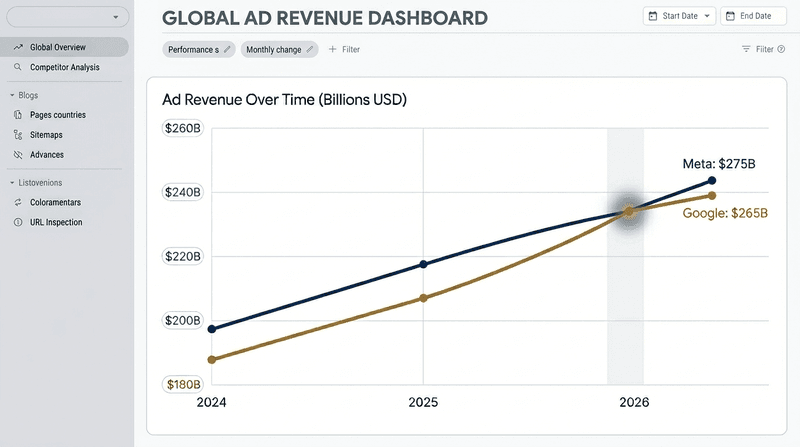
- Emarketer forecasts Meta will generate $243.46 billion in global ad revenue in 2026, surpassing Google's projected $239.54 billion
- This would be the first time Meta overtakes Google in both global and US ad revenue
- Meta's ad revenue growth rate (24.1%) is more than double Google's (11.9%)
- Meta's global market share reaches 26.8% versus Google's 26.4%. Google's share has been falling since 2021
- Together with Amazon, the three platforms control over 60% of all global digital ad spending

For roughly two decades, Google was the largest digital advertising company in the world. That era may end this year.
Emarketer released an updated forecast in mid-April projecting that Meta will generate $243.46 billion in worldwide net ad revenue in 2026. Google is projected at $239.54 billion. The gap is roughly $4 billion in Meta's favor.
If the forecast holds, this would mark the first time Meta surpasses Google in both global and US ad revenue. Adweek, Axios, and MediaPost all covered the shift.
Meta is growing twice as fast
The raw revenue gap matters less than the growth rate difference. Meta's ad revenue is expected to grow 24.1% in 2026, up from 22.1% in 2025. Google's growth holds steady at 11.9%.
When one platform is accelerating, and the other is cruising at a stable pace, the crossover becomes inevitable. And according to Emarketer, it happened this year.
In terms of global market share, Meta reaches 26.8% versus Google's 26.4%. Google's share has been declining since 2021. Meta has been climbing. This is the first year the lines cross.
Last year, the standings were different. Google brought in $214.06 billion in 2025 ad revenue. Meta had $196.17 billion. A $4 billion lead for Meta in 2026 means closing an $18 billion gap in a single year.
What is driving Meta's acceleration
Three forces are behind the shift.
Reels has become Meta's fastest-growing ad surface. Short-form video monetization across Instagram and Facebook is converting user engagement into ad revenue at a rate that did not exist two years ago.
Advantage+ is Meta's automated campaign tool. It uses AI to handle targeting, creative optimization, and budget allocation with minimal advertiser input. The tool reduces the manual work of running campaigns while improving performance metrics. Advertisers are spending more because the returns are measurable.
First-party data is Meta's structural advantage. With billions of users across Facebook, Instagram, WhatsApp, and Threads, Meta collects behavior signals that power highly personalized ad targeting.
Privacy changes like Apple's ATT framework initially hurt Meta, but the company rebuilt its measurement and targeting stack around first-party data and server-side tracking.
Google is not losing. Meta is just growing faster
Google Search revenue still grew 19% in Q1 2026 to $60.4 billion. YouTube Ads brought in $9.9 billion (up 11%). Google Cloud crossed $20 billion. These are not numbers that suggest a company in trouble.
But Google's ad growth rate is about half of Meta's. Google's strength in search advertising is enormous but mature. The fastest growth in digital advertising is happening in social, video, and commerce media, where Meta holds structural advantages.
Emarketer's data shows social media ad revenue hitting $117.7 billion in 2025, with 32.6% YoY growth. Search ad revenue reached $114.2 billion but grew at just 11%. Social passed search in absolute dollars and is growing nearly three times faster.
What this means for marketing budgets
For marketers still allocating the majority of paid budgets to search, this data is a signal to revisit the split.
Search is not going away. Google's revenue growth confirms that. But the fastest returns on incremental ad spend are increasingly found on social platforms, particularly through Reels, Advantage+, and creator-integrated campaigns.
For agencies managing multi-platform campaigns, the Meta-Google balance is shifting. Brands that have not tested Advantage+ or invested in Reels-native creative are underweighting the fastest-growing channel in digital advertising.
Amazon remains the third major player. Together, Meta, Google, and Amazon control over 60% of global digital ad spending. The concentration continues to increase, making it harder for smaller ad platforms to compete for budget.
The Emarketer forecast is a projection, not a certainty. But the underlying trends in growth rates, market share, and platform capabilities all point in the same direction. Meta has caught up and may have already passed Google by the time full-year 2026 numbers are reported.
Disclaimer: This article is AI-assisted content and may contain errors. Revenue projections are from Emarketer's April 2026 forecast, covered by Adweek, Axios, MediaPost, and Tech Economy. Forecasts are estimates and actual results may differ. This is not financial advice.