Key Takeaways:
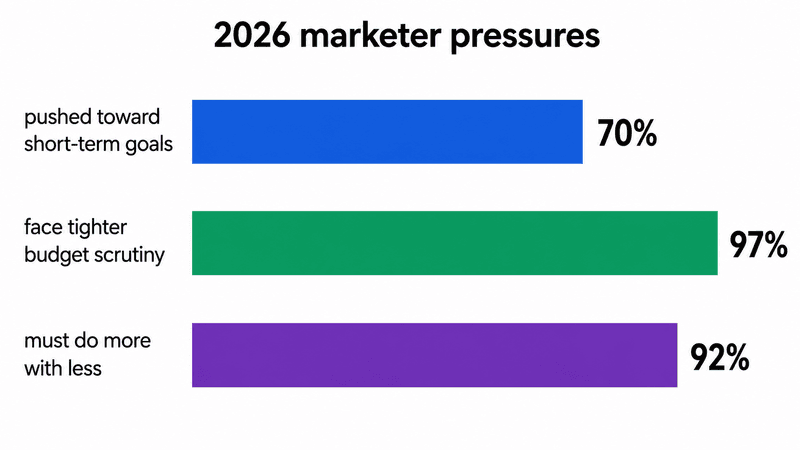
- 70% of marketers face pressure to prioritize short-term performance goals over long-term brand building
- 97% face tighter budget scrutiny in 2026. 92% must deliver more with fewer resources
- Only 21% of B2B companies describe themselves as brand-led. 43% are entirely demand-driven
- Kantar data shows the strongest brands have outgrown the S&P 500 over 20 years. Companies that cut brand investment for short-term gains lose long-term pricing power and demand generation
- 48% of executives call AI adoption "a massive disappointment," suggesting the tools meant to solve the efficiency problem are not delivering as promised
There is a number that explains why so many marketing teams feel stuck. It is 70%.
That is the percentage of marketers being pushed toward short-term performance goals at the expense of brand building. Not by choice. By internal pressure from leadership, budget committees, and quarterly targets that demand measurable returns now.
The data comes from multiple sources tracked through 2025 and into 2026, including Kantar's Marketing Trends reports, the LinkedIn B2B Institute research program, and industry surveys from Emarketer and the Branding Journal. The pattern is consistent across all of them. And it is getting worse.
The pressure numbers are the highest on record
Three data points frame the scale of the problem.
70% of marketers report being pushed toward immediate, short-term goals. This means campaign-level performance metrics (clicks, conversions, ROAS) take priority over brand awareness, recall, and long-term demand generation.
97% face tighter budget scrutiny. Nearly every marketing team in 2026 must justify spend more rigorously than a year ago. CFOs and boards are asking for attribution on every dollar. Investments that cannot be tied to near-term revenue get cut first.
92% must do more with fewer resources. Headcounts are flat or shrinking. Budgets are stable at best. But expectations for output, channels, and performance keep rising.
These three pressures compound. When you must show short-term results, justify every dollar, and produce more with less, the rational response is to shift budget toward performance marketing and away from brand.
That is exactly what is happening.
Brand investment is declining and the consequences are predictable
A Branding Journal survey of B2B marketing leaders found that only 21% of companies describe themselves as brand-led. 43% are entirely demand-driven and 34% try to balance both.
Kantar's long-term data makes the cost of this imbalance clear. The strongest and most powerful brands have consistently outgrown the S&P 500 over the past 20 years. Brand equity compounds. It creates pricing power, reduces customer acquisition costs, and generates organic demand that performance marketing cannot replicate.
Companies that cut brand investment see results in the short term because the existing brand equity continues generating returns for 6-12 months. But after that buffer period, demand weakens, acquisition costs rise, and competitors with stronger brands capture market share.
Kantar describes this as the "seed corn" problem. A farmer who cuts the seed budget to invest in more efficient harvesting sees great yields in year one. By year three, there is nothing left to harvest.
AI was supposed to solve the efficiency problem
When marketing teams adopted AI tools in 2025 and 2026, the promise was clear: do more with less. Generate content faster. Optimize campaigns automatically. Reduce manual work.
The results have not matched the promise for most organizations.
A Writer/Workplace Intelligence report from May 2026 found that 48% of executives describe AI adoption as "a massive disappointment." Only 29% report significant ROI from generative AI. Only 23% see meaningful returns from AI agents.
At the same time, 77% of executives say employees who refuse to become AI-proficient will not get promotions. 60% plan layoffs for employees who cannot use AI. The pressure to adopt is enormous. The results from adoption are underwhelming.
For marketing teams specifically, this creates a double bind. Leadership demands AI adoption for efficiency. AI delivers speed but not strategy. Content volume increases but content quality and differentiation often decline. The team produces more but influences less.
A separate survey found that 26% of marketing professionals report cognitive fatigue or "brain fry" from AI overuse, the highest rate of any profession surveyed. The tools meant to reduce workload are, in some cases, adding a different kind of burden.
The content marketing version of this problem is publishing 30 blogs and getting 1,500 clicks
This pressure pattern shows up in content strategy everywhere. Teams publish high volumes of content because volume is measurable and fast. But they invest nothing in distribution, original research, audience building, or differentiation because those investments take time to show returns.
The result: a blog that publishes daily but reaches almost nobody. A social presence that posts consistently but builds no community. An SEO strategy that targets keywords but earns no citations.
The fix is not more content. It is better content with better distribution.
One original research piece with proprietary data earns more citations, backlinks, and AI visibility than 30 commodity blog posts. One deep analysis shared across email, social, and community channels generates more traffic than 30 posts published to a blog nobody follows.
The math favors quality and distribution over volume. But the pressure favors volume because it is faster, cheaper, and easier to report on.
What marketing leaders can do with this data
The first step is naming the problem. If your team is stuck in a short-term cycle, it is not a strategy failure. It is a pressure problem. The data confirms that nearly every marketing team faces the same forces.
The second step is building a case for balanced investment. Kantar's 20-year data showing brand outperformance is the strongest evidence available. Brand investment is not a luxury. It is an economic asset that compounds over time.
The third step is choosing fewer, higher-impact activities. Instead of publishing 30 mediocre blog posts, publish 10 strong ones with original data and invest the saved time in distribution. Instead of running campaigns on every platform, go deep on the two platforms where your audience actually spends time.
The fourth step is measuring what matters. Performance metrics capture short-term activity. Brand metrics (aided recall, share of voice, repeat purchase rates, direct traffic growth) capture long-term health. Both belong in the reporting dashboard.
The pressure will not disappear. But teams that understand the data behind it are better positioned to push back with evidence rather than instinct.
Frequently asked questions about marketing budget pressure
Why are marketing budgets under more pressure in 2026?
97% of marketers face tighter budget scrutiny due to economic uncertainty, rising expectations for measurable ROI, and pressure from CFOs to justify every dollar of marketing spend.
Is brand marketing or performance marketing more effective?
Kantar's 20-year data shows that strong brands consistently outperform the S&P 500. Brand building creates long-term pricing power and demand generation. Performance marketing captures existing demand but does not create new demand on its own.
Is AI helping marketing teams be more productive?
Results are mixed. 48% of executives call AI adoption "a massive disappointment." AI increases content production speed but does not replace strategic thinking, original research, or creative differentiation.
How should marketing teams balance short-term and long-term goals?
Industry research suggests a 60/40 split between brand building and performance marketing (popularized by Les Binet and Peter Field). The exact ratio varies by industry and business maturity.
Disclaimer: This article is AI-assisted content and may contain errors. Pressure statistics are from Kantar Marketing Trends reports, LinkedIn B2B Institute research, Branding Journal B2B survey, Emarketer, and Mean CEO/Social Media Marketing analysis (May 2026). AI adoption data from Writer/Workplace Intelligence (May 2026). The 60/40 brand-performance split is from Binet and Field's research. Individual organizational circumstances vary.