LinkedIn Replaced Its Feed Algorithm With LLMs and the Old Growth Playbook Is Dead
Key Takeaways:
LinkedIn replaced its feed ranking system with LLM-powered retrieval and a transformer-based Generative Recommender model
The engineering team published the full technical breakdown on March 12. Search Engine Land covered it on March 17, 2026
Richard van der Blom's Algorithm InSights report shows views down 50%, engagement down 25%, follower growth down 59%
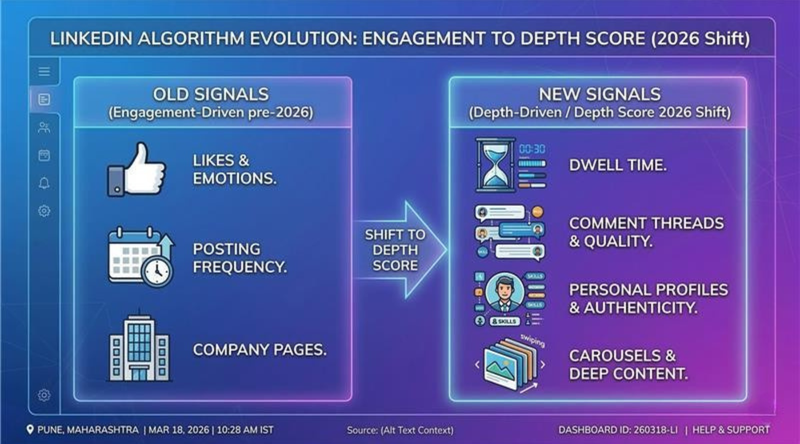
The algorithm now calculates a "Depth Score" based on dwell time, comment quality, saves, and private shares
Company page organic reach has dropped roughly 60% since 2024. Personal profiles dominate 65% of content consumption
If LinkedIn posts have been getting fewer views, less interaction, and slower follower growth over the past few months, the platform just confirmed why.
LinkedIn rebuilt its feed algorithm from scratch. The engineering team published a detailed breakdown on March 12, 2026. Search Engine Land reported on the changes today, March 17. This is not a minor adjustment. The entire ranking infrastructure changed.
What replaced the old system
The previous algorithm was a patchwork of signals. Chronological ranking, trending content detection, collaborative filtering. It rewarded posting frequency, early likes, and engagement pods.
The replacement runs on two AI components. First, a retrieval layer powered by fine-tuned large language models that generates semantic embeddings. It reads content for meaning, not keywords, and matches it against each user's professional interests, job title, skills, and career trajectory.
Second, a Generative Recommender model that treats each user's feed history as a sequence. It analyzes patterns across past interactions, including likes, comments, and dwell time, to predict what that person will find useful next.
LinkedIn's infrastructure processes millions of posts in real time. Content embeddings update within minutes. Retrieval takes under 50 milliseconds. The system reacts to engagement signals almost instantly, not in overnight batches.
Depth Score replaced vanity metrics
The biggest practical change is how LinkedIn measures value. The platform introduced what creators and analysts call the "Depth Score." It tracks how long someone spends with content, not whether they tapped a heart.
What feeds into Depth Score:
Dwell time: actual seconds spent reading or watching
"See more" expansion rate: whether people click to read the full post
Comment depth: multi-reply threads matter far more than standalone reactions
Saves: a strong signal of lasting reference value
Profile visits after reading: shows the content built enough interest to learn about the author
What gets penalized:
Generic comments like "Great post!" carry almost no algorithmic weight
Engagement pods and automation tools are being actively detected and suppressed
External links in post captions reduce distribution by roughly 60%
AI-generated content with predictable, templated language gets downranked
LinkedIn explicitly announced it is reducing "repetitive, click-driven posts" and filtering engagement bait. The platform also confirmed it is cracking down on comment automation tools and browser extensions.
Company pages are losing ground fast
The data on brand pages is blunt. Company page organic reach dropped approximately 60% between 2024 and 2026. Personal profiles now represent about 65% of content consumption. Company pages sit at roughly 5% of user feeds.
The algorithm favors individual expertise over brand broadcasts. A post from a head of marketing sharing a genuine professional insight will outperform the same content published from the company page.
This makes employee advocacy programs more strategically valuable than at any point in LinkedIn's history. The reach is shifting to personal profiles. Brands that build content strategies around their people, not their logo, will see better distribution.
What actually works in March 2026
PDF document carousels generate 2-3x more dwell time than text-only posts. Every slide swiped counts as an interaction on the Depth Score clock. Native video uploaded directly to LinkedIn outperforms external links significantly. YouTube links in captions get treated as exit routes and penalized.
For writing, LinkedIn's systems now flag "low perplexity" content. Posts that read like they were generated by ChatGPT, with predictable structures and generic phrasing, see reduced distribution. Specific examples, first-hand professional experience, and contrarian opinions perform better.
The practical approach: post 2-3 times per week instead of daily. Prioritize depth over frequency. Use carousels for frameworks and how-to content. Respond to comments quickly and substantively. Skip the motivational fluff.
The platforms that reward depth over volume tend to produce better content ecosystems. Whether LinkedIn's bet pays off for users will become clearer over the next quarter. For now, the rules changed and the data shows it.
Disclaimer:This article is AI-assisted content and may contain errors. LinkedIn's algorithm continues to evolve and performance patterns may shift as updates roll out. The statistics cited are from published research and platform announcements as of mid-March 2026. Always test strategies against your own data.