Key Takeaways:
- India has 100 million weekly active ChatGPT users, second only to the US
- Microsoft committed $50 billion for AI in the Global South, Google announced $15 billion for data centers
- Anthropic partnered with Infosys to deploy Claude AI across Indian enterprises
- JioHotstar will integrate ChatGPT for conversational content discovery
- Government-backed BharatGen launched Param 2, supporting 22 Indian languages

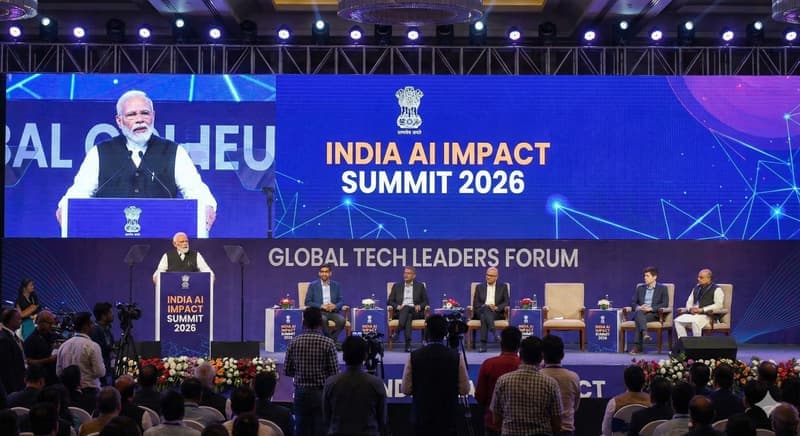
The India AI Impact Summit wrapped up this week in New Delhi, bringing together tech CEOs, world leaders, and over 250,000 visitors. For marketers, the five-day event signaled a clear shift: AI infrastructure is coming to India at scale.
India's AI user base is massive
OpenAI CEO Sam Altman dropped a striking number during his keynote. India now has 100 million weekly active ChatGPT users, making it the company's second-largest market after the United States.
Indian students represent the largest student user base for ChatGPT globally.
Anthropic confirmed similar traction. India is Claude's second-largest market as well. The competition for Indian users between AI labs is intensifying.
"India has all the ingredients to lead in AI," Altman wrote in the Times of India ahead of the summit.
Billions in infrastructure investments
The summit attracted over $200 billion in combined AI investment commitments. The largest announcements came from US tech giants and Indian conglomerates.
Major investments announced:
- Adani Group: $100 billion for renewable energy data centers by 2035
- Microsoft: $50 billion for AI infrastructure across the Global South
- Google: $15 billion for AI data center hub in Visakhapatnam
- Yotta Data Services: $2 billion for Nvidia Blackwell GPU clusters
- TCS: AI data centers starting at 100 MW, scaling to 1 GW
OpenAI will be the first anchor tenant at Tata Consultancy Services' new HyperVault data center. The partnership includes deploying ChatGPT Enterprise across Tata Group subsidiaries.
What this means for Indian marketers
Several announcements have direct implications for marketing teams.
JioHotstar integrates ChatGPT: The streaming platform will use ChatGPT for conversational content discovery. Users can search for shows and movies using natural language, similar to asking a friend for recommendations.
Anthropic partners with Infosys: The collaboration will deploy Claude models across Indian enterprises, starting with telecommunications. For large marketing organizations, this could mean faster AI adoption through trusted IT partners.
Sovereign AI models arrive: Government-backed BharatGen launched Param 2, a 17-billion-parameter model supporting 22 Indian languages. Gnani.ai unveiled Vachana, a text-to-speech system that clones voices across 12 regional languages using just 10 seconds of audio.
"Union Minister Ashwini Vaishnaw outlined India's 'whole-of-nation' AI strategy, describing plans to build a frugal, sovereign and scalable AI ecosystem," according to summit reports.
The marketing implications are real
With 100 million ChatGPT users, AI tools are no longer experimental for Indian consumers. They're mainstream.
For marketers, this creates both opportunities and pressures:
- Content discovery is changing: If JioHotstar's ChatGPT integration works, expect other platforms to follow. Search behavior may shift toward conversational queries.
- Regional language AI is improving: Param 2 and similar models make it easier to create content in Hindi, Tamil, Telugu, and other languages without translation.
- Enterprise AI is accelerating: Infosys and TCS partnerships mean AI tools will spread faster through corporate India.
The summit also drew heads of state from France, Brazil, and the UAE, along with tech leaders like Sundar Pichai, Dario Amodei, and Demis Hassabis.
India's AI moment is no longer theoretical. The infrastructure is being built now.