Key Takeaways:
- Google Search revenue grew 19% YoY to $60.4 billion in Q1 2026. Retail and financial services were the strongest verticals
- Alphabet's total revenue hit $109.9 billion (up 22%), net income surged 81% to $62.58 billion, and Google Cloud crossed $20 billion (up 63%)
- Pichai said on the earnings call that AI Overviews and AI Mode are driving search queries to all-time highs
- Google cut core AI response costs by more than 30% since Gemini 3 launched
- Capital expenditure guidance raised to $180-190 billion for 2026, almost entirely for AI infrastructure

For two years, the tech industry debated whether ChatGPT would kill Google Search. On April 29, Alphabet answered with numbers.
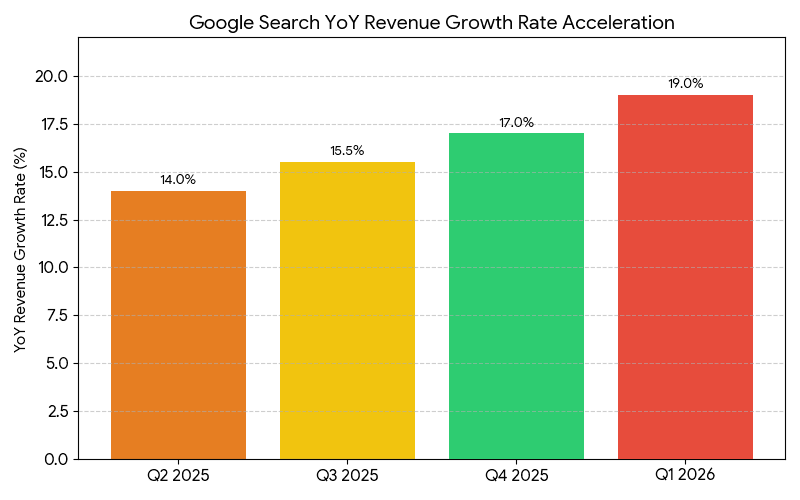
Google Search revenue grew 19% to $60.4 billion in Q1 2026. That is acceleration, not decline. Q4 2025 grew 17%. Q1 2026 grew 19%. The trend is moving in the wrong direction for anyone betting against Google.
On the earnings call, Sundar Pichai was direct: "People love our AI experiences like AI Mode and AI Overviews, and they're coming back to Search more."
The full earnings picture is hard to argue with
Alphabet reported $109.9 billion in total revenue, up 22% year over year. This was the company's 11th consecutive quarter of double-digit growth.
The breakdown across divisions:
- Google Search and Other: $60.4 billion (up 19%)
- Google Cloud: $20.03 billion (up 63%)
- YouTube Ads: $9.9 billion (up 11%)
- Google Network: $6.97 billion (down 4%)
- Google Services total: $89.6 billion (up 16%)
Net income hit $62.58 billion, up 81% from the same quarter last year. Earnings per share came in at $5.11. Alphabet beat analyst expectations on revenue by over $3 billion.
Google Cloud was the standout growth story. Revenue jumped 63% to $20 billion, crossing that threshold for the first time. Cloud backlog nearly doubled to $462 billion. Gemini processes more than 16 billion tokens per minute through direct API use by customers.
AI is not replacing Search. It is expanding it
The most important claim from the earnings call was Pichai's assertion that AI experiences are additive, not cannibalistic, to Search revenue.
He described the current moment as "an expansionary moment for search."
AI Mode and AI Overviews are generating longer queries, more follow-up questions, and more sessions per user. Queries hit all-time highs in Q1.
Google also shared that AI Overviews are monetizing at a rate similar to traditional Search. That is a significant data point. Earlier concerns that AI-generated answers would reduce ad impressions or click-through rates have not materialized in the revenue data.
The company cut core AI response costs by more than 30% since launching Gemini 3. Lower costs mean higher margins on AI-powered search features, making it economically sustainable to serve AI Overviews at scale.
The spending commitment is massive
Alphabet raised its capital expenditure guidance for 2026 to $180-190 billion, up from the $75 billion figure discussed earlier this year. Q1 capex alone was $35.7 billion. Almost all of it goes toward AI infrastructure: data centers, custom TPU chips, and model training compute.
That level of spending signals confidence. Google is not hedging its AI bets. It is increasing them based on revenue data that shows the strategy is working.
A 5% dividend increase was also announced. The quarterly dividend rises to $0.22 per share.
What this means for marketers
For anyone managing SEO, content, or paid search strategy, the earnings tell a clear story. Google Search is not shrinking. It is growing and growing faster because of AI.
That does not mean the traffic dynamics are unchanged. AI Overviews reduce clicks for certain query types. AI Mode keeps users inside Google's interface longer. But overall search volume and revenue are increasing, which means the total addressable market for search-driven marketing is expanding even as individual query economics shift.
Paid search remains stable and predictable. Google Ads revenue grew alongside Search. AI Max for Google Ads added new features, including AI Brief, text disclaimers, and expansion into shopping and travel campaigns.
For the organic strategy, the emphasis on being cited inside AI Overviews becomes more urgent. Google's revenue growth depends on AI features performing well. That means AI Overviews and AI Mode will get more prominent, not less. Content that earns citations will capture more visibility. Content that does not will lose ground.
Google I/O is scheduled for May 19. Pichai hinted that consumer-facing AI announcements are coming. For marketers focused on Search, that event will likely set the agenda for the rest of 2026.
Disclaimer: This article is AI-assisted content and may contain errors. Revenue figures and forward guidance are subject to change. This is not financial advice.