Key Takeaways:
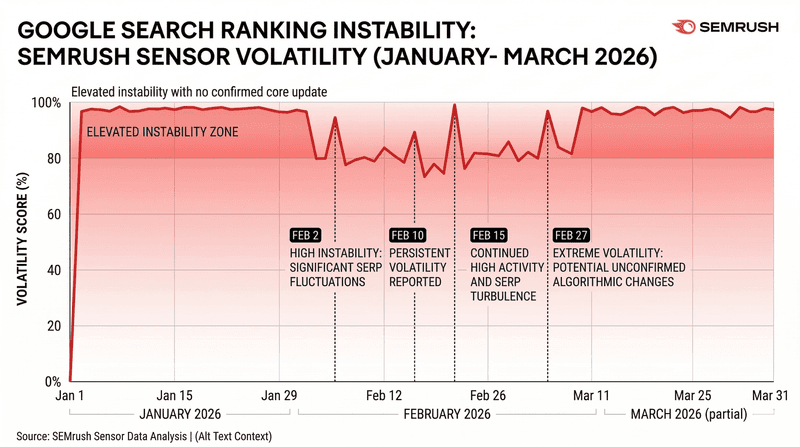
- SEO tracking tools like SEMrush Sensor are showing near-maximum volatility scores as of early March 2026
- Webmasters report traffic drops of 30-80% across multiple categories with no confirmed update
- Google completed its first-ever Discover core update on February 27 but says that only affected Discover, not Search
- Documented ranking spikes occurred on February 2, 10, 15, and throughout the last week of February
- The SEO community is debating whether Google has moved to continuous smaller updates instead of big announced rollouts
Something is happening in Google Search. Google is not saying what.
SEO tracking tools have been running hot since January 2026. As of the first week of March, SEMrush Sensor and other volatility trackers remain at elevated levels. The pattern has not cooled down.
Webmasters across forums like WebmasterWorld are reporting real damage. Traffic drops of 30% to 80% across categories. Some e-commerce sites describe their shops as "at a standstill." News sites report being "in freefall."
Google has not confirmed any Search core update during this period.
What Google did confirm, and what it did not
Google launched the February 2026 Discover core update on February 5. It was completed on February 27 after 22 days. Google was clear: this update only affected Discover feeds. Search rankings were not supposed to be part of it.
But the timing overlapped with visible Search ranking volatility. Documented spikes hit on February 2, February 10, February 15, and across the final week of February. Those spikes appeared in Search, not just Discover.
Google's official position on the Search volatility: nothing. No blog post. No Search Central announcement. No status dashboard update for Search rankings.
Barry Schwartz at Search Engine Roundtable, who tracks these patterns daily, noted the volatility is "very heated" and ongoing. He added that Google "has nothing to share on that topic."
The continuous update theory
A growing number of SEOs are asking the same question: has Google moved away from big announced core updates toward a model of continuous smaller changes?
Google itself hinted at this in late 2025 when it confirmed that "smaller core updates now happen continuously." If true, the traditional pattern of waiting for a named update, then monitoring a two-week rollout, then recovering, may no longer apply.
Instead, rankings may be recalculated in an ongoing flow. That would explain why volatility trackers stay elevated for weeks at a time without a single confirmed event.
This theory is not confirmed. But it matches what the data shows: persistent movement without a clear start and end point.
What webmasters are actually seeing
The reports from March 2026 forums paint a consistent picture:
- US traffic dropping sharply even for sites with stable rankings
- International traffic also affected across multiple regions
- E-commerce sites seeing sales drop despite ad spend remaining constant
- News and content sites reporting dramatic declines in organic referrals
- Some categories bouncing back briefly before dropping again
The frustration is amplified by the lack of official communication. Webmasters cannot diagnose a problem that Google will not acknowledge.
What you should do right now
Without a confirmed update, the standard advice applies. But there are some practical steps worth taking this week:
- Check your Search Console data for the last 90 days. Look for traffic drops that do not correlate with ranking losses. If rankings held but traffic fell, AI Overviews or SERP layout changes may be the cause
- Run your core pages through Google's own quality guidelines. Focus on E-E-A-T signals, especially author expertise and source attribution
- Audit page experience across your entire site, not just your homepage. Google may now evaluate site-wide consistency more heavily
- Do not make sweeping changes during active volatility. Monitor first. Reactive edits during unstable periods often backfire
- Track week-over-week rather than day-over-day. Daily volatility will look alarming even when the underlying trend is stable
The SEO community expects either a formal March core update announcement or continued silence paired with ongoing fluctuations. Either way, the websites that perform best through volatility are the ones built on genuine depth, clear expertise, and clean technical foundations.
Those basics do not change regardless of what Google does or does not announce.
*This post content was created with the help of AI. Kindly cross-verify any data, statistics, or claims through primary sources, as there could be some discrepancies.