Key Takeaways:
- Google I/O (May 19) and Google Marketing Live (May 20) together produced 100+ announcements across AI, Search, ads, YouTube, shopping, and measurement
- The five biggest for marketers: merged AI Overviews/AI Mode, information agents, Ask Advisor, Universal Cart, and generative UI in Search
- Gemini 3.5 Flash is live as the default AI Mode model globally. AI Mode has 1 billion monthly users. AI Overviews reach 2.5 billion
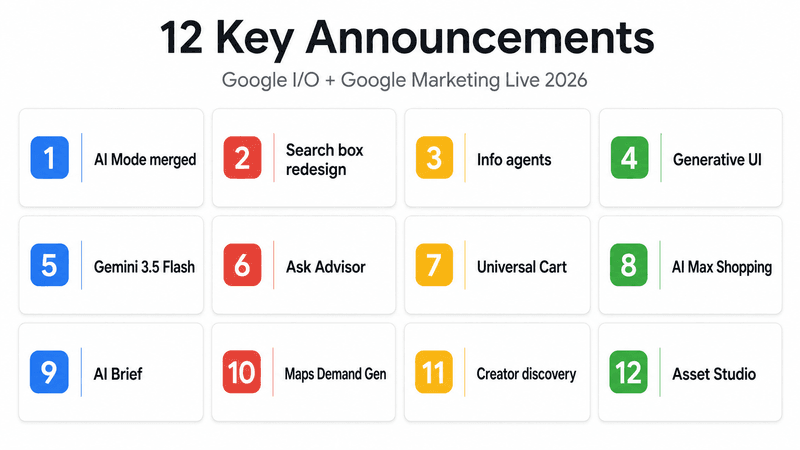
- This blog covers the 12 announcements that directly affect SEO, content marketing, paid search, and e-commerce. No developer-only features

Google published a blog post titled "100 things we announced at Google I/O 2026." Google Marketing Live added 13 more articles on top of that. Two days. Over 100 announcements.
Nobody has time to read all of that. So here are the 12 that directly affect how marketers work.
Search and AI
1. AI Overviews and AI Mode merged into one flow
Users now move from a search query to an AI Overview to a full AI Mode conversation in one continuous experience. No switching tabs. No toggling features. This is live worldwide on desktop and mobile.
Why it matters: The barrier to entering conversational search dropped to near zero. More users will land in AI Mode sessions where 92-94% of interactions end without a click.
2. The search box was redesigned for the first time in 25 years
The new search box accepts text, images, files, videos, and Chrome tabs simultaneously. AI-powered suggestions go beyond autocomplete to anticipate intent and help users formulate complex queries.
Why it matters: Search is now natively multimodal. Content strategies built around text-only keyword matching miss the queries that include visual and file-based inputs.
3. Information agents run in the background 24/7
Users can create persistent AI agents in AI Mode that monitor the web continuously and send synthesized push notification updates. Think Google Alerts but with full AI-powered analysis.
Why it matters: If an agent monitors a topic for a user, that user may never search for it again. Publishers covering recurring topics face a new competition layer.
4. Generative UI builds custom interfaces inside search results
Search can now create interactive tools, graphs, simulations, and visual experiences on the fly using Google Antigravity. Instead of returning links, Search builds the answer as an interactive experience.
Why it matters: This is the most direct threat to publishers who differentiate through tools, calculators, and interactive content. Google can now generate those experiences itself.
5. Gemini 3.5 Flash is live as the default AI Mode model
The new model powers AI Mode globally. It delivers frontier-level intelligence with the speed and cost profile of a Flash model. Google says it outperforms Gemini 3.1 Pro on coding and agentic benchmarks.
Why it matters: Faster, smarter AI Mode means better answers, which means users have even less reason to click through to external sites.
Ads and Commerce
6. Ask Advisor connects the entire Google marketing stack
One Gemini agent now spans Google Ads, Analytics, Merchant Center, and Google Marketing Platform. Cross-platform insights without switching tabs.
Why it matters: Campaign management becomes conversational. The skill floor for effective ad management drops. Agencies that differentiate on technical execution face a new pressure.
7. Universal Cart works across all Google shopping surfaces
Shoppers save items and check out across Search, AI Mode, YouTube, and Maps using one persistent cart. Paired with expanded Universal Commerce Protocol (UCP) to new verticals.
Why it matters: Google becomes a unified shopping platform. Product feed quality is now critical for visibility across conversational AI, video, and maps, not just Shopping tabs.
8. AI Max for Shopping captures conversational queries
Dynamic ads generated from Merchant Center feeds match AI Mode conversational queries. A user asking "best running shoes for flat feet under $150" can see a relevant ad without the advertiser building that keyword match.
Why it matters: Traditional Shopping campaigns miss conversational queries. AI Max captures them automatically from existing product feeds.
9. AI Brief gives advertisers control over AI Max campaigns
Advertisers can write brand guidelines, messaging rules, and matching instructions that AI Max follows. This addresses the biggest concern about automated campaigns: lack of brand control.
Why it matters: AI-driven campaigns become viable for brands with strict messaging requirements. The control gap between automated and manual campaigns narrows.
10. Demand Gen expands to Google Maps
Demand Gen campaigns now target location-intent audiences on Maps. Video and social-format ads appear to users searching for businesses and services nearby.
Why it matters: A new high-intent surface for local businesses and service providers. Maps users have immediate commercial intent.
YouTube and Creative
11. AI-assisted creator discovery for YouTube partnerships
Gemini helps brands find YouTube creators who align with campaign objectives, audience, and brand values. This brings creator matching into Google's ad platform.
Why it matters: Creator partnerships move from external influencer platforms into the same system where brands manage ads, analytics, and measurement. Workflow simplification for agencies.
12. Asset Studio gets multimodal creative capabilities
Advertisers can turn brand guidelines into ad creative using Gemini models inside Google Ads. Integrations with Adobe, Canva, and CapCut connect external design tools directly to Google's creative workflow.
Why it matters: Creative production speed increases. Brands can generate ad variations at scale while maintaining brand consistency through guideline integration.
The meta-pattern across all 12 announcements
Every announcement moves in the same direction: AI handles execution. Humans handle strategy and judgment.
Google is not adding AI features to its products. It is rebuilding its products around AI as the operating layer. Search is now conversational by default. Ads are generated from feeds and guidelines rather than manually built. Shopping works across every surface. Measurement connects every platform.
For marketers, the practical question is not whether to use these tools. It is whether your data, feeds, content, and brand guidelines are clean enough for AI to work with effectively. AI amplifies what you give it. Clean inputs produce good results. Messy inputs produce chaos at scale.
The organizations that spent 2025 building structured data, clean product feeds, consistent brand guidelines, and quality content are positioned to benefit from these announcements. The ones that did not are facing a more urgent infrastructure project than they expected.
Disclaimer: This article is AI-assisted content and may contain errors. All announcements verified against Google's official blog posts (May 19-20, 2026), including the Search blog by Liz Reid, the Ads & Commerce collection by Vidhya Srinivasan, and Sundar Pichai's I/O keynote. Supporting coverage from TechCrunch, The Next Web, eWeek, PPC News Feed, DesignRush, and ALM Corp. Features are rolling out and availability varies.