Key Takeaways:
- Google introduced "information agents" at I/O 2026, a new AI Mode feature where persistent AI runs in the background around the clock
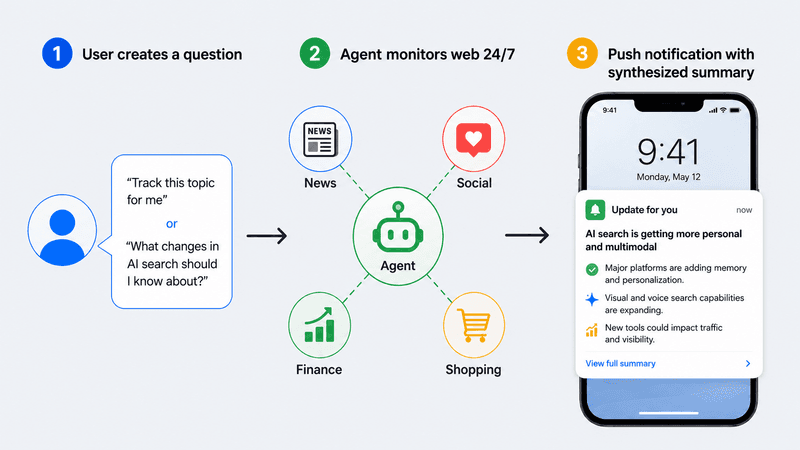
- Users create agents by asking a question in AI Mode. The agent then monitors blogs, news, social posts, financial data, shopping, and sports for changes
- Agents send synthesized push notifications with explanations of why something matters, not just alerts
- Rolling out this summer to US subscribers of Google AI Pro and Ultra. Users can manage multiple agents simultaneously
- Google described this as "the next evolution of Google Alerts" but the capability goes far beyond simple keyword monitoring

Google Alerts sent you an email when a keyword appeared on the web. Google's new information agents do something fundamentally different.
At I/O 2026, Google announced a new category of AI-powered tools that live inside AI Mode in Search. They are called information agents. And they work while you are not searching.
TechCrunch described them as "persistent, background processes that monitor the web on a user's behalf and surface relevant findings without being asked." The Next Web called the announcement a signal that Google sees "conventional search, the ten blue links, the keyword-stuffed query bar, as a transitional technology."
How information agents work
Creating an agent starts with a question in AI Mode. Instead of getting a one-time answer, the user can tell Google to keep monitoring that topic.
The agent then runs continuously in the background. It scans blogs, news sites, social media posts, real-time financial data, shopping listings, and sports results for changes related to that specific question. When something relevant happens, the agent sends a push notification.
These are not simple alerts. The agent synthesizes information from multiple sources, explains why the update matters, compares perspectives, and provides actionable context. It can also suggest follow-up actions.
Users can create and manage multiple agents simultaneously. Each one runs independently, monitoring a different topic or question.
Google's Search blog framed the capability this way: "Your agent will intelligently look across everything on the web, like blogs, news sites and social posts, plus our freshest data, to monitor for changes related to your specific question."
When information agents roll out and who gets them
Information agents launch this summer for US subscribers on Google AI Pro and Ultra tiers. These are paid subscription plans.
Google has not confirmed international rollout timelines or whether agents will eventually reach free-tier users. Given Google's pattern with AI features (AI Mode launched for paid users, then expanded to everyone), broader availability is likely but unconfirmed.
The feature roadmap includes custom sub-agents and authorized budgeting for payments. That last detail is significant. It suggests Google plans agents that can eventually make purchases or take financial actions on behalf of users, not just inform them.
How this differs from Google Alerts
Google Alerts launched in 2003. It monitors the web for specific keywords and sends email notifications when new content matches. The system is simple, effective, and has not changed meaningfully in two decades.
Information agents are a generation beyond that. The differences:
- Google Alerts match keywords. Information agents understand context, intent, and nuance across multiple sources
- Alerts send a link. Agents send a synthesized summary explaining what changed and why it matters
- Alerts are passive. Agents are active, pulling from real-time data sources and comparing perspectives
- Alerts cover web content only. Agents scan news, social, financial data, shopping, and sports simultaneously
- Alerts run on a fixed schedule. Agents run continuously, 24/7
For anyone who has relied on Google Alerts for brand monitoring, competitor tracking, or industry news, the transition to information agents represents a significant upgrade in capability.
Why this matters for publishers and content marketers
If a user's information agent monitors a topic continuously and sends synthesized updates, that user may never search for that topic again. The agent handles the monitoring. The agent delivers the summary. The user reads the notification and moves on.
This compresses the traffic opportunity for publishers who produce ongoing coverage of specific topics. A site that publishes daily updates on AI search news, for example, competes not just with other publishers but with an AI agent that reads all of them and delivers a single synthesis.
The content that agents cite in their summaries becomes the new visibility metric. Being the source an agent references is the equivalent of ranking on page one. But unlike search rankings, users never see the full list of sources. They see only what the agent includes.
For content teams, this reinforces the importance of being an authoritative, citable source. Original data, named expertise, and first-to-publish reporting carry weight with AI systems. Commodity content that restates what others have already published is less likely to be surfaced by an agent that has already synthesized the original sources.
How to prepare for information agents
Monitor what AI systems already say about your brand and topics. Tools like Semrush's AI visibility tracking and Citation Labs' Xofu can show which sources AI Mode currently references.
Publish original, first-to-market content when news breaks. Agents will scan for the freshest, most authoritative coverage. Being first with accurate reporting earns citation priority.
Structure content for passage-level citation. Clear headings, specific claims, and well-sourced data make it easier for AI systems to extract and reference individual sections.
Build direct audience relationships through email and social. When AI agents handle the discovery and monitoring layer, direct channels become the reliable path to your audience that no algorithm intermediates.
Frequently asked questions about Google information agents
What are Google information agents?
Information agents are persistent AI tools inside Google AI Mode that monitor the web 24/7 on your behalf. They scan news, blogs, social posts, and real-time data, then send synthesized push notifications when something relevant changes.
How do I create an information agent?
Ask a question in AI Mode and choose to have Google keep monitoring that topic. The agent runs in the background and sends updates when relevant changes occur.
Are Google information agents free?
They launch this summer for US subscribers on Google AI Pro and Ultra (paid tiers). Free-tier availability has not been confirmed.
Will information agents replace Google Alerts?
Google described them as "the next evolution of Google Alerts." Alerts remain available, but information agents offer significantly more advanced monitoring, synthesis, and notification capabilities.
Disclaimer: This article is AI-assisted content and may contain errors. Details are from Google's official Search blog by Liz Reid (May 19, 2026), TechCrunch, The Next Web, eWeek, and Cloud Captains. Feature availability, pricing, and rollout timelines are subject to change. Verify with Google's official documentation.