Key Takeaways:
- Google rolled out five link updates to AI Overviews and AI Mode on May 6, 2026
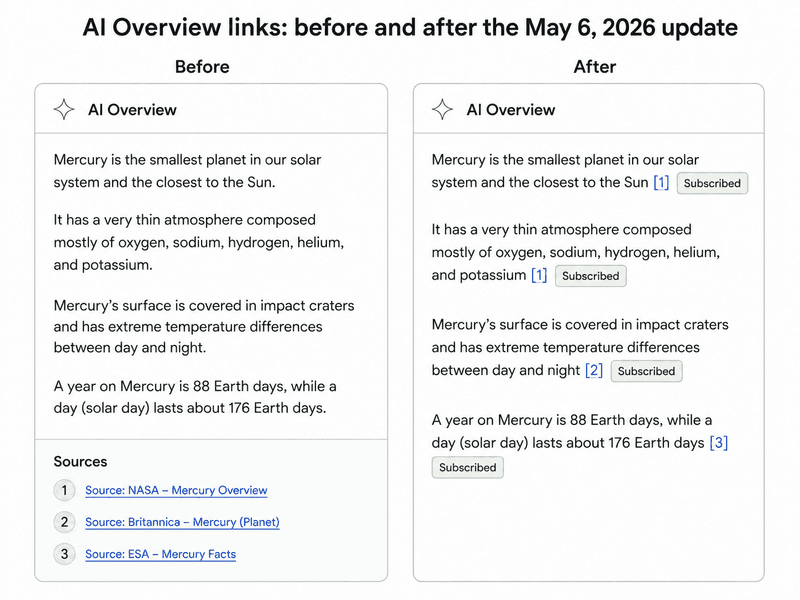
- Inline links now appear next to the specific text they support, not grouped at the bottom of the response
- Subscribed publications get a "Subscribed" label inside AI responses. Google says users were "significantly more likely" to click those labeled links
- A new "Further Exploration" section at the end of responses links to deeper reads not already covered in the AI answer
- Firsthand perspectives from forums and social media now surface with creator names, handles, and community context

For months, publishers have criticized AI Overviews for keeping users inside Google without sending traffic to external sites. On May 6, Google made five changes that directly address that criticism.
Hema Budaraju, VP of Product Management for Search, wrote the blog post announcing the updates. They cover how links appear, where they appear, and what information users see before clicking.
This is the most publisher-friendly update Google has made to AI search since AI Overviews launched in May 2024.
Inline links move next to the text they support
Previously, links in AI Overviews and AI Mode were clustered at the bottom of the response or grouped in a side panel. Users had to scroll past the AI answer to find source links.
Now, links appear directly next to the specific sentence or paragraph they support. If an AI response mentions a product comparison, the source for that comparison sits right beside the text.
This is a structural change, not a cosmetic one. Links placed near relevant text get clicked more than links buried at the bottom. Google knows this from years of search results design. Applying the same principle to AI responses changes the click dynamics meaningfully.
Subscription labels are the biggest win for publishers
Google is now labeling links from publications that a user already subscribes to. When a source appears in an AI response and the user pays for that publication, the link shows a "Subscribed" tag.
Google confirmed that in early testing, users were "significantly more likely" to click links with this label. The company did not share exact numbers.
This matters for two reasons. It gives paying subscribers a visual signal that their subscription content is being used inside AI answers. And it gives publishers a direct path to recover clicks from AI search by encouraging users to connect their subscriptions with Google.
Publishers who want to participate need to submit their subscription infrastructure through a Google form. Details are on Google's developer website.
Firsthand perspectives from real people now show up in AI answers
AI responses will now include a dedicated section surfacing perspectives from public online discussions, social media posts, and forums. When this content appears, Google shows the creator's name, handle, or community name alongside the link.
Phandroid reported that these appear under labels like "Expert Advice" or "Community Perspectives" depending on the query. Not every search triggers them.
This update rewards platforms and creators who publish firsthand experiences. Reddit threads, photography forums, parenting communities, and niche discussion boards now have a formal pathway into AI-generated answers with proper attribution.
For content marketers, this creates a dual strategy. Publish original content on your own site for citation. But also contribute genuine expertise in relevant communities. Both paths now feed into AI search visibility.
"Further Exploration" links point to deeper content
At the end of many AI responses, Google now includes a section suggesting articles and resources for going deeper on the topic. These link to content not already covered in the AI summary.
This is a direct opportunity for long-form, in-depth content. If a user's initial query gets a summary answer, the "Further Exploration" section points them to case studies, detailed guides, and original reporting that adds depth beyond what the AI provided.
Content that covers a narrow topic thoroughly has a better chance of appearing here than content that covers a broad topic superficially.
Desktop hover previews reduce click hesitation
On desktop, hovering over any inline link now shows the website name or page title before the user clicks. This gives users context about where a link leads without leaving the AI response.
The logic is simple. Users hesitate to click links from unfamiliar sources. Showing the destination name reduces that hesitation. This helps smaller publishers and niche sites that may not have instant name recognition but produce strong content.
What to do with this right now
These five updates shift the value of being cited in AI responses. A citation now comes with better link placement, more context, and higher click probability for subscribers.
For publishers: connect your subscription system with Google. Encourage readers to link their subscriptions. The "Subscribed" label is the clearest visibility advantage in AI search right now.
For content teams: structure content so individual sections can be cited with inline links. Clear headings, specific claims, and well-attributed data points make it easier for Google's system to match a paragraph to an inline citation.
For community managers: genuine contributions in forums and social platforms now surface in AI responses with attribution. Building presence in relevant communities is no longer just a brand play. It is a search visibility play.
Google did not share rollout timelines for most of these features, including geography, language, or eligibility details. The subscription integration requires publisher action. The rest appears to be rolling out broadly.
Disclaimer: This article is AI-assisted content and may contain errors. Details are from Google's blog post by Hema Budaraju (May 6, 2026), SEJ, Search Engine Land, 9to5Google, Nieman Lab, and PPC Land. Google did not provide rollout details for most features. Availability and behavior may change.