Key Takeaways:
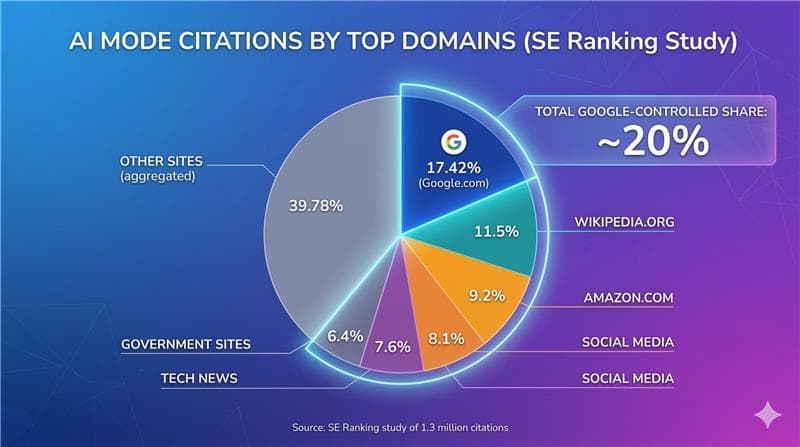
- Google.com accounts for 17.42% of all citations in AI Mode, more than YouTube, Facebook, Reddit, Amazon, Indeed, and Zillow combined
- Including YouTube, Google-controlled properties make up roughly 20% of all AI Mode sources
- Self-citation has tripled in nine months, up from 5.7% in June 2025
- 59% of Google's self-citations now point to organic search result pages, not just Google Business Profiles
- The European Publishers Council filed an antitrust complaint with the EU over this behavior in February 2026

Something unusual keeps showing up in AI Mode results. Ask an informational question about financial planning. One of the cited "sources" in the side panel is not a finance blog or a news outlet. It is another Google search results page.
That is not a one-off. SE Ranking just put hard numbers behind the pattern.
The company tracked 68,313 keywords across 20 industries and collected 1,321,398 citations during a two-week window in February 2026. Google.com came back as the single most cited domain in AI Mode responses. Not Wikipedia. Not Reddit. Not any publisher. Google itself.
The composition changed and that is the real story
Nine months ago, SE Ranking first flagged the self-referencing pattern. Back then, it was mostly a local search issue. 97.9% of Google's AI Mode citations pointing to Google.com led to Google Business Profiles. Restaurants, dentists, mechanics.
As of February 2026, that picture looks completely different.
59% of Google's self-citations in AI Mode now point to traditional organic search result pages. Another 36% still go to Business Profiles. The rest splits between Google Support, Google Flights, and other Google properties.
The practical outcome: a user asks AI Mode an informational question. Instead of citing an independent publisher, AI Mode sometimes cites a Google search results page. The user clicks through to another Google experience. More ads. More Google properties. More monetized results. The loop stays inside Google.
Google dominates almost every industry category
SE Ranking's industry breakdown is striking. Google.com is the top-cited domain in 19 out of 20 niches studied.
Travel had the highest concentration at 53.18%. Entertainment and Hobbies came in at 48.74%. Real Estate at 30.54%. Even Finance (5.13%) and Insurance (6.48%), where specialized publishers should dominate, saw Google hold the top citation position.
The single exception: Careers and Jobs. Indeed was cited 3.1x more often than Google in that category.
Regulators are already paying attention
In February 2026, the European Publishers Council filed a formal antitrust complaint against Google with the EU. The complaint specifically named AI Mode alongside AI Overviews. The argument: Google uses publisher content in AI-generated answers without proper authorization, without effective opt-out options, and without compensation.
That investigation could force structural changes in how AI Mode handles citations. But regulatory processes move slowly. The self-referencing pattern keeps accelerating in the meantime.
What this means for content and SEO strategy
The data adds a difficulty layer for anyone whose traffic depends on AI Mode citations. The competition is not just other publishers. It is Google itself occupying citation space.
A counterpoint worth noting: SE Ranking's analysis points out that since 59% of Google's self-citations now include organic rankings in the citation panel, strong organic performance still matters inside AI Mode. Getting ranked well increases the chance of appearing in that panel even when Google is also citing its own results alongside yours.
The focus stays the same. Build content deep enough that AI Mode needs it. Structure it so AI systems can extract it cleanly. Publish on topics where real expertise is hard to replicate. Google will always have the advantage of citing itself. The question is whether the content is good enough to share that space.
Disclaimer: This article is AI-assisted content and may contain errors. The data and statistics referenced are sourced from published research as of mid-March 2026. This is a fast-moving space where numbers, policies, and platform behaviors change frequently. Always verify with original sources before making business decisions.