Key Takeaways:
- Google rolled out UCP-powered checkout in AI Mode. US shoppers can now buy from Etsy and Wayfair directly inside search results
- Shopify, Target, and Walmart integrations are coming soon. Over 20 major companies have endorsed the protocol
- Google also redesigned how AI Mode handles recipe searches after months of backlash from food creators
- The new recipe display shows meal options with images that link to creator sites, replacing the "Frankenstein recipe" approach
- Both updates signal Google is turning AI Mode from a research tool into a commerce and content discovery tool

You can now buy a couch from Wayfair without leaving Google Search. That sentence would have sounded absurd two years ago.
Google rolled out UCP-powered checkout inside AI Mode in early March. UCP stands for Universal Commerce Protocol, an open standard Google developed with Shopify, Etsy, Wayfair, Target, and Walmart. It lets users complete purchases directly inside AI Mode in Search and the Gemini app.
The same week, Google redesigned how AI Mode displays recipes. Both updates point in the same direction: AI Mode is no longer just a research tool. Google is building it into a place where people discover, evaluate, and buy.
How AI Mode checkout works
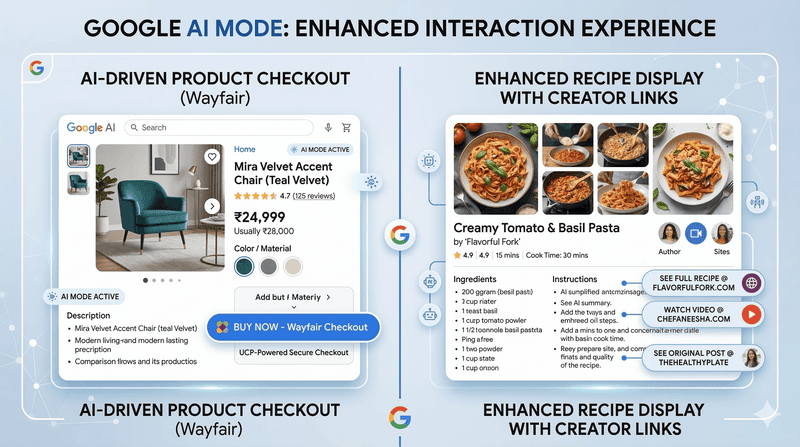
When a user asks AI Mode about a product and the response includes an eligible listing from a participating retailer, a "Buy" button appears. Tapping it starts a checkout process without leaving the search interface.
Payment goes through Google Pay using information already saved in Google Wallet. PayPal support is coming soon. The retailer stays the seller of record. They control pricing, inventory, and fulfillment.
Right now, Etsy and Wayfair are live. Google confirmed that Shopify, Target, and Walmart integrations are next.
Glenn Gabe, a well-known SEO consultant, was among the first to spot it in the wild. He posted on X: "Big news for ecommerce, for Google, and AI search. You can see a buy button... and then the checkout process right in AI Mode."
What this means for e-commerce SEO
If you sell products online, the discovery-to-purchase path just got shorter. Users no longer need to click through to your site to buy.
That is both an opportunity and a risk:
- Products listed in Google Merchant Center with UCP eligibility get a direct "Buy" button in AI Mode results
- Brands not in the program lose that conversion shortcut. The user sees a competitor's buy button instead
- UCP supports new Merchant Center data attributes designed for conversational commerce. These go beyond traditional product feeds
- Google said it will expand UCP globally and add features like loyalty rewards, related product discovery, and custom shopping experiences
For e-commerce teams, the action item is clear. Make sure your Merchant Center account is active, your product data is complete, and you are on Google's radar for UCP integration. Sitting this out means losing transactions to competitors who are already inside the checkout flow.
The recipe fix: Google responded to creator backlash
The recipe update came on March 4 when Robby Stein, VP of Product for Google Search, posted that Google is "making updates to better connect people with recipe creators on the web."
The old AI Mode recipe experience was a mess. Google would synthesize multiple recipes into a single blended response. Food creators called these "Frankenstein recipes." Their work got remixed into AI-generated answers with no meaningful traffic flowing back to the original sources.
Food bloggers reported traffic drops of 30% to 80% during 2025. The anger was public and sustained.
The new experience works differently. When someone searches for meal ideas in AI Mode, they see a visual display of dishes. Tapping on a dish opens a side panel with an image, a recipe summary, and a clear link to the creator's site.
The user can click through to explore the full recipe on the original blog. Google is no longer presenting the AI answer as the final destination for recipe queries. It is now a starting point that funnels users toward creators.
Two updates, one direction
These are separate changes, but the pattern is consistent. Google is turning AI Mode into something more than a research assistant.
For products, it is becoming a storefront. For recipes, it is becoming a discovery engine that credits creators. In both cases, Google is absorbing more of the user journey into its own interface.
For marketers, this means your presence inside Google's AI surfaces matters more every month. Product feeds, structured data, Merchant Center accounts, and content quality all determine whether your brand shows up inside the AI experience or gets skipped.
The users are already there. The question is whether your content and products are visible where they are looking.
………
*This post's content was created with the help of AI. Kindly cross-verify any data, statistics, or claims through primary sources, as there could be some discrepancies.