Key Takeaways:
- Google is testing a feature on desktop that pushes users from AI Overviews directly into AI Mode
- This transition previously existed only on mobile. The desktop test was spotted on April 8, 2026
- AI Mode sessions are 3x longer than traditional searches and 92-94% end without a click to an external site
- The test suggests Google wants desktop users to adopt conversational search behavior
- If this rolls out broadly, the window for publishers to capture organic traffic from AI-powered results shrinks further

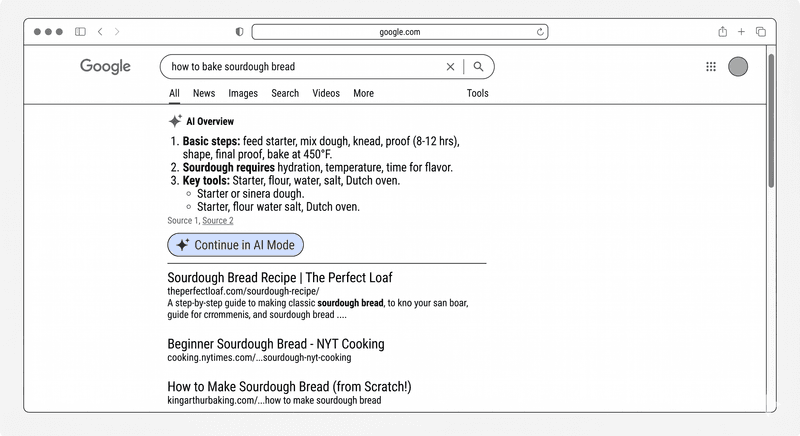
Google is building a bridge between AI Overviews and AI Mode. And it now works on desktop.
Optimized reported on April 8 that Google is testing a feature allowing desktop users to jump directly from an AI Overview into AI Mode. Previously, this transition only existed on mobile search.
The test means users who see an AI Overview at the top of search results can now tap into a full conversational AI experience without leaving the search page. On mobile, this pattern has been live for months. Bringing it to the desktop signals Google is serious about training all users to interact with search conversationally.
Why this matters more than it looks
The numbers behind AI Mode make this test significant.
Google distributed a guide to marketers in March 2026, confirming that AI Mode queries are now 3x longer than traditional typed searches. Users ask follow-up questions within the same session. They combine text, voice, and camera inputs.
Semrush data from late 2025 found that 92-94% of AI Mode sessions end without a click to an external website. Users spend an average of 49 seconds per session, more than double the 21 seconds for AI Overviews. For brand comparisons, the median session time was 77 seconds.
That behavior pattern means most users get their answers inside AI Mode and never visit a publisher's site. If Google funnels more desktop users into AI Mode through AI Overviews, the zero-click problem gets bigger.
Desktop users search differently and this changes the equation
Mobile users adopted AI Overviews and AI Mode faster. Desktop users tend to be more research-oriented. They open multiple tabs, compare sources, and click through to websites more often.
Pushing desktop users from AI Overviews into AI Mode could change that behavior. Instead of scanning ten blue links and opening several, users would enter a conversational interface that synthesizes answers from multiple sources into a single response.
For publishers, desktop search has been a relative safe zone compared to mobile. Desktop click-through rates from traditional search results are generally higher. If AI Mode adoption grows on desktop, that advantage narrows.
What content teams should track
This is still a test. Google has not confirmed plans for a broader rollout. But the pattern from previous tests is consistent. AI headline rewrites started as a "small test" in Discover and became a permanent feature within a month. The same language appeared for the Search headlines test.
For SEO and content teams, the practical steps are:
- Monitor desktop traffic trends in Google Search Console separately from mobile
- Track how much of your traffic comes from traditional search results versus AI-generated features
- Focus content on topics where users need depth that a single AI answer cannot provide
- Ensure your content is structured to be cited by AI systems, not just ranked in traditional results
Google has 75 million daily active users in AI Mode globally, a number shared by VP Nick Fox in March 2026. If desktop adoption accelerates through features like this, that number will grow significantly.
The direction is clear. Google is moving every user toward conversational AI search. The question for publishers is not whether this will happen. It is how fast.
Disclaimer: This article is AI-assisted content and may contain errors. The desktop AI Mode test was reported by Optimixed on April 8, 2026. Google has not confirmed broader rollout plans. AI Mode usage statistics are from Google and Semrush data referenced in March 2026 reporting. Features and availability change frequently.