Key Takeaways:
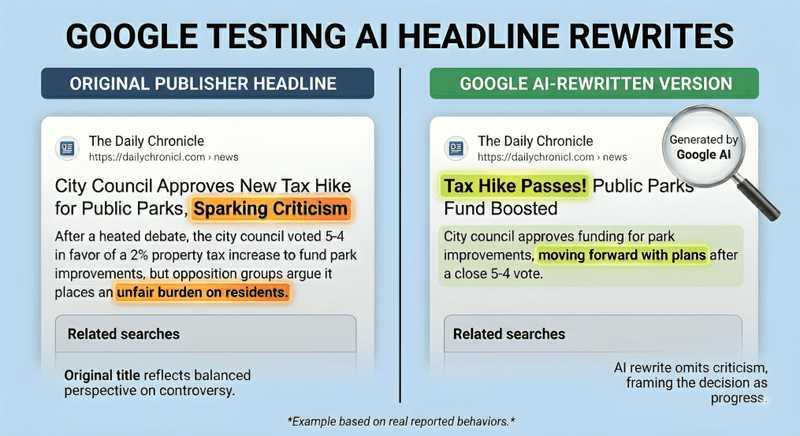
- Google confirmed to The Verge that it is testing AI-generated headline rewrites in traditional Search results
- The test is described as "small" and "narrow" but affects news sites and other types of websites
- In one example, a headline was changed from a full critical sentence to a fragment that implied the opposite conclusion
- Google already rewrites 76% of title tags using rule-based systems. This test uses generative AI to create entirely new phrasing
- Google ran a similar test in Discover that became a permanent feature within a month. No opt-out mechanism exists

The headline a publisher writes may no longer be the headline that appears in Google Search. Google confirmed it is testing a system that uses AI to generate entirely new titles for search results.
The Verge broke the story after multiple staff members noticed their headlines appearing in Google in forms they never wrote. These were not truncations or minor edits. They were complete rewrites with different phrasing, different tone, and in some cases, different meaning.
Google confirmed the test to The Verge through three company spokespeople. The company described it as a "small and narrow" experiment aimed at "better matching titles to users' queries and facilitating engagement with web content."
This is different from what Google already does with titles
Google has rewritten title tags for years. An analysis of over 80,000 title tags found Google changed 61% of them. A follow-up study put that number at 76% in Q1 2025.
Those existing rewrites pull from elements already on the page: the title tag, the H1 heading, og:title meta tags, and anchor text from other sites. The system selects from text that already exists.
The new test is different. Google's AI is generating phrasing that does not exist anywhere in the article. That is generative creation, not selection.
One documented example: The Verge's headline "I used the 'cheat on everything' AI tool and it didn't help me cheat on anything" appeared in Google as "'Cheat on everything' AI tool." The original headline's entire conclusion, that the tool did not work, was stripped. The rewritten version implied the opposite.
Another rewrite changed a Microsoft Copilot headline to "Copilot Changes: Marketing Teams at it Again," phrasing the article never used.
The Discover precedent matters
Google tested AI headline rewrites in Discover in late 2025. The company called it a small experiment. Within a month, it became a permanent feature. Google cited "strong user satisfaction" as justification.
Search Engine Journal noted the pattern: "the same language Google used before reclassifying AI headlines in Discover as a feature" is now appearing for the Search test.
An analysis of over 400 publishers found Discover's share of Google-sourced traffic had climbed from 37% to roughly 68%. If AI headline rewrites become permanent in both Discover and Search, publishers would lose control over how their content is presented across both primary Google traffic sources.
Publishers and SEO professionals are responding
Sean Hollister, senior editor at The Verge, compared the practice to "a bookstore ripping the covers off the books it puts on display and changing their titles."
Louisa Frahm, SEO director at ESPN, wrote on LinkedIn that if headlines get misrepresented, "long-term audience trust will be compromised."
The concern is not theoretical. Title tags are one of the few remaining tools publishers control in search results. With AI Overviews answering queries without requiring clicks and referral traffic declining across the board, the headline on a blue link is often the last chance to attract a reader. Replacing it with AI-generated text removes that control entirely.
Google offers no opt-out mechanism. The company said any broader launch "may not use generative AI" but did not explain what the alternative would look like.
What to do now
The test is live and affects real search results. Some practical steps:
- Match title tags to H1 headings as closely as possible. When these two elements say substantially the same thing, Google has less reason to generate its own version.
- Use dashes as separators instead of pipes. Data shows Google replaces dash-separated titles 19.7% of the time versus 41% for pipe-separated ones.
- Avoid breaking titles into distinct sections with multiple separators. Each break gives Google a natural point to truncate or rewrite.
- Monitor search appearance in Google Search Console. If titles showing in results do not match what was published, document the discrepancies. Google has asked for feedback during this test phase.
The broader pattern is consistent. Google is taking more control over how content is presented inside its ecosystem. AI Overviews summarize content. AI Mode synthesizes answers. And now, AI may rewrite the headline on the last remaining blue link. The space publishers control in Google is shrinking.
Disclaimer: This article is AI-assisted content and may contain errors. Details are sourced from The Verge, Search Engine Journal, Search Engine Land, and 9to5Google reporting between March 20-28, 2026. Google described the test as a limited experiment that has not been approved for broader rollout. Features and testing scope may change.