Key Takeaways:
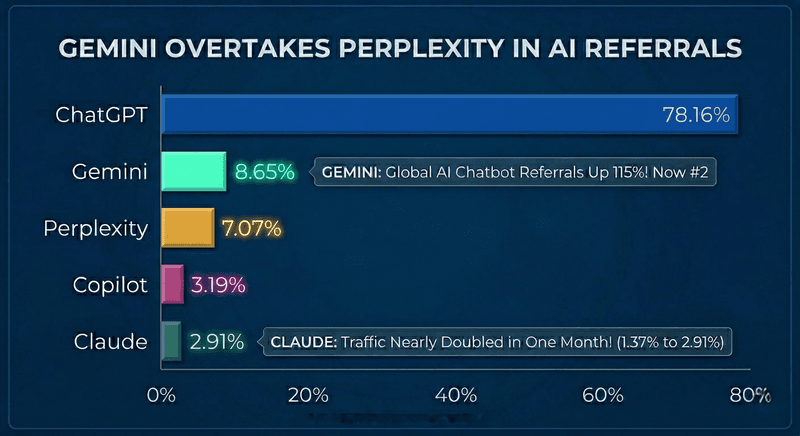
- Statcounter March 2026 data shows Gemini at 8.65% of global AI chatbot referrals, up from 2.31% a year ago
- Perplexity dropped to 7.07%, down more than 40% from its April 2025 peak of 12.07%
- ChatGPT still dominates with 78.16% of all AI referral traffic
- Anthropic's Claude jumped from 1.37% in February to 2.91% in March, nearly doubling in one month
- SE Ranking separately found that Gemini referral traffic to websites grew 115% between November 2025 and January 2026

A year ago, Perplexity was sending three times more referral traffic to websites than Gemini. That gap just flipped.
Statcounter released March 2026 data in early April, showing Google's Gemini now accounts for 8.65% of global AI chatbot referrals. Perplexity fell to 7.07%. It is the first time Gemini has held the number two position.
ChatGPT remains far ahead at 78.16%. But the movement behind it is where the story gets interesting for content marketers.
Google's ecosystem advantage is showing up in the data
Statcounter CEO Aodhan Cullen pointed to a straightforward reason for Gemini's rise. Google integrates Gemini across Search, Android, Workspace, and Chrome. That built-in distribution means users encounter Gemini without needing to visit a separate website or download a new app.
SE Ranking's separate analysis of over 101,000 websites with Google Analytics confirmed the trend. Between November 2025 and January 2026, Gemini's referral traffic to websites grew 115%. The acceleration started in December, right after Google rolled out Gemini 3 models across its products.
Before December, Gemini's monthly growth was roughly 4%. After the Gemini 3 rollout, it jumped to 47% monthly growth. That is a 12x acceleration from the prior pace.
In the US specifically, Gemini was sending 41% more referral traffic than Perplexity by January.
Claude's growth is the most dramatic single-month move
Anthropic's Claude jumped from 1.37% in February to 2.91% in March. That is more than double in a single month. Since April 2025, Claude's referral share has grown nearly tenfold from just 0.30%.
Weekly data from Statcounter shows Claude peaked at 3.6% in mid-March (week 12) before dropping to 2.49% in week 13. Cullen noted this spike may have been partly driven by the news cycle around users switching from ChatGPT during the Pentagon controversy and ad rollout backlash.
Whether Claude sustains its gains depends on whether the switching behavior sticks or fades.
Why this matters for content and SEO strategy
The practical takeaway is that AI referral traffic is no longer a one-platform story.
ChatGPT still sends roughly 80% of all AI-driven website visits. But the gap is narrowing. A year ago, ChatGPT's lead over Gemini was 22x. By January, it was 8x. If Gemini continues integrating across Google products, that gap will keep closing.
Other platforms in the March data included Microsoft Copilot at 3.19% and DeepSeek at 0.02%.
All AI platforms combined still represent a small share of overall web traffic. SE Ranking puts the total at about 0.24% of global internet traffic, up from 0.15% in 2025. It is growing, but it is still tiny compared to traditional search.
For content marketers, the action items are concrete:
- Check your own Google Analytics referral data for Gemini, ChatGPT, Claude, and Perplexity traffic
- Track which pages AI platforms are sending traffic to and what content earns citations
- Stop optimizing for one AI platform only. The referral landscape is splitting across multiple players
- Monitor conversion rates from AI referrals. Earlier data from Ahrefs found ChatGPT referral visitors convert at 15.9%, well above traditional organic rates
The AI referral market is moving fast. The brands and publishers paying attention to this data now will be better positioned as these numbers grow.
Disclaimer: This article is AI-assisted content and may contain errors. AI referral traffic volumes and percentages change frequently. Verify with your own analytics data.