Key Takeaways:
- Anthropic refused to let the Pentagon use Claude for mass surveillance or autonomous weapons. The government blacklisted them within hours
- OpenAI signed a replacement deal the same night, with what Sam Altman later called "opportunistic and sloppy" timing
- A boycott campaign called QuitGPT claims 1.5 million people have taken action against ChatGPT
- ChatGPT uninstalls surged 295% in a single day. Claude hit #1 on the App Store for the first time ever
- Over 600 Google and OpenAI employees signed an open letter backing Anthropic's position

Anthropic told the Pentagon no. What happened next changed the AI industry in five days.
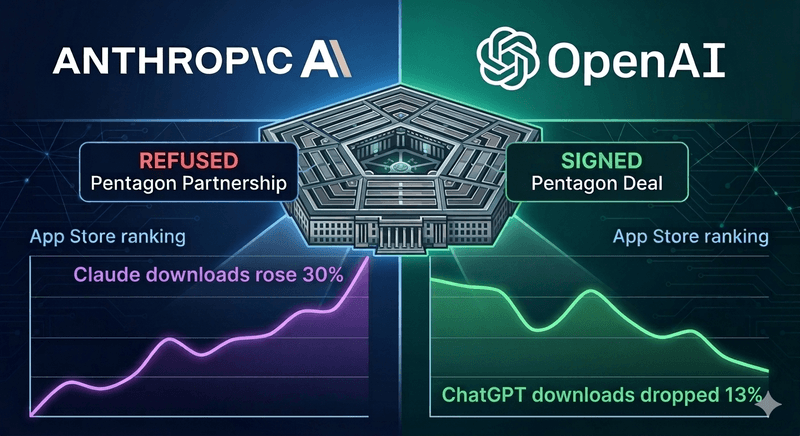
The timeline starts on February 27. Defense Secretary Pete Hegseth gave Anthropic a choice: let the military use Claude for any lawful purpose, or face consequences. CEO Dario Amodei refused. He would not remove safeguards against mass surveillance of Americans or autonomous weapons that kill without human oversight.
The Pentagon's response was immediate and unprecedented. Hegseth designated Anthropic a "supply chain risk to national security." That label had only been used against foreign companies like Huawei. This was the first time it was applied to an American company.
President Trump followed up on Truth Social, calling Anthropic a "Radical Left AI company run by people who have no idea what the real World is all about."
By Friday evening, OpenAI announced it had signed its own Pentagon deal.
OpenAI took the contract. Then the backlash hit
Sam Altman said OpenAI's deal included the same two red lines Anthropic had fought for: no mass surveillance, no autonomous weapons. The Pentagon agreed to those terms from OpenAI but rejected them from Anthropic.
The difference? Framing. Anthropic wanted explicit contractual prohibitions written into the agreement. OpenAI accepted that the Pentagon could use its tech for "any lawful purpose" while building what it called a "safety stack" of technical controls.
The internet noticed the gap between those two approaches immediately.
Within hours, a grassroots campaign called QuitGPT went live. The movement claims over 1.5 million people have taken action, including cancelling paid subscriptions, deleting the app, and sharing boycott messages. "Cancel ChatGPT" trended across Reddit and X through the weekend.
The numbers from Sensor Tower tell the story:
- ChatGPT uninstalls surged 295% on Saturday, February 28
- ChatGPT downloads dropped 13% the same day
- One-star reviews for ChatGPT jumped 775% overnight
- Claude downloads rose 37% on Friday and 51% on Saturday
- Claude hit #1 on Apple's US App Store for the first time, pushing ChatGPT to #2
Anthropic says free active users have increased over 60% since January. Daily signups have quadrupled. Paid subscribers have more than doubled in 2026.
Altman admitted he rushed it
By Monday, Altman was in damage control. He published an internal memo on X admitting the deal was a mistake in execution.
He used the words "opportunistic and sloppy."
He said OpenAI "shouldn't have rushed to get this out on Friday" and announced the company was renegotiating the contract to add explicit language barring domestic surveillance. He also said the Pentagon had confirmed that intelligence agencies like the NSA would not use OpenAI's tools.
His own employees were not convinced. Leo Gao, an OpenAI alignment researcher, publicly criticized the company on X for agreeing to "any lawful purpose" and then adding what he called "window dressing." Research scientist Aidan McLaughlin posted that he personally did not think "this deal was worth it." That post drew nearly 500,000 views.
600+ employees across rival companies signed a joint letter
Here is the part that makes this story different from a normal tech controversy.
573 Google employees and 93 OpenAI employees signed an open letter titled "We Will Not Be Divided." The letter argued the government was "trying to divide each company with fear that the other will give in."
Google's Chief Scientist Jeff Dean personally endorsed it.
A separate group of Google DeepMind employees wrote directly to Dean raising concerns about how Gemini's government contracts could be extended to cover surveillance. Over 100 Google staff had already demanded an end to military AI contracts before this standoff began.
This was the first time employees across competing AI companies organized together on military ethics.
Why this matters for anyone who uses AI tools
If you use ChatGPT, Claude, or Gemini in your work, this story is directly relevant to you.
The AI tools that power content workflows, SEO research, strategy documents, and client deliverables are now at the center of a political standoff between the US government and the companies that build them. The values those companies hold will shape what their tools can and cannot do.
Anthropic's supply chain risk designation bars every military contractor from working with the company. That could limit its access to enterprise clients and government-adjacent businesses. It could also limit its revenue growth at a critical moment.
But the consumer market just voted. Claude's downloads broke every record Anthropic has ever set. The QuitGPT campaign, regardless of whether it dents OpenAI's $29.4 billion revenue target, proved that users care about what their AI providers stand for.
For content marketers, agency owners, and SEO professionals who build their daily operations around these tools, this is the week to ask a simple question: do you know what the company behind your AI stack believes in?
Anthropic is challenging the supply chain risk designation in court. Altman is renegotiating his Pentagon deal. And a protest called "No Killer Robots, No AI Surveillance" is scheduled outside OpenAI's San Francisco headquarters today, March 4.
This story is not over.