Key Takeaways:
- 43% of consumers use AI for shopping at least once a week, per an Exploding Topics survey of 1,000+ people published on Search Engine Land
- The most common amount consumers would let AI spend on their behalf is $0. 31% would not authorize any autonomous AI spending at all
- 51% are uncomfortable with AI tools storing their credit card details. Only 25% are "very comfortable" with it
- 75% of Americans would trust AI shopping less if results were influenced by paid advertising, per a separate Quad/Harris Poll survey
- 56% of consumers expect AI to play a bigger role in how they shop within five years

AI shopping adoption is growing fast. Trust in letting AI actually buy things is not keeping pace.
Search Engine Land published an Exploding Topics consumer survey on April 27. Over 1,000 people were surveyed. The results reveal a sharp gap between how people use AI to shop and how much control they are willing to give it.
43% of consumers now use AI for shopping at least once a week. Over half use it at least monthly. Only about 10% have never used an AI tool.
But when asked how much they would trust an AI agent to spend on their behalf, the most common answer was zero.
The trust wall hits at the point of payment
31% of consumers said they would not authorize any autonomous AI spending. 17% would cap it at $20. Another 21% would cap it at $50. The median cap across all respondents was $50.
This means the majority of consumers are comfortable asking AI for product recommendations, but will not hand over purchasing authority. They want AI as an assistant, not an agent.
The credit card question made this even clearer. 51% of consumers said they are at least somewhat uncomfortable with AI tools storing their payment details. Only about 1 in 4 said they were "very comfortable" with the idea.
Even among the most frequent AI shoppers, barely more than half said they would be comfortable sharing card details. Among occasional AI shoppers, that number dropped to 7%.
Consumers trust AI recommendations but verify everything
The survey found that 60%+ of shoppers mostly trust AI for product recommendations. But that trust comes with a qualifier: most consumers check the recommendations themselves before buying.
This matches a finding from Klaviyo's 2026 AI Consumer Trends Report, which found only 13% of consumers completely trust AI. Another 36% somewhat trust it. 30% are neutral. The pattern is consistent: people use AI for convenience and speed, then verify before committing money.
For e-commerce brands, this means AI-powered product recommendations can influence purchase decisions. But the final transaction still happens through familiar, human-controlled checkout flows.
The jump to fully autonomous AI purchasing that companies like Google (with its AP2 Protocol) and OpenAI (with ChatGPT shopping) are building toward does not match current consumer readiness.
Sponsored results would erode trust further
A separate Quad/Harris Poll survey of 2,180 Americans, published April 13, found that 75% would trust AI shopping agents less if their recommendations were influenced by paid advertising. The same percentage said they would trust brands less if they paid to influence AI agent recommendations.
This finding creates a direct tension with how AI platforms plan to make money. ChatGPT launched ads in February. Google integrates ads into AI Overviews and AI Mode. If consumers associate AI shopping recommendations with paid influence, the trust gap could widen instead of closing.
73% of consumers said algorithm-driven pricing makes it hard to know if they are getting the best deal. 54% find it unappealing to let AI access their shopping history. Being an informed shopper is more important today than a year ago for 73% of respondents.
What this means for marketers and e-commerce brands
The data points in one direction: AI is a discovery and research tool for shoppers, not yet a purchasing tool.
Brands building AI-powered shopping experiences should focus on the recommendation and comparison stage. That is where trust exists. Pushing for autonomous checkout or AI-driven purchasing will meet resistance from the majority of consumers.
Product content needs to be optimized for AI citation. When 43% of consumers use AI weekly to shop, being recommended by ChatGPT, Gemini, or Perplexity matters. That means detailed product descriptions, structured data, strong reviews, and content that answers specific buying questions.
The advertising question is unresolved and risky. Consumers are telling researchers clearly that sponsored results would reduce their trust. Brands paying for AI placement may gain short-term visibility at the cost of long-term credibility. Balancing paid AI promotion with genuine product quality signals will become one of the hardest strategic decisions in 2026.
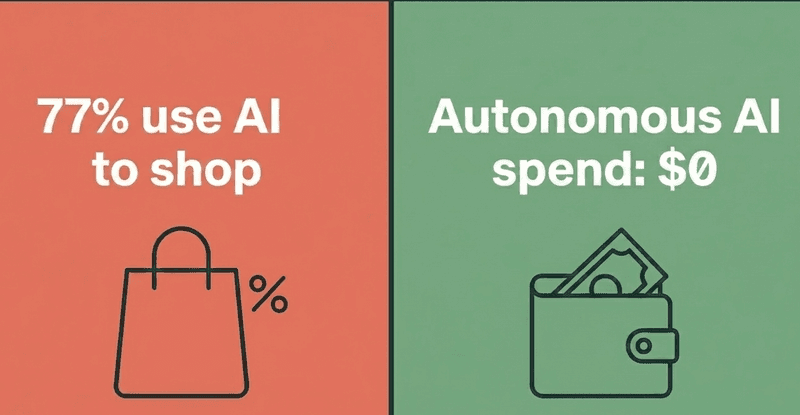
The gap between AI shopping adoption (77%) and AI purchasing trust ($0 median) is the most important number in this data. Closing that gap will take time, transparency, and a lot of consumer education.
Disclaimer: This article is AI-assisted content and may contain errors. Consumer data is from an Exploding Topics survey of 1,000+ respondents published on Search Engine Land on April 27, 2026. Verify with original sources before making business decisions.