Key Takeaways:
- The American AI Jobs Risk Index from Tufts University projects 9.3 million US jobs at risk of AI displacement in 2-5 years
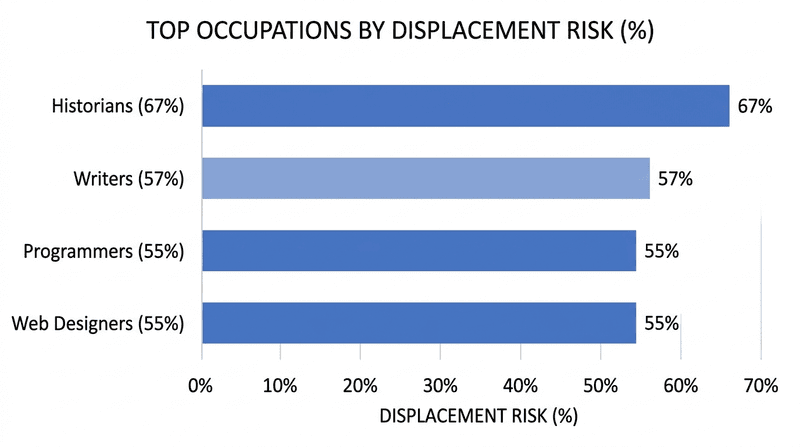
- Writers and Authors face 57% displacement risk. Computer Programmers: 55%. Web and Digital Interface Designers: 55%
- Historians top the entire list at 67% of tasks expected to be automatable
- 33 "tipping point" occupations covering 4.9 million workers could swing from under 10% to over 40% displacement
- The safest jobs are the lowest-paid ones: roofers, orderlies, and dishwashers face less than 1% displacement risk

If you write content for a living, this study puts a number on the risk you probably already feel.
Digital Planet at Tufts University's Fletcher School released the American AI Jobs Risk Index on March 24. It ranks 784 US occupations, 530 metro areas, 50 states, and 20 industry sectors by vulnerability to AI-driven job loss.
The headline number: 9.3 million jobs are projected to be at risk within the next 2-5 years. The range spans from 2.7 million to 19.5 million, depending on how fast AI adoption accelerates.
The highest-risk jobs are knowledge work, not manual labor
The occupations most vulnerable to AI displacement are not factory workers or truck drivers. They are the people who work with words, code, and analysis.
The top occupations by displacement rate:
- Historians: 67%
- Writers and Authors: 57%
- Computer Programmers: 55%
- Web and Digital Interface Designers: 55%
- Software Developers, Management Analysts, and Market Research Analysts: among the largest absolute projected losses
The industries with the highest average vulnerability are Information (18%), Finance and Insurance (16%), and Professional, Scientific, and Technical Services (16%).
That list includes the exact audience reading this article. Content marketers, SEO specialists, and digital strategists sit squarely in the zone of highest risk.
The people building AI are also at risk from it
One of the more striking findings: over one million workers whose jobs involve studying, building, or reporting on AI face displacement rates between 26% and 55%.
The researchers noted this irony directly. The cities most invested in developing AI, Silicon Valley, Boston, Washington, and Seattle, also face the highest projected job losses from it. Tufts called these "Wired Belts," becoming the new "Rust Belts."
Silicon Valley (San Jose metro) leads all regions with 9.9% of jobs at risk. New York City alone could lose more than 600,000 jobs and tens of billions in annual household income.
The safe zone is the low-wage zone
About 38% of American workers face less than 1% displacement risk. But these are the country's lowest-paid jobs.
Roofers, orderlies, dishwashers, and workers in physical, spatially embedded, or unpredictable tasks are the most protected. Not because their work is hard. Because current AI systems handle variable physical conditions poorly.
The researchers stated it plainly: "The occupations AI cannot touch are largely those the economy has always undervalued."
What the study does not measure
The index measures job displacement vulnerability, not actual layoffs. These are projections based on AI adoption scenarios, not employment data.
The study also does not yet include job creation data. Future versions will attempt to estimate new roles created by AI alongside the roles displaced. That matters because previous waves of automation eliminated some jobs while creating others.
For content professionals and marketers, the practical question is not whether AI will affect their work. It already has. The question is whether the value they add is something AI cannot replicate.
Original reporting, firsthand expertise, editorial judgment, and client relationships are harder to automate than writing a 500-word blog post. The Tufts data suggests that professionals who build those skills will remain employable. Those who compete directly with AI on tasks AI does well will face the steepest displacement pressure.
Disclaimer: This article is AI-assisted content and may contain errors. All projections are from April, 2026. Verify with the original research.