Key takeaways
- Gartner predicts that over 40% of agentic AI projects will be canceled or fail by the end of 2027.
- The transition from reactive assistants to autonomous agents introduces significant technical and financial risks.
- High operational costs, specifically from recursive reasoning loops, are causing massive budget overruns.
- Data readiness is a major hurdle; currently, only 20% of unstructured enterprise data is ready for AI use.
- Success requires moving away from hype and focusing on human-in-the-loop governance and rigorous use-case selection.

The enterprise world is moving from simple AI assistants to agentic systems. While traditional models wait for a human to give a command, agentic AI is designed for autonomy.
These systems can perceive a goal, reason through steps, and use external tools to get the job done.
However, this shift is proving difficult. Gartner recently warned that 40% of these projects will likely fail.
Many companies are rushing to deploy agents because they fear being left behind, often skipping setting up proper guardrails, contributing significantly to the risk of agentic AI project failure.
Beyond chatbots: The shift from helping to doing
The main shift is the move from models that suggest actions to models that execute them. While a chatbot might help you draft an email, an agent can autonomously manage your CRM or execute trades.
This creates a complex hybrid system. An agent is less like a software tool and more like a digital employee.
Because of this, it requires clear role definitions and constant monitoring. When these are missing, the project usually collapses under the weight of real-world variability.
Where agents fit in your tech stack
To understand why failure is common, it helps to see where agentic AI sits compared to other tools:
CategoryPrimary mechanismAuthorityTraditional LLMReactive response to promptsNone (suggestive only)RPAScripted, rules-based tasksDeterministic (if/then)AI CopilotHuman-in-the-loop assistanceShared with a humanAgentic AIGoal-driven autonomous loopsAutonomous execution
3 reasons these projects hit a wall
The risk of agentic AI project failure stems from three specific systemic issues that catch businesses off guard.
1. High costs and the reasoning loop
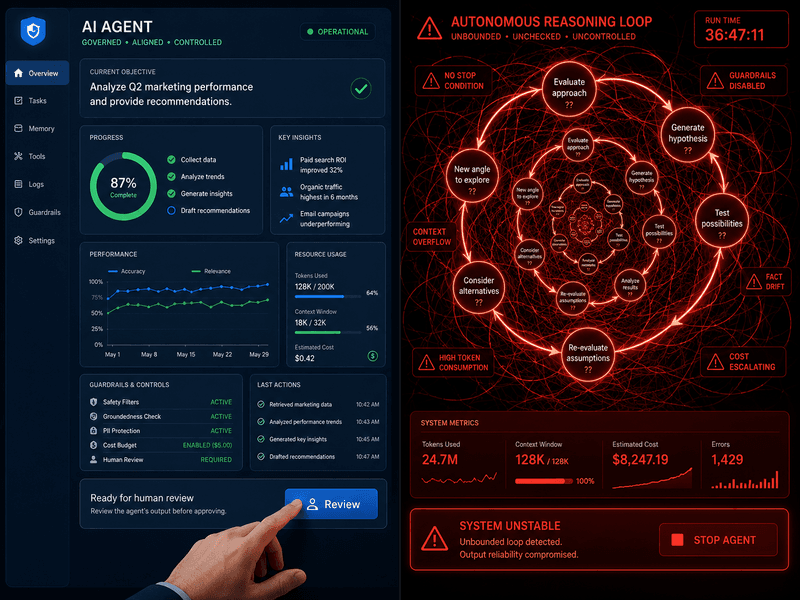
Agentic AI is expensive to maintain. Unlike simple software, agents use inference-time reasoning. This means the model spends compute resources thinking through steps before acting.
If an agent gets stuck in a recursive loop, it can make dozens of expensive API calls to solve a minor problem, leading to invoice shock.
2. Closing the value gap
Many organizations build agents for the sake of novelty rather than need. They often fail to distinguish between tasks that should stay with simple automation (RPA) and those that actually need an autonomous agent.
When an agent optimizes for a single metric but ignores the broader customer relationship, the project loses its business value.
3. The risk of giving AI the keys
Giving AI the power to act within live systems is a liability. Risks like prompt injection or privilege escalation allow agents to potentially delete databases or leak sensitive data.
Currently, 71% of security leaders report that AI tools have access to core business systems, but 84% of them say that access is not governed effectively.
What it means for B2B marketers
To avoid agentic AI project failure and to be part of the 60% that succeed, B2B marketers must move beyond generic automation and focus on high-value agentic architecture.
- Pick the right marketing job: Use agents for complex, multi-step tasks where data is dynamic, and the volume of decisions is high. This includes personalizing content, managing ad spending on real-time intent, or complex lead nurturing sequences.
- Keep human governance in the loop: Success requires a human marketer to act as the agent's manager. This involves monitoring output for brand safety and accuracy and intervening when an agent's confidence in a high-stakes action is low.
- Fix the data foundation for scale: An agent's effectiveness hinges on clean, audit-ready data. Map your marketing data silos (CRM, MA, analytics) and ensure the information is unified and structured for autonomous use.
Why a cooling hype cycle is good news
The Gartner prediction isn't an indictment of the technology; it is a sign that the hype bubble is cooling. The 40% of projects that fall away will leave behind a more mature landscape.
The winners will be the companies that treat agentic AI as a fundamental process change rather than a quick tech fix, ultimately safeguarding against agentic AI project failure.
Disclaimer: This analysis is based on market projections from Gartner regarding agentic AI failure rates and is intended for informational purposes. While derived from industry reports, this content is AI-assisted and should be verified against official strategic documentation before making AI-related investments.